49 works in this view — arrow keys or swipe to move between them.
Dance in Art
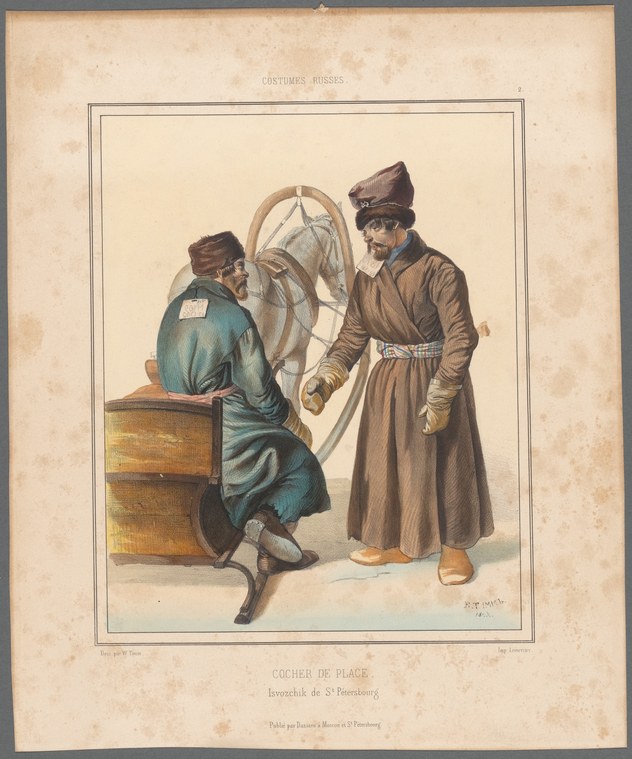
Costumes russes: Cocher de place, Isvoschik de St. Petersbourg
Unknown artist
- Collection:
- Prints depicting dance
- Source:
- New York Public Library
- Rights:
- Public domain — free to use, share and adapt.
- Recorded as:
- Public Domain
Though not a depiction of dance itself, this engraving illuminates the visual vocabulary available to choreographers and costume designers working with Russian themes in the 19th century—the palette of recognizable dress and gesture that signaled national character on stage. For historians of ballet and opera, such costume studies are essential evidence of how 'Russianness' was constructed and visualized in performance, even when the actual content was not dancing.
What you are looking at
A Russian coachman (isvoschik) in St. Petersburg urban dress is shown in conversation with a woman seated on a wooden bench. The man stands in profile facing left, wearing a tall brown fur hat (typical of Russian coachmen), a long brown overcoat with a belt, and boots. The woman is turned away from the viewer, seated on the bench wearing a teal or greenish-blue dress with a white collar or badge visible on her back. Between them stands a horse, depicted in profile with careful attention to anatomy and harness. The setting is sparse and formal—a plain background with no ground detail—suggesting a costume study or character sheet rather than a narrative scene. The composition emphasizes the coachman's posture and dress as the primary subject, with the seated woman and horse as secondary elements establishing his professional context.
The dancing
The coachman stands in a relaxed contrapposto, with one leg bearing weight and his body angled toward the seated woman; his arms hang naturally at his sides, suggesting a moment of pause or conversation rather than active labor. The woman's seated position with her body angled away creates a sense of social distance or formality. Neither figure is in dance posture or holds—there is no elevation, no turn-out, no line of extension through the limbs. The stance is naturalistic and occupational, not choreographed.
The dance depicted
This image does not depict dance. While labeled as part of a 'Costumes russes' series and thus part of the visual culture of Russian performance, the coachman and woman are shown in social/occupational dress and posture, not in a dance frame or movement. The image serves as a character or costume study—likely for theatrical, operatic, or ethnographic documentation—rather than as a record of an actual dance or dance style. Russian folk and character dances were performed in the ballet and opera of the 19th century, but this plate documents costuming and social behavior, not choreography.
How it was made
This is a hand-colored engraving or aquatint, executed with fine detail and subtle shading in the faces and drapery. The technique allowed for mass production and wide distribution of costume documentation across Europe. The careful attention to textile patterns, the horse's anatomy, and the psychological distance between the two figures suggests the work was made by someone with trained observation of life drawing and costume. The coloring—applied by hand in translucent washes—is characteristic of early 19th-century Russian or French costume documentation, which often circulated among theater companies, dance masters, and collectors of ethnographic imagery.
About this work
This is a colored engraving documenting Russian urban dress and social custom, likely from the early 19th century, part of a 'Costumes russes' (Russian Costumes) series that recorded the distinctive appearance of St. Petersburg's social types and professional classes. The coachman (isvoschik) was a recognizable figure in Russian urban life—skilled, economically independent, and marked by distinctive dress. While housed in a dance collection, the image is not primarily a dance document; it belongs rather to the broader visual culture that surrounded theater and performance in the period, when opera, ballet, and theatrical spectacle drew heavily on ethnographic and character costume. The work reflects a European taste for 'Russian' imagery that fed both the Imperial Russian theaters and the Romantic ballet's appetite for exotic national subjects.
How to look at it
Attend to the coachman's silhouette and dress: the height and shape of his hat, the long line of his coat, the stance of standing leisure rather than active work. The artist has frozen a social moment—a coachman in conversation—to preserve the particularities of his professional costume and bearing. The inclusion of the horse (rather than a carriage or street scene) emphasizes the coachman's identity as someone in service to the animal, essential to his role. The woman's presence may indicate the social world in which the coachman moved, or may simply balance the composition.
The artist
Unknown. The signature or artist mark on the plate, if present, has not been identified in the catalogue record. The work appears to be part of a commercial costume-documentation series, likely produced in Paris or St. Petersburg for circulation among theater professionals and European collectors of Russian imagery. Such series were a standard product of the European print industry in the early 19th century.
The period
The early 19th century saw an intense European fascination with Russian life and character, fueled by Napoleonic politics, the visibility of Russian aristocrats in European capitals, and a Romantic appetite for the exotic and the national. Russian character dances and costumes became fashionable in opera and ballet—Marius Petipa and his predecessors incorporated Russian themes into classical ballet. Simultaneously, a market for ethnographic and costume prints served both professional theater-makers and educated collectors who wanted visual documents of foreign lands. This plate sits at the intersection of theatrical practice and ethnographic documentation.
Where it lives
Held at the New York Public Library as part of a print collection on dance. The work's classification within a dance collection suggests it was valued for its documentation of performance culture and national character, even though the image itself depicts costuming and social behavior rather than choreography.
Questions about this work
Is this a dance scene?
No. While classified in a dance collection, the image documents the costume and posture of a Russian coachman in conversation with a woman, not a choreographed dance or dance style. It is a costume study or character documentation, likely made for reference by theater professionals or for sale to collectors of Russian imagery.
What is an isvoschik?
An isvoschik (извозчик in Russian) was an urban coachman or cab driver in Russian cities, particularly St. Petersburg and Moscow. They were skilled professionals who owned or operated horse-drawn cabs and were recognizable by their distinctive dress, including the tall fur hat visible in this plate. They occupied an important social and economic niche in 19th-century Russian urban life.
Why is this in a dance collection?
The image circulated as part of a 'Costumes russes' series that documented Russian national types and dress. Such material was valued by theaters and dance companies for costume reference and for its documentation of national character, even when not depicting active performance. Russian themes were highly fashionable in 19th-century European ballet and opera.
What can this tell us about Russian dance or theater?
While not a dance image, it shows the visual vocabulary of 'Russianness' that stage designers and choreographers drew on when creating Russian-themed works for the ballet and opera stage. It documents how Russian urban identity was constructed and visualized during the period when Russian culture was becoming fashionable in European performance.
More dance artwork





