49 works in this view — arrow keys or swipe to move between them.
Dance in Art
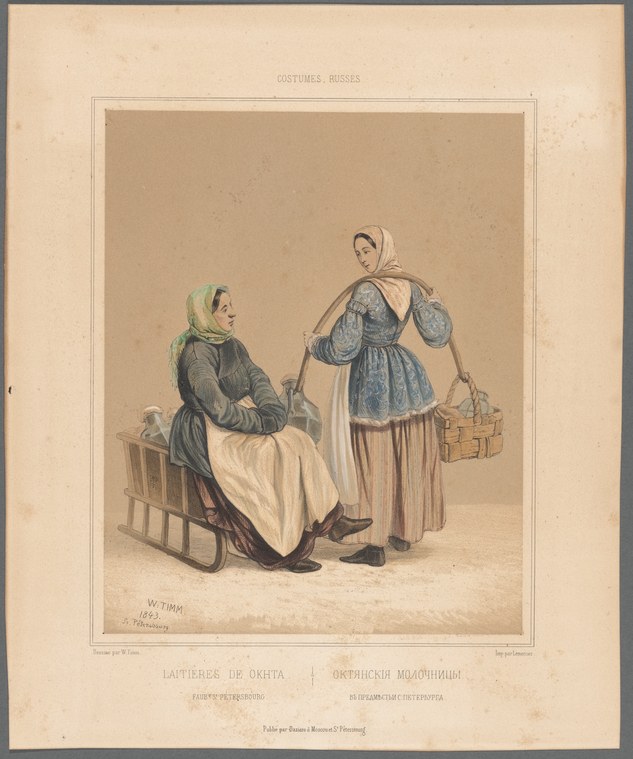
Costumes russes: Laitières de Okhta, Faubg St. Petersbourg
Unknown artist
- Collection:
- Prints depicting dance
- Source:
- New York Public Library
- Rights:
- Public domain — free to use, share and adapt.
- Recorded as:
- Public Domain
This image is significant precisely because it does not depict dance, even though the standing woman's vessel-carrying posture and the regional costume might suggest folk or theatrical performance. It demonstrates how 19th-century European art collected and commodified the bodies and dress of working-class and rural women as visual types, and how such ethnographic prints circulated separately from but alongside theatrical dance imagery. A historian examining when and how Russian dance imagery entered European art collections must contend with the abundance of non-dance costume and character documentation that shares the same visual language.
What you are looking at
Two women in 19th-century Russian provincial dress are shown in an interior scene. The woman on the left sits on a low wooden bench or stool, facing right, wearing a dark jacket with white apron and a green headscarf. She holds her hands folded in her lap in a posture of repose. The woman on the right stands, wearing a darker dress with a peach or salmon-colored shawl draped over her shoulders and arms, and a matching headscarf. She carries large circular decorated plates or trays suspended from her arms—these appear to be the characteristic copper or brass vessels associated with dairy workers. The setting is spare and neutral, with a pale ground suggesting an indoors or studio space. The title indicates these are milkmaids (laitières) from the Okhta district near St. Petersburg, and the image presents them as types or social characters rather than as individuals.
The dancing
Neither figure is actively dancing. The seated woman holds a static, reserved posture with hands clasped. The standing woman is positioned in profile, her body upright and still, weighted evenly on both legs. The suspended vessels dominate the composition as functional objects rather than props of movement. There is no visible weight transfer, no indication of a closed or open frame, and no suggestion of the footwork or arm sequences that would characterize any dance tradition. The image presents occupational posture and costume rather than choreographed movement.
The dance depicted
This image does not depict dance. It is a character study of Russian provincial women identified by their trade and regional origin. The Okhta milkmaids were a recognizable social type in 19th-century St. Petersburg—working women whose costume and vessel-work were visually distinctive. While folk dancers from rural and working-class communities were a subject of European artistic interest in this period, and while such types sometimes appeared in ethnographic or character dances of theatrical contexts, nothing in this image itself suggests movement, rhythm, or choreography. The women are posed, not in motion.
How it was made
This is a hand-colored lithograph or engraving, identifiable by the precise linear work, the refined gradation of tones, and the characteristic soft modeling of form typical of 19th-century European print-making for documentary and ethnographic purposes. The printing technique allowed for wide circulation of such character studies, which were popular as cultural documentation and as fashionable curiosities among educated European audiences. The artist's monogram and publication information appear in the lower margin, suggesting commercial production by an established print house.
About this work
This is a documentary character print from the 19th century depicting two Russian milkmaids as ethnic or occupational types, not as performers. It belongs in a dance archive only insofar as it records the dress, bearing, and social identity of women whose labor and regional origin made them visually distinctive in the urban landscape of St. Petersburg. The image itself contains no choreography, no movement vocabulary, and no indication of dance practice. It is ethnographic costume documentation rather than dance imagery.
The work is part of a larger body of European character prints that collected regional and occupational types as curiosities or as aids to understanding non-metropolitan European societies. Russian subjects were particularly fashionable in mid-to-late 19th-century French and European visual culture. Such prints often supplied costume reference for theatrical designers and opera companies, and may have circulated as costume guides. However, this particular work records occupational identity and dress, not dance.
How to look at it
Attend to the postures of both figures: they are still, not caught in movement. The seated woman's clasped hands and forward gaze, and the standing woman's upright, balanced stance, express occupational identity and social position rather than kinetic energy or rhythmic intent. The vessel-carrying is functional labor, not a prop held in a dance frame. The print documents how working-class women of this region and trade presented themselves or were conventionally represented—their costume, their bearing, their tools—rather than how they moved in celebration or performance. The absence of suggestion of motion is itself informative: this is ethnographic portraiture, not dance imagery.
The artist
The work is signed "W. Timm" (or similar), identifiable as a practitioner of 19th-century European commercial lithography or engraving specializing in character types and ethnographic subjects. Such artists worked in established print production houses, often in Paris or major cultural centers, and supplied a steady market for character studies, costume documentation, and regional or occupational types. The style and publication format suggest mid-to-late 19th century practice, though attribution beyond the signature and dating would require archival research.
The period
The 19th century saw intense European artistic and commercial interest in documenting the dress, customs, and 'types' of non-metropolitan European populations, particularly Russians, Eastern Europeans, and Scandinavians. This impulse was partly scholarly—feeding anthropological and ethnographic curiosity—and partly aesthetic, as Romanticism and Orientalism made non-Western and rural cultures fashionable subjects for visual consumption. Simultaneously, European opera and ballet were incorporating 'Russian' and 'folk' elements into theatrical spectacle, creating demand for costume reference and cultural documentation. Lithography and commercial engraving made such prints affordable and widely distributed. However, the line between documentary costume study and theatrical dance imagery remained distinct: this print records occupational dress and bearing, not performance.
Where it lives
The work is held in the New York Public Library's Prints collection, catalogued as a work depicting Russian customs and costume. It is one of many 19th-century European character and costume prints in institutional holdings, most of which are costume documentation or ethnographic studies rather than dance-specific imagery.
Questions about this work
Why is this in a dance archive if the women aren't dancing?
This print was likely catalogued under 'dance' because it depicts women in distinctive regional dress and may have been acquired as part of a broader costume or ethnographic collection. 19th-century institutions often conflated costume documentation, ethnographic study, and theatrical dance imagery under a single rubric. The image is valuable to dance historians precisely because it shows the difference between costume record and dance documentation, and because such prints influenced how European theater imagined 'Russian' visual identity.
Could the vessels suggest a particular dance tradition?
No. The circular vessels are explicitly identified in the title as characteristic of these women's trade as milkmaids. While occupational or labor-based dances exist in many cultures, and while Russian folk traditions are rich, nothing in this image—the posture, the moment, the framing—indicates choreography or performance. This is occupational portraiture, not dance.
What does the costume tell us about the women depicted?
The dress—headscarf, apron, jacket, the decorated vessels—identifies these women as dairy workers from a specific urban district (Okhta) near St. Petersburg. The costume was distinctive enough to make them recognizable types in 19th-century Russian urban society and fashionable enough as a 'character' subject to warrant reproduction as a print for European audiences. The image thus documents both occupational identity and European curiosity about Russian life.
More dance artwork





