49 works in this view — arrow keys or swipe to move between them.
Dance in Art
Lulu Walzer
Unknown artist
- Collection:
- Prints depicting dance
- Source:
- New York Public Library
- Rights:
- Public domain — free to use, share and adapt.
- Recorded as:
- Public Domain
This image captures a key moment in early 20th-century theatrical marketing: the use of impossible, surreal imagery to sell dance and music to popular audiences. The floating figure represents not a ballroom technique but the dream of transcendence and liberation that performance promised—especially in the context of the 1920s avant-garde fascination with weightlessness, dream states, and the body freed from gravity. For historians of dance imagery, it shows how theatrical posters diverged dramatically from ballroom documentation, using fantasy and exaggeration to create desire and excitement rather than instruction.
What you are looking at
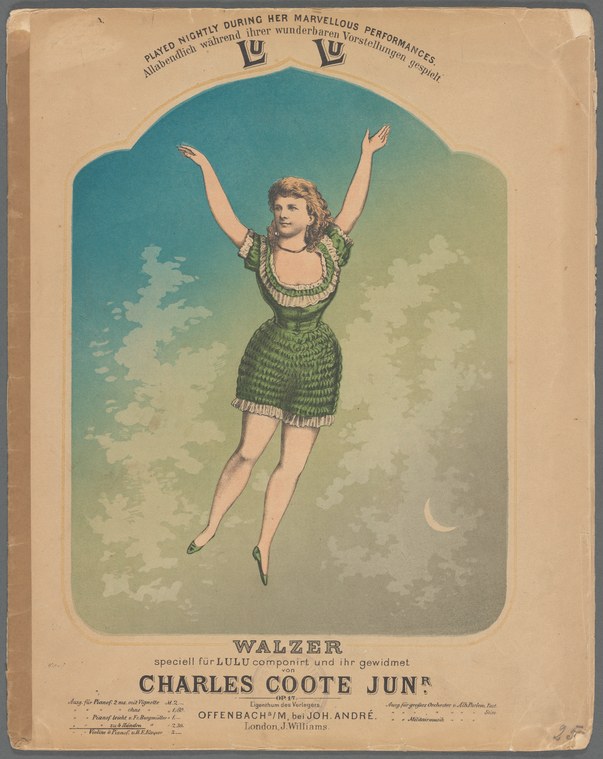
A young woman in a short green sequined or beaded dress floats horizontally against a soft sky, her body fully levitated above the ground in an impossible, dreamlike pose. Her blonde hair is styled in waves typical of the 1920s, and she wears a beaded necklace and black heeled shoes. Her arms are raised overhead in a gesture of exultant freedom, her legs extended and relaxed. The background shifts from pale blue-green at the top to cream and grey tones toward the bottom, with faint clouds visible. The figure appears suspended in mid-air rather than performing any grounded movement. The composition is framed within a decorative arched cartouche in pale tan, with ornamental typography above and below. The overall effect is theatrical and fantastical—a promotion for a spectacular performance rather than documentation of earthly dance.
The dancing
A single female figure dominates the frame in a horizontal floating position, completely unsupported. Both arms are raised symmetrically overhead in a triumphant or ecstatic gesture, the hands open and fingers extended. Her legs are extended straight or slightly relaxed, with no visible weight or tension in the feet. The entire body is held in a supine or near-supine suspension against gravity, creating an impossible, weightless quality. The posture suggests liberation and abandon rather than technical control or the grounded partnered positions of ballroom dance.
The dance depicted
This is a promotional image for *Lulu*, most likely the 1920s theatrical production associated with the Wedekind play or an operatic adaptation. The figure does not depict an identifiable ballroom or theatrical dance technique; instead, it presents a fantastical, gravity-defying image of a performer in the act of floating or levitating. The title *Lulu Walzer* (Lulu Waltz) suggests the piece was marketed as a waltz, but the actual movement shown—complete weightlessness, horizontal suspension, arms overhead—bears no resemblance to the closed partnered frame, upright posture, and traveling action of waltz. This is theatrical fantasy, not ballroom documentation.
How it was made
This is a colour lithographic print, a commercial theatrical poster or advertisement. The medium is characteristic of early 20th-century performance promotion: lithography allowed bright, saturated colours, soft tonal gradations in the background, and fine detail in costume and facial features. The technique was ideal for mass production and circulation, meaning this image was intended to reach wide audiences in public spaces—street hoardings, playbills, windows—rather than elite collectors. The decorative cartouche and prominent typography identify it as advertising ephemera designed to sell tickets and create visual excitement around a live performance.
About this work
This is a 1920s colour lithographic theatre poster advertising a dance performance or musical production titled *Lulu* with music or choreography credited to Charles Coote Jnr. The image is not a dance documentation but rather a fantastical, gravity-defying promotional image: a young woman in a sequined evening dress floats horizontally through space with her arms raised in exultation, her blonde waves and jewelry catching light against a soft cloud-filled sky. The title references a waltz, but the actual pose—complete weightlessness and upward-reaching arms—represents theatrical fantasy rather than any real waltz technique. The lithographic process and decorative typography mark it as commercial performance advertising intended for public display and ticket sales.
How to look at it
The artist has chosen to freeze an impossible moment—the body completely weightless and suspended. Attend to the contrast between the precise, naturalistic rendering of the figure's face, hair, and costume (which grounds her as a real performer of the period) and the physically impossible floating pose (which transforms her into a dream or fantasy). The raised arms point upward and outward, inviting the viewer to share in a moment of transcendence or escape. The soft, hazy background—neither clearly sky nor stage—further dissolves the boundary between reality and imagination. This is a poster designed to make you want to attend the show by promising you will witness something wondrous.
The artist
The artist is not recorded. The poster credits the dance or music to Charles Coote Jnr, and the lithography to London printers (the text reads "London: Williams"), but the illustrator remains anonymous—typical of commercial poster production in this era, where illustrators were often uncredited staff or freelancers working rapidly for print shops. The Offenbach reference and the style of the image suggest a London West End or Continental theatrical context, possibly connected to a revival or adaptation of a popular musical.
The period
The 1920s saw a transformation in how dance was advertised and imagined. Ballroom dancing (waltz, foxtrot, tango) was enormously popular in social and theatrical contexts, yet theatrical posters often abandoned realism in favour of fantasy and spectacle. This was also the era of Dada, Surrealism, and avant-garde theatre, which celebrated impossible imagery, dreamscapes, and the liberation of the body from conventional form. The beaded, short-skirted flapper silhouette and the levitation motif both align with the decade's fascination with modernity, speed, weightlessness, and escape from Victorian constraints. The poster sits at the intersection of commercial entertainment, art-world experimentation, and the visual language of the Jazz Age.
Where it lives
This lithographic poster is held in the New York Public Library's collection of prints depicting dance, a major institutional source for early 20th-century performance ephemera. Posters of this type were produced in large editions and distributed to theatres, shops, and public spaces; survival was incidental rather than planned, and examples are often undated and uncredited.
Questions about this work
Is this actually depicting a waltz?
No. While the title *Lulu Walzer* suggests a waltz context, the floating, horizontal pose with raised arms bears no resemblance to waltz technique or posture. This is theatrical fantasy, not ballroom documentation. The artist prioritized visual spectacle and the dream of weightlessness over accurate dance representation.
Who was the performer?
The poster does not identify the dancer. It credits the dance or musical composition to Charles Coote Jnr and the printer to Williams of London, but the performer and the illustrator are both unrecorded—typical of commercial theatre posters from this era.
What is *Lulu* and when was this performed?
The date is unknown from the record. *Lulu* could reference Wedekind's famous play *Lulu* (1894–1903), an operatic adaptation, or an original theatrical work. The 1920s styling of the costume and the lithographic technique suggest production in the early-to-mid 20th century, likely in a London West End or Continental theatre context.
Why would a waltz be advertised with a floating figure?
Because theatrical posters sold dreams, not instruction. By the 1920s, ballroom dance was socially respectable and widely taught, but theatrical performance offered escape, fantasy, and spectacle. A weightless figure promised transcendence and liberation—the fantasy of what dance could make you feel, rather than what it actually looked like.
More dance artwork





