49 works in this view — arrow keys or swipe to move between them.
Dance in Art
Mlle Dumilâtre: La polka
Unknown artist
- Collection:
- Prints depicting dance
- Source:
- New York Public Library
- Rights:
- Public domain — free to use, share and adapt.
- Recorded as:
- Public Domain
This image is primary evidence for the polka craze of the 1840s–1860s and for the specific performance practice of theatrical polka in France. It shows how a social dance with a precise technique—the characteristic hopping three-beat step—was adapted for the stage, costumed, and mythologized in popular culture. For dancers and historians, it documents the body, bearing, and costume of one of the period's most sought-after performers.
What you are looking at
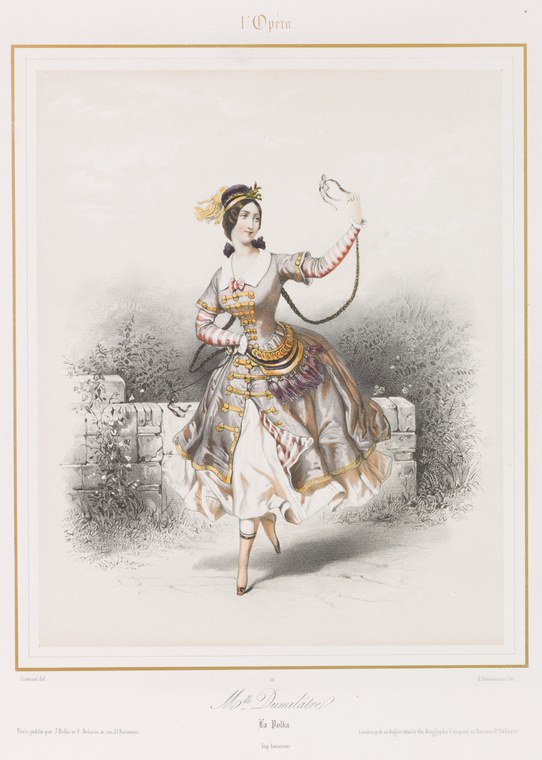
A solo female dancer poses in an ornate interior setting, likely a theater or ballroom, captured mid-movement in a moment of theatrical display. She wears an elaborate costume of the mid-19th century: a white tulle skirt with deep gold and purple trim at the hem, a fitted bodice with gold ornamental detail, and a short dark jacket or bolero. Her dark hair is crowned with a gold tiara or decorative headpiece, and she holds what appears to be a long ribbon or scarf in her raised right hand, creating a sweeping line across the composition. The setting shows classical architectural elements—stone pedestals or urns flank the figure, rendered in soft gray wash that creates atmospheric depth. The overall tone is pale and delicate, with the white dress dominating the composition and drawing the eye to her poised, animated frame.
The dancing
The dancer stands in a three-quarter pose with her weight shifted onto her left leg, creating an engaged, forward-moving line. Her right leg appears lightened, ready for motion. Both arms are active: the right hand holds the ribbon aloft, the left drops naturally. Her torso is upright and elongated; her head is held high and turned slightly toward the viewer. The pose reads as a suspended moment rather than a static position—the body suggests forward momentum and theatrical presentation rather than balletic verticality, though the posture is refined and controlled.
The dance depicted
This is the polka, a dance that swept European ballrooms and stages in the 1840s–1860s. The title identifies the sitter as Mlle Dumilâtre, a Parisian dancer known for performing this enormously fashionable social dance on the theatrical stage. The polka's characteristic light, bouncing quality is suggested by the dancer's poised, elevated stance and the floating quality of her costume. Unlike the rigorous upward drive of ballet, the polka was danced in a more relaxed, social frame with energetic but earthbound steps. This image captures how the polka moved from ballroom to stage spectacle, with a solo dancer in costume performing what was primarily a couple's dance.
How it was made
This is a hand-colored lithograph, identifiable from the characteristic soft edges, the delicate tonal modeling achieved through stone, and the careful color separation of gold, purple, and flesh tones over a gray monochromatic base. The inscription at the bottom—partially legible as relating to the performer and the work—is typical of commercial theatrical prints. The technique allowed for rapid reproduction and wide circulation, making this the kind of souvenir or promotional image that would have been sold at the theater, in shops, or as part of a collected series of famous dancers. The hand-coloring indicates a higher-quality, more expensive production aimed at wealthy patrons or serious collectors of theatrical imagery.
About this work
Mlle Dumilâtre: La polka is a mid-19th-century theatrical portrait of one of the period's most celebrated performers in the moment of her signature role. The polka had become a mania across Europe after its introduction in the 1830s, and the transition of this social dance to the concert stage, with solo dancers performing virtuosic variations, marks a crucial moment in dance history. This lithograph documents both the dancer and the dance—showing how the polka was costumed, framed, and presented to an audience accustomed to ballet but hungry for something new, faster, and more vital.
The work sits at the intersection of popular culture and fine art production. It is neither a documentary record nor a fine-art engraving, but a commercial theatrical print—the 19th-century equivalent of a lobby card or promotional photograph. Yet it is also a work of considerable artistic skill, capturing the personality and physical presence of a celebrated artist and preserving visual evidence of how the dance was actually performed, dressed, and understood.
How to look at it
Notice how the artist has chosen to freeze the dance at a moment of suspension and display rather than in the thick of rhythmic action. The raised ribbon draws the eye upward and creates a sense of lightness and forward momentum without the dancer appearing to be in a step. Observe the costume: the short white skirt and fitted bodice are not ballet dress—they are cut for visibility of the legs and freedom of movement in a bouncing, social dance. The architectural setting and theatrical lighting are conventions of the period's ballet prints, borrowed here to elevate the polka to the status of high theatrical art. The overall impression is of a performer pausing to show off both the dance and herself to the audience.
The period
The polka arrived in European ballrooms around 1835–1840 from Bohemia and became an almost instantaneous sensation, eclipsing the waltz and quadrille in fashionability among younger dancers and progressive society. By the 1840s, the polka had moved to the concert stage: professional dancers performed solo and ensemble polkas in theaters, often in elaborate costumes and with choreographed variations. This theatrical phase lasted roughly 1840–1870, after which the polka retreated from concert stages but remained a social dance. Lithographic theater prints of celebrated dancers became a major form of popular visual culture during this period, much like theater photographs would in the early 20th century. The combination of technical refinement, celebrity culture, and mass production visible in this print reflects the period's hunger for dance entertainment and the emergence of the star performer system.
Where it lives
This hand-colored lithograph is held in the New York Public Library's collection of prints depicting dance. It is a commercial theatrical print, likely produced for sale and distribution in the mid-19th century, and would have been colored by hand after lithographic printing, a labor-intensive process that increased its cost and exclusivity.
Dance in this work
Questions about this work
What is the polka and why was it so popular?
The polka is a couples' dance in 2/4 time with a characteristic hopping three-beat step, originating in Bohemia (now the Czech Republic) in the 1830s. It spread across Europe with astonishing speed in the 1840s because it was faster, more energetic, and more playful than the prevailing waltz—and because it was explicitly modern and fashionable rather than rooted in aristocratic tradition. By the 1850s it had become a mania, and every major city had polka music, polka quadrilles, and polka fever.
Who was Mlle Dumilâtre?
Mlle Dumilâtre was a celebrated Parisian dancer of the 1840s–1850s, known especially for her performances of the polka on the concert stage. The print identifies her as a star performer of this role. Beyond that, detailed biographical information is not available from this image alone, but she was clearly prominent enough to have theatrical prints produced and sold in her name.
How was theatrical polka different from social polka?
Social polka was danced in couples in ballrooms and at private dances, using the basic step with variations. Theatrical polka, as represented here, was performed by soloists or small ensembles on a stage, often with elaborate choreography, costume, and scenery. The dancer performed variations and showpiece steps designed to impress an audience rather than to facilitate social interaction. Stage polkas were faster, more technical, and more overtly athletic than their social counterparts.
What does the ribbon signify?
The ribbon or scarf in the dancer's raised hand is both a costume element and a device for creating visual spectacle. It extends the line of the arm, makes the movement of the body visible from the back of a theater, and adds an element of grace and fluidity to what is fundamentally a bouncy, down-to-earth dance. It may also reference the ribbons or scarves used in other theatrical dances of the period, positioning the polka within a lineage of stage dance.
More dance artwork





