49 works in this view — arrow keys or swipe to move between them.
Dance in Art
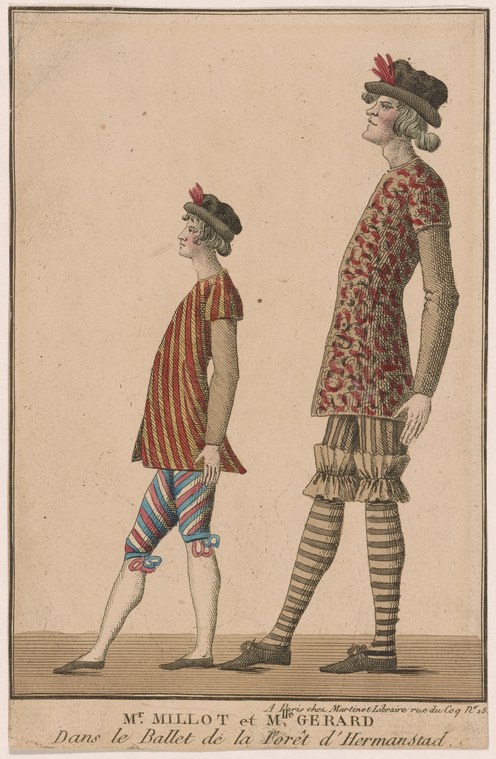
M'r Millot et M'lle Gérard dans le ballet de la Forêt d'Hermanstad
Unknown artist
- Collection:
- Prints depicting dance
- Source:
- New York Public Library
- Rights:
- Public domain — free to use, share and adapt.
- Recorded as:
- Public Domain
For historians of 18th-century dance, this engraving is primary documentary evidence of how professional dancers dressed, presented themselves to audiences, and were publicly named and celebrated. It preserves the names Millot and Gérard and their association with a specific ballet production, anchoring these performers in the historical record. The print also reveals what *La Forêt d'Hermanstad* looked like to contemporary viewers—costume, scale, character type—at a period when choreographic notation was rare and moving images did not exist.
What you are looking at
A hand-colored engraving showing two dancers in profile against a plain background, presented as a size comparison. The figure on the left, identified as M. Millot, wears a short tunic in red and gold vertical stripes with a decorative hat topped with pink feathers, and colored striped stockings in red and blue. The figure on the right, Mlle Gérard, is notably taller and wears a longer garment in red with ornate floral or patterned detailing, short puffed sleeves, and stockings with horizontal stripes. Both performers wear feathered hats in the same style. The composition is formal and documentary in character—not a narrative scene but a presentation of two bodies and their costumes, with the two figures standing still and facing left, their bodies upright and at rest rather than in motion.
The dancing
Both dancers stand upright with neutral posture and no weight shift or movement suggested. Their arms hang at their sides or rest naturally. The engraving makes no attempt to depict active dancing—the bodies are presented as costume display rather than as performers mid-movement. The height difference between the two figures dominates the composition and appears to be the point of the image. No hold, frame, or spatial relationship between the dancers is implied.
The dance depicted
The title identifies this as a scene from the ballet *La Forêt d'Hermanstad* (The Forest of Hermanstad), a theatrical work that would have been performed in the 18th century on European stages. Millot and Gérard were professional dancers of that era. The image functions as a costume and cast documentation rather than a representation of a choreographed moment; it records what these performers wore and how they appeared rather than how they danced. The static presentation suggests this is a playbill or promotional engraving made to advertise the production and its stars.
How it was made
This is a hand-colored engraving, a common reproductive medium for theatrical documentation in the 18th century. The colored inks have been applied by hand after the engraved outline was printed, which explains the slight variations in pigment application visible in the garments. Engravings of this type were distributed as playbills, souvenirs, and publicity for ballet productions and were affordable enough to circulate widely among theater-goers and collectors. The technique allowed precise delineation of costume detail—the stripe patterns, embroidered motifs, and hat decorations are recorded with clarity that would serve dancers and costumiers.
About this work
This is a documentary engraving of two performers in the ballet *La Forêt d'Hermanstad*, likely created in the mid-to-late 18th century as a theatrical playbill or cast record. Rather than depicting the dance itself, the print serves as a costume inventory and performer advertisement, showing the audience what Millot and Gérard would wear and how they would appear on stage. The side-by-side presentation emphasizes the physical contrast between the two dancers, making this both a promotional image and a record of how bodies and dress were instrumentalized in theatrical spectacle.
As a dance historical document, the engraving tells us about the costumes, scale, and presentation conventions of 18th-century ballet, about the professional dancers who populated European theaters, and about how dance was marketed and made visible to the public before photography. It is one of many such prints that constitute our visual archive of preromantic ballet.
How to look at it
This is not a snapshot of dancing but a formal portrait of costume and professional identity. The viewer should attend to the details of dress—the stripe patterns, the embroidery, the hats—as evidence of how bodies were costumed for the theater, and to the size difference between the two performers as a deliberately recorded fact about their bodies. The plain background and profile view create a timeless, documentary quality; this is how the dancers *looked*, not how they *moved*. The engraving's strength lies in its specificity: the names, the ballet title, the precise recording of garment construction and color.
The artist
The engraver is not recorded in the catalogue, which was common for theatrical prints of this era. The hand-coloring and style suggest a professional theater publishing workshop, likely French or German, but without a signature or documented provenance the specific maker remains unknown. Such prints were often produced anonymously or by workshop assistants and were valued for their content—the image of the performers and the ballet—rather than for the artist's reputation.
The period
The mid-to-late 18th century saw rapid professionalization of ballet and a growing public appetite for information about dance and dancers. Ballet was performed in courts and public theaters across Europe, and dancers became celebrities whose images were collected and traded. The costume style visible here—the short tunics with decorative elements, the feathered headdresses, the attention to leg and stockings—reflects the conventions of theatrical dress in this period, which combined classicizing elements with contemporary ornament. Hand-colored engravings were the primary visual medium for documenting and publicizing theatrical performances before lithography became widespread in the 19th century.
Where it lives
The work is held in the Prints collection of the New York Public Library, part of their holdings of dance-related pictorial material. It is a playbill or theatrical advertisement print, the kind that would have been sold at theater doors or distributed to patrons and collectors.
Questions about this work
Are Millot and Gérard shown dancing?
No. Both figures stand still in neutral posture. The engraving is a costume and cast record, not a representation of choreography. It documents how the performers appeared in the ballet rather than showing them in motion.
Why are they shown at different heights?
The height difference appears to be a recorded fact about the two performers' bodies, presented here for documentary purposes. Whether this was intentional casting or a natural difference is not evident from the image alone.
What was *La Forêt d'Hermanstad*?
A theatrical ballet performed in 18th-century Europe. Beyond the title and these dancers' names, the specific choreographer, date, and performance history are not evident from the engraving itself. The title suggests a narrative set in a forest, likely a fairy-tale or pastoral subject.
How common were prints like this?
Very common. Hand-colored engravings of ballet performances, costume designs, and famous dancers were a standard form of theatrical publicity and souvenir in the 18th century. They served functions similar to playbills and cast posters today.
More dance artwork





