49 works in this view — arrow keys or swipe to move between them.
Dance in Art
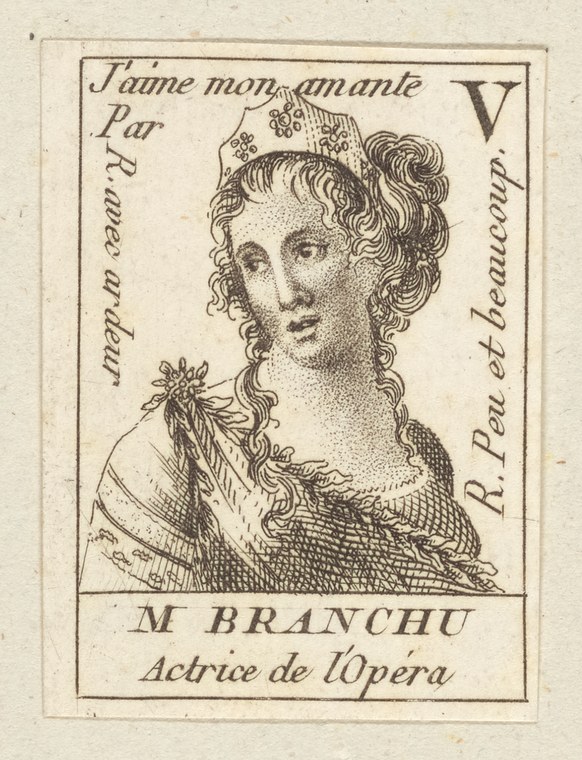
M Branchu, actrice de l'Opéra
Unknown artist
- Collection:
- Prints depicting dance
- Source:
- New York Public Library
- Rights:
- Public domain — free to use, share and adapt.
- Recorded as:
- Public Domain
Engraved portraits of opera singers and actresses from this period are rare documentary evidence of how performers were promoted and visualized to the public. The work shows how women performers were presented to the theatrical market and contributes to our understanding of the material culture and celebrity iconography of opera in the late 1700s.
What you are looking at
This is a portrait engraving of a woman identified as M. Branchu, an opera singer and actress. She is shown from the shoulders up, turned slightly to her left, wearing an ornate headdress decorated with jewels or beads and a low-cut dress with cross-hatched shading suggesting rich fabric. Her hair is elaborately curled in the style of the late 18th century. The image is framed within a simple rectangular border, with text identifying her below: the title "M BRANCHU" and the designation "Actrice de l'Opéra" (Actress of the Opera). The inscription at the top reads "J'aime mon amante / Par" on the left side and "V / Pen & bercoup" on the right—fragmentary text that may reference a theatrical or romantic sentiment. The engraving employs fine parallel lines and stippling to create tonal depth, particularly in rendering the shadow and texture of her clothing and the delicate modeling of her face.
The dancing
The figure is a three-quarter-length bust portrait with her head angled in a contemplative or composed pose. There is no active movement or dance gesture; this is a formal theatrical portrait. Her arm is partially visible at the lower edge, resting naturally. The pose and presentation are those of a posed sitter for a portrait, not a performer in motion.
The dance depicted
This image does not depict dance. It is a portrait of an opera actress, and while the subject may have performed in dance or mime as part of operatic productions of her era, the engraving itself shows a stationary, formal portrait pose with no evidence of movement, choreography, or dance technique.
How it was made
This is an engraving—a fine intaglio print executed with a burin, as evidenced by the consistent parallel line work and stippled shading visible throughout. The technique allowed for detailed facial likeness and fine tonal gradation, making it ideal for theatrical publicity. Engravings of this type circulated widely as broadsheets and in theatrical publications, serving to promote performers and their roles to the literate public of the late 18th century.
About this work
This is a late 18th-century engraved portrait of Mademoiselle Branchu, an opera actress whose name identifies her as a professional performer of the period. While it is a theatrical portrait rather than a depiction of dance itself, it documents the appearance and status of a woman working in the operatic world—a context in which dance, pantomime, and sung recitative were closely interwoven. The work belongs in a dance collection as evidence of the visual culture surrounding theatrical performers and of the integration of dance within operatic performance during the era.
How to look at it
Observe the care taken in rendering the headdress and facial features—this is a portrait designed to be recognizable and to convey status and gentility. The formal pose and direct presentation are typical of theatrical publicity portraiture, where the goal was to create a flattering likeness that could be circulated as a broadsheet or published in theatrical directories. The text identifying her role reminds viewers that she was a working professional, not an aristocratic amateur.
The artist
The artist is not recorded. The engraving is unsigned or the signature is not visible. The work is catalogued within the New York Public Library's collection of prints depicting dance, suggesting it was acquired as part of a broader effort to document theatrical performance imagery.
The period
This engraving dates to the late 18th century, a period when opera and theatrical spectacle were dominant forms of entertainment and when engraved portraits of celebrated performers became commercial commodities. Women performers in opera gained significant public visibility and celebrity status during this era, despite legal and social restrictions on their professional movement. Dance was an essential component of operatic performance, integrated into narrative works through choreographed ensemble scenes and solo variations.
Where it lives
The work is held in the New York Public Library's collection of prints depicting dance. It was acquired as part of a specialized collection focused on dance imagery across genres and periods.
Questions about this work
Was Mademoiselle Branchu a dancer?
The record identifies her as an opera actress, not specifically as a dancer. However, dance and pantomime were integral to operatic performance in the late 18th century, and she almost certainly performed choreographed movement as part of her operatic roles. This portrait does not show her dancing.
What do the handwritten words at the top mean?
The inscription fragments visible at the top of the portrait are unclear in this image and may be partially cut off or damaged. They appear to reference affection or romantic sentiment, but their full meaning is not established. They may refer to the opera or role she was famous for.
Why is this in a dance collection if it's just a portrait?
Portraits of theatrical performers, especially opera singers, are important documentation of the visual culture surrounding dance and theatrical movement. They provide evidence of how performers were promoted, what aesthetic standards governed their appearance, and how they were consumed by the public.
More dance artwork





