49 works in this view — arrow keys or swipe to move between them.
Dance in Art
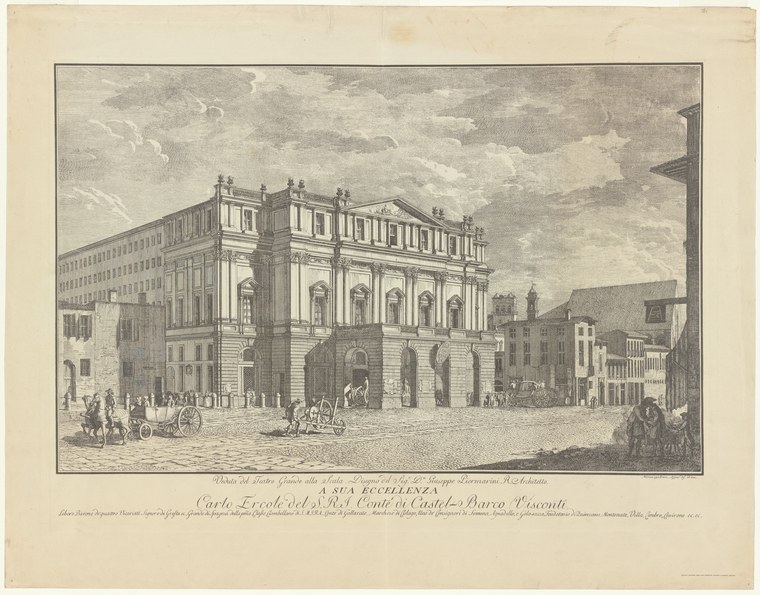
Veduta del Teatro Grande alla Scala. Disegno del Sigr. Dn. Giuseppe Piermarini R. Architetto
Unknown artist
- Collection:
- Prints depicting dance
- Source:
- New York Public Library
- Rights:
- Public domain — free to use, share and adapt.
- Recorded as:
- Public Domain
For dance historians, this print documents the physical theater that would host some of ballet's most significant works and dancers from the late 18th century onward. It shows the Scala as urban stage—the built environment that framed performance—and records Piermarini's neoclassical design at a moment when such theaters were central to the professionalization and prestige of ballet in Europe.
What you are looking at
This is an architectural veduta—a precise, detailed view of a grand neoclassical theater building rendered in engraving. The Teatro alla Scala occupies the center of the composition, a monumental structure with a rusticated ground floor, a piano nobile articulated by tall arched windows, and an upper story of smaller rectangular openings. The façade is symmetrical and formal, ornamented with pilasters and cornices. A substantial plaza spreads before the building, animated by small figures of pedestrians, vendors, and carriages: women in long dresses, men in period dress, a cart pulled by horses, small clusters of conversation. The surrounding cityscape—lower buildings, church spires, domestic facades—frames the theater and establishes it within its Milan context. The sky occupies roughly the upper third, rendered in fine parallel lines suggesting clouds and atmospheric depth. The whole is executed in the meticulous linear style of 18th-century engraving, with careful attention to shadow, proportion, and the play of light across the building's surfaces.
The dancing
The human figures scattered across the plaza are tiny and schematic—reduced to silhouettes that indicate activity and scale without anatomical precision. They appear to be walking, standing, or conversing in groups of two or three. Some wear long skirts or coats characteristic of late 18th-century dress. None are dancing; all are in the casual postures of urban pedestrians and street life. The figures serve as scale markers rather than dramatic protagonists.
The dance depicted
This image does not depict dance. It is a documentary architectural print recording the exterior appearance of the Teatro alla Scala, Milan's principal opera and ballet house. The theater building itself is the subject, not any performance or dancing body. The small figures in the plaza are city dwellers going about daily business, not dancers or performers. While the Scala would have hosted ballet and operatic dance throughout its history, this veduta captures the building as urban monument, not as a venue shown in the act of its function.
How it was made
This is an engraving (evident from the precise parallel hatching, fine lines, and formal composition characteristic of 18th-century printmaking). The technique allows for high detail, clear tonal modeling through line density, and reproducibility. The print would have circulated widely among architects, patrons, and educated urban audiences as a record of a major civic monument. The formal precision and architectural focus suggest this served both documentary and celebratory functions—recording the building accurately for professional reference while also promoting Milan's cultural prestige.
About this work
This is an engraved veduta of the Teatro alla Scala, Milan, drawn by the architect Giuseppe Piermarini (to whom the inscription credits the design). It records the exterior of one of Europe's most important opera and ballet theaters in meticulous neoclassical style. The print captures the building as civic monument and symbol of cultural authority, with the theater's formal façade dominating the composition while street life circulates around its base. Though the Scala became one of the world's principal homes of ballet, this image documents its architectural identity rather than the dance performed within it. It is valuable as a historical record of the building's design at the moment of its prominence and as evidence of how civic theaters were represented and celebrated in print.
How to look at it
Observe the meticulous rendering of architectural detail: the careful gradation of shadow across the façade, the precise proportions of each element. Note how the small figures in the plaza—pedestrians, vendors, carriage traffic—establish scale and suggest the theater's place in urban life rather than showing any theatrical activity. The composition presents the building as a stable, permanent civic monument. The formal symmetry and the placement of the theater at the center of the composition assert its cultural authority and importance.
The artist
Giuseppe Piermarini (1734–1808) was the chief architect of Lombardy and one of the major neoclassical designers of the late 18th century. He redesigned the Teatro alla Scala following a fire in 1776, completing it in 1778. This veduta records his design and was likely engraved for circulation among architects, patrons, and the educated public. Piermarini was known for his precise, systematic approach to neoclassical form.
The period
The Teatro alla Scala was rebuilt and reopened in 1778 during the height of neoclassicism. This was the era when purpose-built theaters were becoming permanent civic institutions, moving away from temporary court spectacles toward public opera houses. At the Scala, ballet was performed as part of opera productions, and the theater quickly became a center for the development of new choreographic styles. The veduta genre flourished in the 18th century as a means of recording and circulating images of architectural achievement, particularly in Italy. These prints served both documentary and aspirational functions, establishing the theater as a monument and the city as culturally advanced.
Where it lives
This engraving is held in the New York Public Library's collection of prints depicting dance, indicating its inclusion in a dance archive despite its architectural rather than choreographic focus. It was likely engraved and published in Milan in the late 18th or early 19th century as a record of Piermarini's design.
Questions about this work
Is this showing a ballet performance?
No. This is an architectural veduta—a precise print of the theater building itself. The small figures in the plaza are pedestrians and city dwellers, not dancers. While the Scala became famous for ballet, this image records the building's exterior design, not any performance within it.
Who was Giuseppe Piermarini?
Piermarini was the leading neoclassical architect of Milan. He rebuilt the Teatro alla Scala after a fire in 1776, completing the new structure in 1778. This print documents his design. He was influential across Lombardy and is recognized as one of the major architects of the late 18th century.
Why is this in a dance collection?
The Scala is one of the world's most important venues for ballet. Though this veduta does not depict dance, it records the physical theater that hosted major ballet productions and dancers from its reopening in 1778 onward, making it historically significant for understanding the institution of ballet.
What is a veduta?
A veduta is a precise, detailed view of a cityscape or building, rendered in engraving or painting. The genre flourished in 18th-century Italy as a means of recording and celebrating architectural achievement and urban life. Vedute served both documentary and promotional purposes, circulating images of important buildings to a broad audience.
More dance artwork





