49 works in this view — arrow keys or swipe to move between them.
Dance in Art
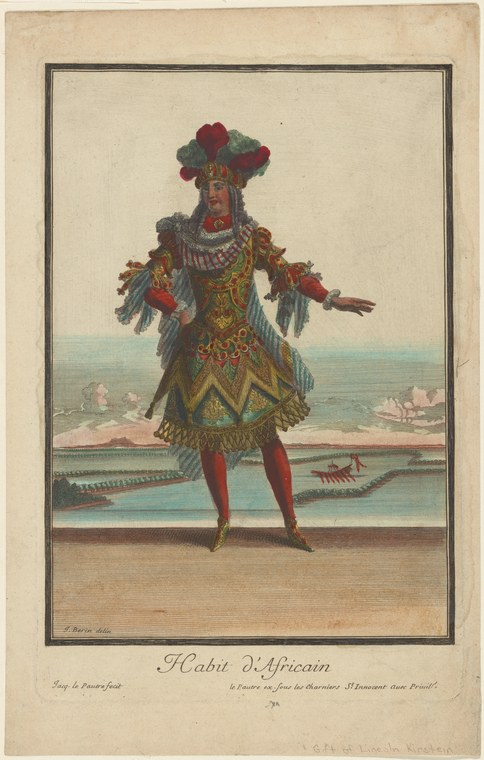
Habit d'Africain
Unknown artist
- Collection:
- Prints depicting dance
- Source:
- New York Public Library
- Rights:
- Public domain — free to use, share and adapt.
- Recorded as:
- Public Domain
This print documents an early European encounter with African dress and offers a window into how European artists and audiences understood—or imagined—African visual culture. For dance historians, it demonstrates the ways costume and body presentation were recorded and circulated in the early modern period, and raises questions about the relationship between documentation, exoticization, and the actual practices being represented.
What you are looking at
A single figure stands alone on a sandy shore, facing forward in a formal pose against a pale sky. The figure wears an elaborate costume: a richly decorated tunic or dress in gold and jewel tones with geometric patterning, layered with draped fabrics in deep blue-green, and ornamental tassels or fringed elements hanging from the shoulders and sides. A tall feathered headdress in dark red crowns the figure. The setting is a coastal landscape rendered in soft washes—calm water and distant buildings visible behind, with small boats on the water. The composition is frontal and hieratic, presenting the figure as though for inspection or documentation rather than caught in motion. A thin black border frames the entire composition.
The dancing
The dancer stands with weight evenly distributed, arms extended outward to the sides at shoulder height with a slight bend at the elbows, palms facing forward in a gesture of display or presentation. The stance is vertical and upright, the body not bent or twisted. The posture and arm position suggest formal presentation or ceremonial bearing rather than active choreographic motion. There is a single figure only, isolated in the frame.
The dance depicted
The costume and presentation suggest African ceremonial or courtly dress, though the specific dance tradition cannot be determined from the stance alone. The formal, frontal pose and the emphasis on costume detail over movement suggest this is documentation of dress rather than a narrative moment of dancing. If this depicts a dance at all, it would be a formal or processional movement in which the costume and bearing—the stateliness of the presentation—constitute the primary visual meaning. The inscription 'Habit d'Africain' identifies the subject as 'African dress' or 'African costume,' placing the emphasis on sartorial rather than kinetic content.
How it was made
This is a hand-colored engraving or etching, as evidenced by the fine line work forming the figure and setting, the precision of the border, and the layered application of watercolor or gouache over a printed base. The technique allowed for wide circulation of exotic imagery in early modern Europe; such prints were collected, bound into costume books, and used as reference for theatrical and masquerade productions. The hand-coloring—particularly the rich reds, golds, and blues—adds prestige and expense, indicating an educated audience.
About this work
This is a costume study or ethnographic portrait in the form of a hand-colored print, depicting an African figure in formal or ceremonial dress. The work belongs to a long tradition of European documentation and representation of non-European dress, popular from the 16th century onward, when such prints served multiple functions: antiquarian curiosity, theatrical reference, and assertion of European knowledge of distant peoples. While the inscription names it as 'African dress,' the specific regional origin, the identity of the wearer, and the context of the costume remain obscure.
The print's relationship to dance is ambiguous. The figure's formal stance could indicate a dancer poised or presenting, or it could simply be a model displaying costume. What is certain is that the visual energy of the work lies entirely in the elaborate dress—the geometry of the tunic, the sweep and weight of the draped fabrics, the ornamental surplus of the headdress—rather than in any captured movement. If dance is present, it is implied through the ceremonial bearing and the costume's visual command, not through active gesture.
How to look at it
Study the costume in detail: the precision of the geometric patterning on the tunic, the layering and weight suggested by the drapery, the ornamental fringe and tassels, and the striking feathered headdress. Notice how the artist has rendered these elements to convey both their texture and their visual impact. The formal, frontal pose freezes the figure in a moment of presentation rather than action, inviting you to examine the ensemble as a whole rather than to read a narrative or a sequence of movement. The landscape background—present but subdued—grounds the figure in a specific place without narrative elaboration.
The period
This print belongs to a substantial body of costume and ethnographic prints produced from the 16th through 18th centuries, when European interest in distant peoples, dress, and customs was at its height. Such prints often appeared in compilations of 'habits' (costumes) of the world, functioning as both art objects and reference materials. In the theater, such costume prints influenced the design of masquerade and exotic-themed productions. The hand-coloring technique and the careful documentation of textile and ornamental detail reflect the period's investment in the material culture of otherness.
Where it lives
The work is held in the New York Public Library's collection of prints depicting dance. It is cataloged as a hand-colored print, date and artist unknown, suggesting it is part of a larger collection of such costume and ethnographic documentation.
Dance in this work
Questions about this work
Is this actually a dance?
The figure's formal stance and the emphasis on dress suggest this is a costume study or ethnographic portrait rather than a captured moment of dancing. If dance is present, it would be formal or processional, where the bearing and presentation constitute the movement rather than limbs and footwork.
Who made this print and when?
The artist and date are not recorded in the catalogue. Based on the style, materials, and composition, it appears to be a European hand-colored engraving or etching from the 17th or 18th century, but this cannot be confirmed without further research.
What does 'Habit d'Africain' mean?
The French phrase translates to 'African dress' or 'African costume.' It identifies the subject as a representation of African sartorial practice, though the specific region, people, and context are not indicated.
How was this print used?
Such prints were collected, studied, and bound into costume books that served theatrical, antiquarian, and educational purposes. They circulated in elite European circles and influenced the design of masquerades and exotic-themed entertainments.
More dance artwork





