49 works in this view — arrow keys or swipe to move between them.
Dance in Art
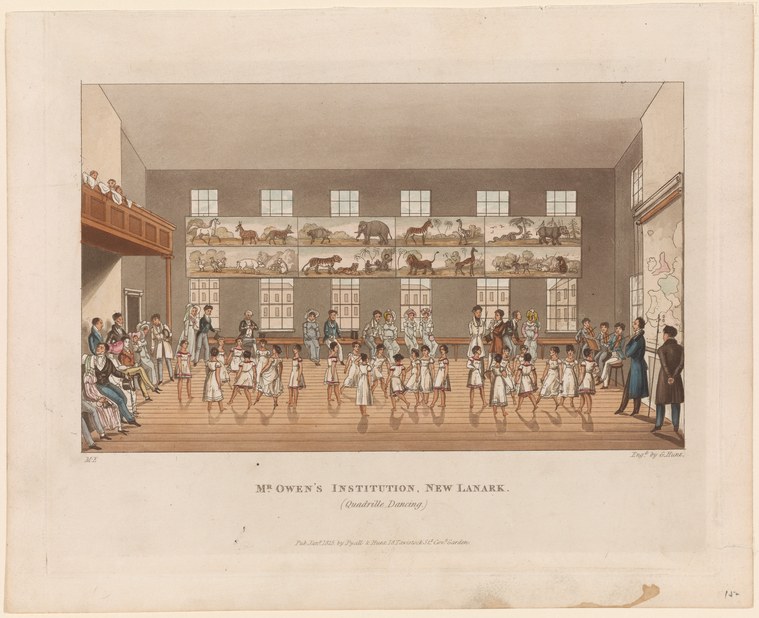
Mr. Owen's institution, New Lanark
Unknown artist
- Collection:
- Prints depicting dance
- Source:
- New York Public Library
- Rights:
- Public domain — free to use, share and adapt.
- Recorded as:
- Public Domain
This is a rare visual record of pedagogical movement in an educational context before the professionalization of physical education and dance instruction. It shows how movement—ordered, collective, supervised—was understood as part of children's moral and physical development in a utopian community, and how visual representation was used to promote educational innovation.
What you are looking at
A large institutional hall with a soaring ceiling and multiple tall windows admits bright natural light across a wooden floor where dozens of children in light-colored clothing (mostly white or pale) are in motion. The space is orderly and airy, with what appears to be pedagogical illustrations—possibly animal studies or movement examples—mounted in a grid on the wall at mid-height. Adults in darker dress (likely instructors or supervisors) stand at the margins and edges of the room, observing. The composition is crowded but not chaotic; the children are scattered across the floor in no fixed formation, their bodies at various angles and attitudes of movement. The setting is institutional rather than theatrical: this is a schoolroom, not a performance venue.
The dancing
The children's bodies are in varied states of motion and stillness—some appear to be moving freely or gesturing, while others stand or crouch. Their light dress and bare or lightly shod feet suggest purposeful movement rather than play. The postures are not codified or synchronized; there is no visible partnering, no closed hold, no line. The adults remain still and separate, positioned as watchers rather than participants. The overall impression is of spontaneous or directed movement activity rather than structured ballroom or theatrical dance.
The dance depicted
This appears to document movement instruction or physical education at an institutional school, most likely the New Lanark Institution established by Robert Owen. The children's varied, non-synchronized movement suggests rhythmic gymnastics, calisthenics, or free movement under instruction rather than a specific dance form. The pedagogical function is explicit in the setting and the presence of supervisory adults. While movement is occurring, it does not conform to any recognizable historical dance genre—this is educational movement practice, which may have incorporated dance elements but was not primarily dance performance.
How it was made
This is a hand-colored engraving or aquatint, evident from the linear work visible in architectural detail and the careful tonal gradation in the walls and floor. The technique allowed for wide distribution of the image as a document of Owen's educational innovations. The inclusion of didactic wall illustrations within the print itself—as part of what is being depicted—shows the artist's interest in conveying pedagogical method visually. Color has been added by hand, a common practice for institutional records of the period.
About this work
This print documents the daily practice of movement and physical education at Robert Owen's New Lanark Institution in Scotland, a pioneering communal and educational establishment of the early 19th century. The image records not a dance performance but a structured movement practice—possibly influenced by contemporary pedagogical thought about the body and education. The careful composition and institutional detail suggest this was made to publicize Owen's educational methods, part of the visual argument for the institution's progressive approach.
The work belongs in a dance history collection as evidence of how movement education was conceived and practiced in an influential social experiment. It shows that dance-like activity—rhythmic, directed, collective—was part of institutional childhood even when not named as dance, and that its documentation was used to argue for social reform.
How to look at it
Attend to the architecture of the space and the precision of its depiction—the artist is documenting an ideal institutional environment. Notice the contrast between the animated, varied postures of the children and the stillness of the adults: movement is being observed and presumably evaluated. The wall illustrations are part of what the print argues for: visual instruction in movement or form. The light from the windows is not incidental; it emphasizes the clarity and openness Owen's educational philosophy proposed.
The artist
The artist is not recorded. The print's style and execution suggest a professional engraver of the early 19th century, likely working from a commission by Owen's Institution or its supporters to create promotional visual records.
The period
The New Lanark Institution (established 1800) was known for progressive approaches to education, labor, and community living. Movement and exercise were part of Owen's belief in the physical and moral development of children. Early 19th-century pedagogical theory, influenced by European progressive thinkers, was beginning to incorporate systematic movement and exercise into education. This predates organized physical education curricula, making the image historically significant as evidence of how movement was valued and structured in institutional settings.
Where it lives
Held by the New York Public Library in its collection of prints depicting dance. The print is a document created to publicize the New Lanark Institution's educational methods and would have circulated among advocates of social reform and educational innovation.
Questions about this work
Is this a dance lesson or performance?
Neither. It documents supervised movement activity in an educational setting. The children are engaged in what may have been called calisthenics, rhythmic exercise, or free movement under instruction—not a codified dance form or a performance staged for an audience.
What was the New Lanark Institution?
A pioneering community and factory school established by Scottish industrialist and social reformer Robert Owen around 1800. It was known for progressive approaches to education, labor conditions, and communal living, and it operated on the belief that environment and education could improve human character and society.
Why are the children's clothes so light and loose?
Light clothing allowed free movement. The style reflects both practical pedagogical reasoning (children could move more easily) and Owen's belief that comfortable, rational dress was part of creating a more enlightened society.
What are the illustrations on the wall?
Likely teaching aids showing animals, forms, or movement poses. Their inclusion in the print signals that visual instruction—learning by observing and imitating—was central to the Institution's method.
More dance artwork





