49 works in this view — arrow keys or swipe to move between them.
Dance in Art
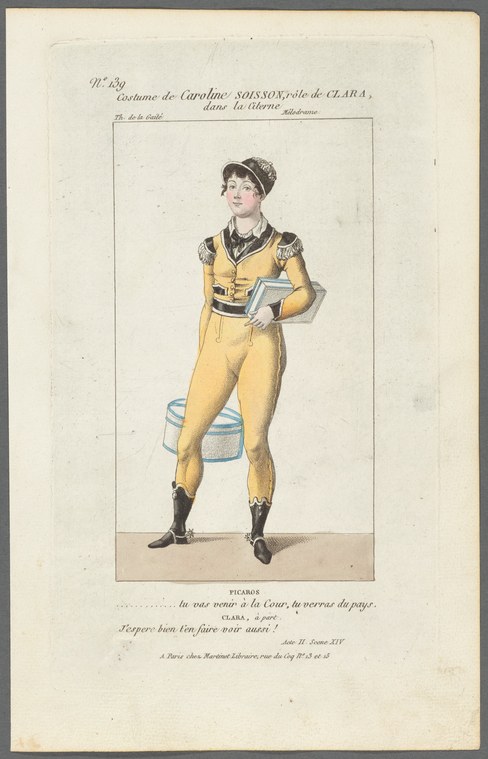
139. Costume de Caroline Soisson, rôle de Clara, dans La citerne, Th[éâtre] de la Gaité, mélodrame
Unknown artist
- Collection:
- Prints depicting dance
- Source:
- New York Public Library
- Rights:
- Public domain — free to use, share and adapt.
- Recorded as:
- Public Domain
This image preserves a record of early 19th-century popular theatrical costume and cross-dressing performance convention, and it testifies to the theatrical culture of a specific Parisian house during a period when melodrama and pantomime were dominant forms. For historians of performance, it offers concrete evidence of how gender, costume, and character were negotiated on the commercial stage.
What you are looking at
A single female figure stands in a confident contrapposto pose against a plain background, wearing a striking yellow costume consisting of fitted breeches and a short tunic with black trim and decorative shoulder pieces. Her dark hair is gathered in a small cap or bonnet, and she wears black boots. She holds what appears to be a script or document in one hand, positioned at her hip, and gazes toward the upper left with a composed expression. The figure occupies the center of the composition, framed by a simple rectangular border. Below the image is a caption in French, identifying this as the costume of Caroline Soisson in the role of Clara from *La citerne*, a melodrama performed at the Théâtre de la Gaité. The hand-colored engraving technique produces soft modeling in the flesh tones and careful gradation in the yellow fabric, giving the figure dimensional presence against the plain ground.
The dancing
The dancer stands in a relaxed but dignified posture with weight evenly distributed, one leg slightly forward in a natural stance rather than a formal dance position. The torso is upright and the shoulders are level. The arm holding the script is bent naturally, while the other hangs at the side. There is no suggestion of active movement, balletic extension, or acrobatic skill—the pose is presentational, designed to display the costume itself and project the character's dignity and composure.
The dance depicted
This is not a document of dance technique but of theatrical costume worn by an actress playing a dramatic role. Caroline Soisson was a performer at the Théâtre de la Gaité, a house known for melodramas, pantomimes, and popular theatrical spectacle. The masculine-coded yellow costume—breeches, tunic, boots—suggests either a travesty role (a female character dressed as a man or boy) or a traditionally masculine dramatic role performed by a woman, a common convention in early 19th-century melodrama. No dance style is depicted; the figure is an actor in character, not a dancer executing choreography.
How it was made
This is a hand-colored engraving, identifiable by the fine parallel line work visible in the shading, particularly in the tunic and boots, and the precise definition of outlines characteristic of the engraving process. The coloring—applied by hand after printing—is skillfully restrained, with warm yellow contrasting against flesh tones and dark accents. The technique allowed rapid reproduction for distribution to playgoers and theater patrons; such costume prints were common ephemeral documents of early 19th-century theatrical practice, affordable enough for a popular audience but executed with care sufficient to preserve detail for the historical record.
About this work
This is a theatrical costume print documenting the dress worn by an actress in a popular melodrama of the early 19th century, not a record of dance or choreography. The Théâtre de la Gaité was a house of spectacle and popular entertainment where such costume documentation served promotional and archival purposes. The hand-colored engraving technique and format suggest this is one of a series of character prints produced for theater patrons, a common form of theatrical ephemera that also survives in the holdings of major libraries.
The work belongs in a dance collection only if the collection's scope includes theatrical costume, performance culture, and the material conditions of performance spaces beyond formal dance technique. It documents what a performer wore and how she presented herself on a commercial stage, which is relevant to understanding the broader ecosystem in which theatrical dance developed, but it does not itself depict dance.
How to look at it
Attend to the costume itself: the cut of the breeches, the fit of the tunic, the decoration of the shoulders, the choice of yellow as the dominant color. These details convey the character's social status and dramatic function within the melodrama. The pose is deliberately static and frontal—this is a costume display, not a moment of action or dance. The figure's calm gaze and composed bearing communicate theatrical authority and dignity, appropriate to a character of consequence within the plot of *La citerne*.
The artist
The artist is not recorded. The engraving technique and hand-coloring method suggest a commercial print shop producing costume documentation for the Théâtre de la Gaité. Such prints were a standard product of Parisian theatrical commerce in the early 19th century and were often produced by specialized workshops rather than signed individual artists.
The period
Early 19th-century melodrama, particularly as performed at popular houses like the Théâtre de la Gaité, was a dominant form of theatrical entertainment in Paris. These theaters featured elaborate spectacle, stock characters, and often cross-dressed roles as part of comic or dramatic convention. Costume prints served both as promotional materials and as mementos for playgoers. This was the era before Romantic ballet became the prestige form of theatrical dance, and before the strict codification of women's roles that would characterize later 19th-century performance.
Where it lives
This print is held in the New York Public Library's collection of prints depicting dance. It appears to be one of a series of costume documentation prints produced by Parisian theaters in the early 19th century.
Questions about this work
Is this a ballet?
No. This is theatrical costume documentation for a melodrama, not a ballet or dance work. The Théâtre de la Gaité was a house of popular melodrama and pantomime. While theatrical dance and pantomime overlapped in this period, this particular print documents an actress in a dramatic role, not a dancer executing choreography.
What is a 'travesty role'?
A travesty role is a character traditionally written as male but performed by a female actor, or vice versa. The yellow masculine-coded costume—breeches and tunic—suggests Soisson's character Clara was either a travesty role or a character written to wear male dress for dramatic effect. Such roles were common in melodrama and comedy.
Why would this be in a dance collection?
Costume prints from popular theaters are sometimes included in dance collections because they document the material culture of performance and the bodies performing on theatrical stages. However, this particular work is not a record of dance technique or choreography, and its primary value is as a document of theatrical history rather than dance history.
More dance artwork





