49 works in this view — arrow keys or swipe to move between them.
Dance in Art
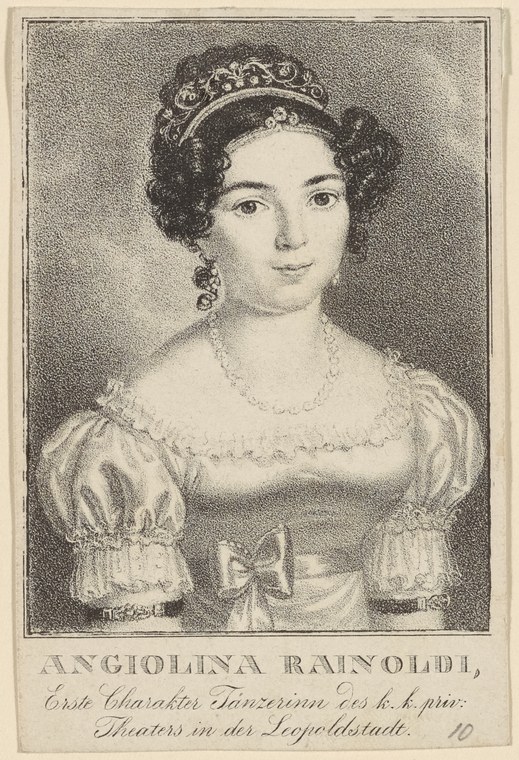
Angiolina Rainoldi, Erste charakter Tänzerinn des k. k. priv: Theaters in der Leopoldstadt
Unknown artist
- Collection:
- Prints depicting dance
- Source:
- New York Public Library
- Rights:
- Public domain — free to use, share and adapt.
- Recorded as:
- Public Domain
This work documents a dancer and a theatrical tradition that is now largely forgotten. Character dancing was central to Viennese popular theatre but has left almost no visual record. Rainoldi's name appears nowhere in standard dance histories, yet this engraving proves she was prominent enough to merit professional portraiture—evidence of a thriving theatrical culture and a performer whose work mattered to her contemporaries.
What you are looking at
A half-length portrait of a young woman facing the viewer, rendered in fine stippled engraving. She wears her dark hair parted and arranged in fashionable ringlets pinned with a jeweled tiara. Her dress is of white muslin or linen with characteristic early 19th-century styling: short puffed sleeves gathered at the shoulder, a low square neckline trimmed with fine lace, and a narrow waist defined by a bow. She wears a pearl necklace and matching pearl drop earrings. The figure is set against a plain background within a rectangular border frame. The inscription below identifies her as a dancer of the Leopoldstadt Theatre in Vienna, suggesting this is a theatrical portrait commemorating a professional performer.
The dancing
The subject is shown in frontal pose with shoulders squared toward the viewer, her gaze direct and engaging. Her arms rest at her sides, her posture upright and composed. There is no active dancing gesture or movement suggested—this is a formal portrait type rather than a dance action scene. The positioning and demeanor are consistent with professional theatrical portraiture of the period, designed to showcase the dancer's appearance and status rather than to capture movement.
The dance depicted
The inscription identifies Angiolina Rainoldi as an 'Erste charakter Tänzerinn' (lead character dancer) of the k.k. (royal and imperial) privileged theatre in the Leopoldstadt district of Vienna. Character dancing in early 19th-century Vienna typically meant theatrical dance in dramatic works—repertoire that included pantomime, national dances, and character roles distinct from classical ballet. The Leopoldstadt Theatre was a popular venue in Vienna, and Rainoldi's billing as a lead character dancer suggests she performed principal roles in theatrical productions. The engraving itself documents her professional identity rather than her technique.
How it was made
This is an engraving, identifiable by its fine parallel hatching lines (stippling) and linear rendering characteristic of the medium. The precision and finish suggest a professional theatrical print, likely produced for distribution as a souvenir or advertisement. Engravings of this type were the standard vehicle for circulating images of celebrated performers in the early 19th century, reaching audiences in Vienna, the German-speaking lands, and beyond. The technique allowed for multiple impressions and wide circulation at modest cost.
About this work
This is a professional theatrical portrait engraving of Angiolina Rainoldi, a lead character dancer at Vienna's Leopoldstadt Theatre in the early 19th century. Character dancing occupied a distinct niche in the theatrical hierarchy of the period—neither classical ballet nor folk performance, but a theatrical specialty requiring versatility in mime, expression, and command of national and dramatic styles. The engraving documents not the dance itself but the dancer's professional identity and the visual culture through which early 19th-century Vienna recognized and celebrated its theatrical stars. Such portraits were a primary means by which dancers reached audiences beyond the theatre and secured their reputation.
How to look at it
Attend to the signals of professional status in the image: the fine tiara, the fashionable and expensive muslin dress, the jewels, the direct frontal gaze. These are the visual language through which early 19th-century Vienna conveyed theatrical prestige. The formal portrait type—not a scene from performance, but a statement of identity—was itself a convention; being engraved and distributed as a theatrical portrait was a mark of a dancer's importance. The inscription is as important as the face: it tells you who this woman was and where her name belonged.
The period
Early 19th-century Vienna saw a flourishing of popular theatres distinct from the court opera. The Leopoldstadt Theatre, established in the suburban Leopoldstadt district, served a middle-class and popular audience with a repertoire of comedies, pantomimes, and spectacular works. Character dancing—as opposed to the classical ballet then emerging at the court theatres—was central to this repertoire. The same period saw the rise of professional theatrical portraiture as a medium: engravings of celebrated actors and dancers were produced for sale to the public, creating a visual culture of theatrical celebrity. Rainoldi's portrait reflects both the vitality of this theatrical world and the conventions of how performers were presented to the public: frontal, formally dressed, bearing markers of rank and respectability.
Where it lives
This engraving is held in the New York Public Library's Prints collection. It is a single sheet, likely one of many such theatrical portraits produced in Vienna and distributed commercially or as souvenirs.
Questions about this work
Who was Angiolina Rainoldi?
Rainoldi was a lead character dancer at Vienna's Leopoldstadt Theatre in the early 19th century. Beyond this engraving and the inscription, little is known of her life or career. She was prominent enough to merit professional portraiture, suggesting she was celebrated in her time, but her name does not appear in surviving theatrical records or dance histories.
What was character dancing?
Character dancing was a theatrical specialty distinct from classical ballet. It centered on expressiveness, mime, and often national or regional dances performed in costume within dramatic works. Character dancers were essential to the popular and commercial theatres of 19th-century Vienna and other European cities.
What was the Leopoldstadt Theatre?
The Leopoldstadt Theatre was a popular theatre in the Leopoldstadt district of Vienna, serving a middle-class and working-class audience. It competed with the more elite court theatres and produced comedies, pantomimes, and spectacular works featuring character dancing, music, and spectacle.
Why is this a print rather than a painting?
Engraving allowed for multiple copies to be printed and sold affordably. Professional theatrical portraits of this period were almost always produced as prints so they could reach a wide audience and be sold as souvenirs to theatregoers.
More dance artwork





