49 works in this view — arrow keys or swipe to move between them.
Dance in Art
Dr. Syntax at the Opera
Unknown artist
- Collection:
- Prints depicting dance
- Source:
- New York Public Library
- Rights:
- Public domain — free to use, share and adapt.
- Recorded as:
- Public Domain
The work reveals how Regency society understood opera and spectacle not primarily as artistic or choreographic events but as occasions for social performance and display. It shows that the "dance" of courtship and fashion was perceived as more interesting than the staged spectacle itself, a perspective that historians of social dance and gender performance should consider. The image documents the gendering and class anxieties around public sociability and entertainment in the early 19th century.
What you are looking at
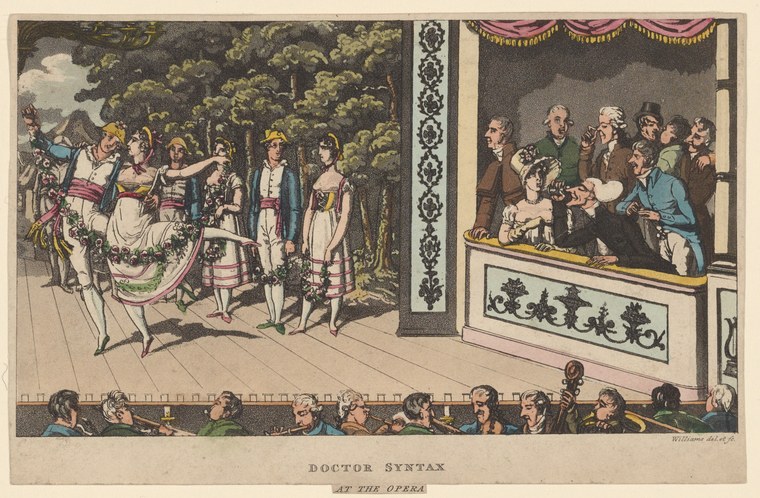
A hand-colored engraving presents two theatrical scenes stacked vertically, both labeled "Doctor Syntax at the Opera." The upper scene shows fashionable figures in Regency dress gathered in a wooded setting, with women in high-waisted white gowns and men in colorful coats and breeches. They appear to be promenading or conversing in a formal outdoor space rendered with trees and architectural elements. The lower scene depicts the interior of an opera house box, where an audience of well-dressed spectators watches a performance on stage. The stage itself shows classical or mythological figures in flowing drapery arranged in a formal tableau. The composition exploits the contrast between the frivolous social world of the promenade and the theatrical spectacle that forms the justification for gathering. Light is distributed evenly across both scenes in the manner of print media.
The dancing
The promenaders move without apparent physical exertion, their bodies upright and formal, arranged in conversational groupings rather than coordinated formations. The figures in the opera box sit or lean forward in attitudes of attention, their bodies still and structured. On the stage itself, figures in classical dress hold static poses suggesting tableau vivant or the formal arrangements typical of operatic spectacle—no dynamic movement is evident. Posture and positioning throughout emphasize social hierarchy and decorum rather than the release or physicality of dance.
The dance depicted
The work does not depict dance as a primary action. Instead, it satirizes the social rituals surrounding operatic entertainment in Regency England. The print presents the performance as a backdrop for social display and the staging of self in fashionable society. Though the stage shows classical or mythological figures in draped costume, they are arranged as a spectacle to be observed rather than as dancers executing a choreography. The ironic title—referring to the bumbling protagonist of William Combe's satirical poem *The Tour of Doctor Syntax*—suggests that the "dance" being mocked is the social performance of courtship, fashion, and pretense that occurs in and around the opera house.
How it was made
This is a hand-colored engraving, a reproductive print medium that allowed wide circulation of satirical imagery in early 19th-century Britain. The artist used line engraving for the primary image and applied watercolor or hand-tinted pigment afterward, a labor-intensive process that made such prints relatively expensive and targeted at a middle to upper-class audience. The technique permitted fine detail in architectural elements and facial features while maintaining the clarity and legibility essential for social satire. The print format and satirical subject matter suggest this was part of a series or portfolio of Doctor Syntax illustrations that circulated as both entertainment and social commentary.
About this work
This is a satirical engraving depicting not a dance but the social theatricality of Regency opera-going. The work stages two overlapping scenes—the fashionable promenade and the opera house interior—to ridicule the pretense and courtship rituals performed in these spaces. Though no actual dance occurs, the image uses the formal geometry of bodies and classical operatic spectacle as counterpoint to the frivolity of the fashionable world. The print belongs in a dance history collection because it documents the cultural context in which dance was consumed and the social rituals that framed performance in the Regency era.
How to look at it
Attend first to the formal contrast the engraver creates between the static geometric arrangement of the fashionable crowd and the equally static arrangement of the opera stage. Notice how the spectators' bodies are nearly as carefully positioned as the performers—hierarchy and decorum structure both spaces. The humor lies in the equality implied: the social posturing in the promenade is as choreographed and artificial as any stage performance. Read the facial expressions and the glances exchanged; the social "dance" of flirtation and observation is what the artist has actually illustrated.
The artist
The work is from the illustrative tradition of William Combe's *The Tour of Doctor Syntax in Search of the Picturesque* and its sequels, wildly popular satirical poems first published 1812–1821, illustrated by Thomas Rowlandson. The Doctor Syntax series was one of the most widely circulated satirical print cycles of the Regency, targeting pretension, fashion, education, and respectability. Though the catalogue does not name the engraver, the style and composition are consistent with the collaborative print shops producing Rowlandson's designs in this period. The series was republished repeatedly and pirated extensively, making it one of the most visible forms of visual culture available to English readers.
The period
This print dates to the height of Regency society (c. 1811–1820), a period of unprecedented fascination with fashion, social performance, and public entertainment in London. The opera house and the fashionable promenade were sites of intense scrutiny in satirical print; contemporaries mocked both the pretense of operatic taste and the use of public entertainment as a venue for courtship and social climbing. This coincided with the flourishing of social dance in ballrooms and assemblies, but opera-going was understood as a more elevated (and mockable) pursuit. The print reflects the anxiety and humor with which Regency society negotiated the performance of gentility.
Where it lives
This work is held in the New York Public Library's collection of prints depicting dance. It is part of the broader print culture of Regency Britain, a period when hand-colored engravings were a major medium for satire and social commentary. The identification as a Doctor Syntax illustration suggests it derives from one of the published editions or a contemporary reprint or adaptation.
Questions about this work
Is this actually a dance?
No. The work satirizes social performance and courtship rituals in the opera house, not any choreographic or balletic practice. However, it documents the cultural context in which dance was consumed and the social rituals that framed performance, making it valuable for understanding how Regency society understood bodily display and spectacle.
What is Doctor Syntax?
Doctor Syntax is a fictional bumbling clergyman and the protagonist of William Combe's wildly popular satirical poem series (1812–1821), illustrated by Thomas Rowlandson. The character wandered through English society observing and mocking contemporary foibles. The series was one of the most widely circulated print cycles of the period and targeted education, fashion, taste, and social pretension.
Why include a non-dance print in a dance collection?
This print illuminates the social context and visual culture surrounding dance and performance in the Regency era. It shows how contemporaries understood spectacle, courtship, and bodily display; it documents the gendering of public entertainment; and it reveals the anxieties and humor with which society negotiated fashion and social performance.
More dance artwork





