49 works in this view — arrow keys or swipe to move between them.
Dance in Art
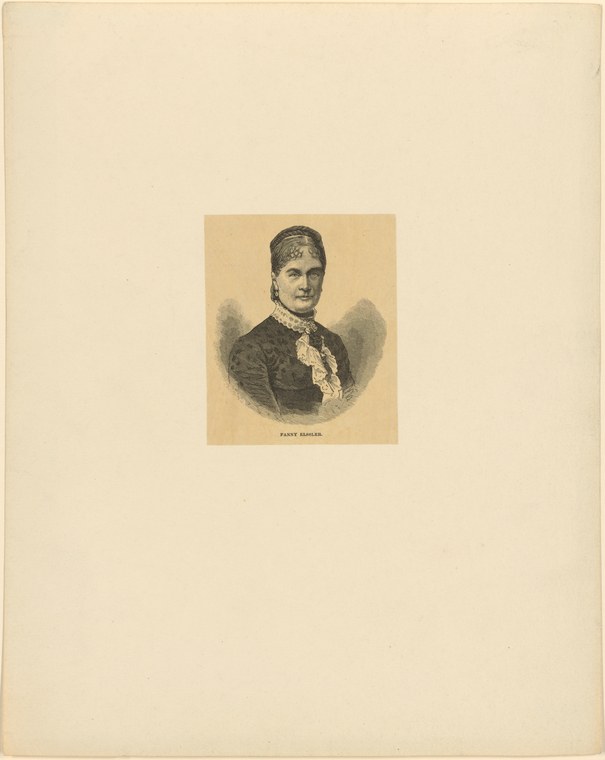
Fanny Elssler: portrait
Unknown artist
- Collection:
- Prints depicting dance
- Source:
- New York Public Library
- Rights:
- Public domain — free to use, share and adapt.
- Recorded as:
- Public Domain
Fanny Elssler was one of the two dominant figures in European ballet during the 1830s–1840s, rivaling Marie Taglioni as a icon of the Romantic ballet age. This portrait is evidence of her celebrity status and the machinery of theatrical promotion in the period. The image reveals how a dancer's public identity was constructed through dress, pose, and visual representation—a dimension of dance history often overlooked in favor of performance itself.
What you are looking at
A half-length portrait of a woman in early 19th-century dress, set against a plain cream background. She wears a dark velvet or silk jacket with fashionably sloped shoulders, over a white chemise with an elaborate lace or embroidered collar and a silk ribbon bow at the throat. Her dark hair is parted in the center and styled close to the head in the Regency mode, with a small ornamental comb or tiara visible. The woman's posture is upright and composed, her gaze directed outward with the directness expected in portraiture of the period. The bust-length framing and formal presentation suggest this is a promotional or commemorative image of a named subject rather than a generic portrait.
The dancing
The figure is shown stationary and posed, not in motion. Her shoulders are relaxed and level, her neck extended, the classical carriage of a woman of the period trained in deportment. No active dance position or dynamic tension is visible in the body; this is portrait pose, not performance capture. The arm and hand positioning is not visible, as the image is cropped at mid-torso.
The dance depicted
The catalogue identifies the subject as 'Fanny Elssler,' the celebrated Austrian ballet dancer of the Romantic era. No dance movement is depicted here—this is a portrait of the person, not a representation of her dancing. Elssler was known for her roles in ballets including *La Sylphide* and *Giselle*, and for her tours of Europe and the Americas in the 1830s–1840s. The image documents her as a public figure and star performer of her time, but the still, formal portrait cannot convey the virtuosity or style of her performance.
How it was made
This is a hand-colored engraving or lithograph, typical of 19th-century theatrical publicity and celebrity portraiture. The technique—line-based printing with selective coloring—allowed for rapid reproduction and distribution to audiences and collectors. The delicate handling of shadow and detail, especially in the face and the textures of fabric and lace, suggests skilled printmaking. This form of image was the primary means of circulating the likenesses of celebrated performers before photography became standard, making such prints both mementos of performance and documents of early celebrity culture.
About this work
This is a portrait print of Fanny Elssler, one of the major ballet stars of the Romantic period. Although it does not depict dance itself, it is a primary historical document of 19th-century theatrical stardom and the visual culture surrounding it. The image shows how a celebrated dancer was presented to the public: as an elegant, refined woman of fashion, with carefully controlled deportment and aristocratic dress. For historians of dance and theater, such promotional images are as important as action scenes; they record how performers were branded, marketed, and imagined by their contemporaries.
How to look at it
The viewer should attend to the costume and posture as records of how a Romantic-era star dancer was expected to present herself in public: refined, composed, fashionably but not extravagantly dressed. The formal portrait mode—the direct gaze, the clear light, the plain background—removes the dancer from the theater and the stage action, presenting her as a woman of culture and distinction rather than as a performer in motion. The delicacy of the printmaking technique, especially in the rendering of the lace and silk textures, shows the care lavished on promotional images of celebrated performers.
The artist
The artist is not recorded in the catalogue. The work is a professional theatrical print, likely produced by a printmaking house specializing in celebrity portraiture. Such images were rarely attributed in full to their engravers or colorists, who were often regarded as anonymous tradespeople rather than artists in the fine-art sense.
The period
This portrait dates to the height of Romantic ballet, approximately the 1830s–1840s, when the art form was dominated by the ethereal, otherworldly aesthetic of works like *La Sylphide* (1832) and *Giselle* (1841). The fashionable dress and hairstyle—the Regency style with its emphasis on simplicity and classical line—had given way by this time to fuller skirts and more ornate decoration, but the sober, refined elegance of Elssler's costume in the portrait reflects the balletic ideal of grace and control. Celebrity culture in the theater was booming; dancers and singers were the first mass-media celebrities, and their likenesses were collected and traded as precious commodities.
Where it lives
This is a print from the New York Public Library's collection of prints depicting dance, held as part of its broader holdings of theatrical and dance iconography. It is a secondary source for understanding Elssler's fame and public image rather than a primary document of her actual performance style.
Questions about this work
Who was Fanny Elssler?
Fanny Elssler (1810–1884) was an Austrian ballet dancer and one of the two superstar ballerinas of the Romantic era, alongside Marie Taglioni. She was celebrated for her technical brilliance and her role in expanding the repertoire of Romantic ballet. She toured extensively in Europe and made a famous tour of the United States in 1840–1842, where she was wildly popular.
What does this portrait tell us about 19th-century dance?
The portrait documents how dancers were marketed and celebrated as public figures and fashion icons, not just as performers. The refined dress and composed posture reflect the Romantic era's ideal of the dancer as an elegant, educated woman—a key element of how ballet differentiated itself from other theatrical entertainments and secured its status as a high art form.
Why is there no dance visible in this image?
Portraits served a different purpose than action scenes or narrative prints: they were mementos for collectors and the general public, meant to capture the subject's beauty and status rather than their skill in motion. Dancers were celebrities; their portraits were as much about glamour and fashion as about dance itself.
More dance artwork





