49 works in this view — arrow keys or swipe to move between them.
Dance in Art
M'lle. [Louise] Lamoureux, the celebrated danseuse [with accompanying article]
Unknown artist
- Collection:
- Prints depicting dance
- Source:
- New York Public Library
- Rights:
- Public domain — free to use, share and adapt.
- Recorded as:
- Public Domain
This artifact shows how professional dancers of the 19th century—especially women and foreign performers—were promoted and discussed in American popular media, and reveals the gap between the celebrity of performers and the visual documentation available to modern scholars. The periodical format was the primary way most Americans encountered information about theatrical dance outside of live performance.
What you are looking at
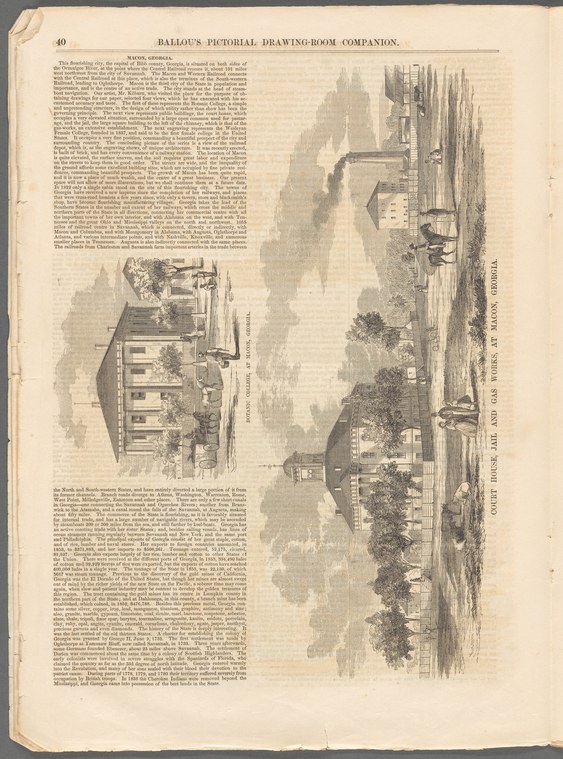
This is a printed page from Ballou's Pictorial Drawing-Room Companion, a mid-19th-century American periodical. The page combines dense letterpress text in two columns with two engraved illustrations integrated into the layout. The upper illustration shows an interior architectural space with tall windows and classical details; the lower illustration depicts an outdoor scene with buildings and foliage. The text discusses M'lle. Louise Lamoureux, identified as a celebrated danseuse. The engravings appear to be generic architectural and landscape views rather than depictions of the performer or dance itself. The page is yellowed with age and shows the characteristic typography and layout conventions of 1840s–1850s periodical publishing.
The dancing
No figures engaged in dance are visible in the illustrations on this page. The two engravings are architectural and landscape views without human subjects. The page functions as a printed article or review rather than as a visual record of performance.
The dance depicted
The page is a printed article about M'lle. Louise Lamoureux, a professional dancer of the mid-19th century, but it does not contain an illustration of her dancing. The text would need to be read in full to establish what style of dance she performed or what the article discusses. The presence of her name and title in the periodical indicates she was a notable performer known to the magazine's American readership.
How it was made
This is a letterpress page from a bound or unbound periodical, printed on newsprint-quality paper with wood or steel engravings integrated into the text. The technique allowed for rapid mass production and wide circulation; Ballou's Pictorial was a major American popular magazine. The engravings were separate blocks inserted during printing, a standard method for periodical illustration of the period. The quality and scale suggest a commercial publication aimed at a middle-class audience.
About this work
This is a page from Ballou's Pictorial Drawing-Room Companion documenting or reviewing the work of a mid-19th-century professional dancer, M'lle. Louise Lamoureux. The page exemplifies how dance was discussed and circulated in American print media of the period—not through action images of the performer, but through accompanying critical or biographical text. The periodical itself was a major vehicle for bringing dance news, reviews, and celebrity coverage to American households. The page belongs in a dance gallery as a record of how dance was mediated and made visible to the public through print journalism.
How to look at it
Read the page as a primary source document of mid-19th-century dance journalism rather than as a visual representation of dance itself. The engravings are context-setters—architectural and landscape views—typical of periodical layout strategy. The real content is in the printed text, which would reveal who Lamoureux was, what she danced, and how critics and editors positioned her for an American audience. The page demonstrates the material conditions of dance history before photography: a performer's legacy rested on written reviews and testimony, not visual records of movement.
The artist
The page is a product of Ballou's Pictorial Drawing-Room Companion, a Boston-based periodical founded in 1851 and edited by Maturin M. Ballou. The magazine employed staff writers and commercial engravers to produce weekly illustrated content. The engravings are unsigned and were typical of mid-century periodical production—often generic views chosen for layout and aesthetic balance rather than specific documentary purpose. Individual artist attribution for periodical illustrations of this era is rarely recoverable.
The period
Mid-19th-century American dance culture was dominated by European performers, particularly female ballet dancers and character dancers, who toured extensively. Louise Lamoureux would have been part of the international circuit of stars who appeared in major American cities. This was the era of Romantic ballet, though the page does not confirm Lamoureux's specific style or repertory. American periodical culture was booming, with illustrated magazines like Ballou's competing to offer readers access to transatlantic celebrity and culture. The absence of a dance-specific illustration suggests that either no suitable image was available or the text was deemed sufficient.
Where it lives
This page is held in the New York Public Library's collection of prints depicting dance. It is part of a bound or unbound copy of Ballou's Pictorial Drawing-Room Companion, a weekly American periodical. The collection preserves such pages because of their documentary value for dance history, even though the illustrations themselves are not dance scenes.
Questions about this work
Does this page show M'lle. Lamoureux dancing?
No. The page is a printed article about her, but the two engravings are architectural and landscape views. There is no illustration of the performer or of any dance in progress. This reflects the practical limitations of mid-19th-century periodical publishing, where suitable images were often unavailable.
What kind of dance did Louise Lamoureux perform?
The visible text does not establish her specific style, though her title as 'danseuse' indicates she was a professional theatrical dancer. To answer this question, the full article text would need to be read.
Why is this in a dance gallery if there's no dancing shown?
This page is valuable as a record of how dance was circulated and discussed in 19th-century American culture. It shows a professional dancer being reviewed in a major popular magazine, revealing the gap between a performer's celebrity and the visual documentation available to the public.
What was Ballou's Pictorial?
A Boston-based weekly illustrated magazine founded in 1851, aimed at middle-class American readers. It was one of the major periodicals of its era and a primary vehicle for news, reviews, and images of theater, dance, and celebrity.
More dance artwork





