49 works in this view — arrow keys or swipe to move between them.
Dance in Art
Marie Taglioni
Unknown artist
- Collection:
- Prints depicting dance
- Source:
- New York Public Library
- Rights:
- Public domain — free to use, share and adapt.
- Recorded as:
- Public Domain
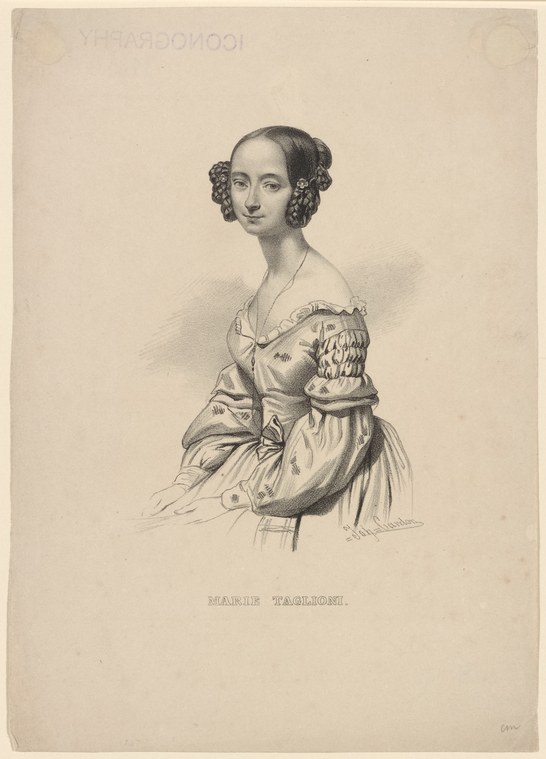
Marie Taglioni's name is inseparable from Romantic ballet and the apotheosis of the female dancer in the early 19th century. This engraving circulated widely and shaped public understanding of who she was; it is a primary document of celebrity and the commodification of the dancer's image. The portrait also illustrates the contrast between the theatrical idealization of the Romantic heroine and the reality of Taglioni as a fashionable woman of her time.
What you are looking at
A three-quarter-length portrait of a young woman, shown from the waist up, wearing a pale silk or satin dress with off-the-shoulder décolletage and short puffed sleeves gathered at the upper arm. The dress is notably simple and unadorned except for delicate fabric detail at the neckline. Her dark hair is arranged in long ringlets pinned up at the crown in the romantic style of the 1830s–40s. She turns slightly to the left, her body angled in three-quarter view, with a serene, refined expression. The background is plain and neutral, rendered with light stippling that suggests depth without distraction. The entire composition is executed as a fine engraving or steel engraving, with careful attention to the play of light across fabric and the subtle modeling of her face.
The dancing
The figure stands in a relaxed, upright posture with her weight evenly distributed. Her shoulders are held back and open, her arms rest naturally at her sides, and her head is tilted slightly, creating an elegant line from neck to shoulder. The pose is static and frontal rather than caught in motion—this is a formal portrait, not a dance image. There is no indication of active movement, partnering, or the physical effort associated with dance performance.
The dance depicted
This is not a dance image. Although the sitter is identified by the inscription as Marie Taglioni, the preeminent Romantic ballet dancer of the early 19th century, the work shows her in formal portrait dress, not in theatrical costume or during performance. It is a representation of the woman herself, not her art. The simple neoclassical dress and composed pose are consistent with 1830s–40s fashion portraiture rather than with theatrical depiction of ballet.
How it was made
This is a steel or copper engraving, identifiable by the fine parallel lines (hatching and cross-hatching) that build tone and shadow, and the characteristic linear precision of the medium. The technique allowed for the precise rendering of delicate fabrics and facial features, and enabled multiple prints to be pulled from a single plate—making this an image designed for circulation and collection. The quality of execution suggests this was a commercial portrait engraving, intended for a broad audience rather than a unique artwork.
About this work
This is a formal engraved portrait of Marie Taglioni, the legendary Romantic ballet dancer, rendered in the 1830s or 1840s. It shows her as a society figure in contemporary dress rather than as a performer. The work belongs in a gallery about dance because Taglioni was one of the most influential dancers in ballet history and the most celebrated artist of her era, but it is a portrait that happens to depict a dancer rather than a depiction of dance itself. It offers insight into how Taglioni was presented to and perceived by her public—as a refined, elegant woman of her time—rather than documentation of her performance technique or of Romantic ballet as a theatrical form.
How to look at it
Attend to the absolute stillness and formality of the pose: this is not a dancer caught in movement, but a woman sitting for a portrait. Notice the contemporary fashion—the off-the-shoulder neckline and simple silk dress—and how it differs from the elaborate theatrical costumes Taglioni wore on stage. The engraver has invested considerable skill in rendering the texture of the fabric and the softness of her hair; these details emphasize her status and refinement rather than her physicality as a performer. The inscription at the bottom serves as a label confirming identity, making this as much an artifact of fame as a work of portraiture.
The artist
The artist is not recorded. The work is a commercial engraving in the neoclassical portrait tradition, likely produced by a workshop specializing in celebrity portraiture. Such engravings were sold as prints to the public and collected in albums; they were major vectors for the dissemination of images of famous performers.
The period
Taglioni danced during the height of Romantic ballet (1830s–1840s), when the ethereal, otherworldly female dancer became the dominant figure on stage. Her most celebrated roles—particularly in La Sylphide (1832)—established the image of the ballerina en pointe as a supernatural being. Meanwhile, mass-produced portrait engravings had become a standard form of celebrity merchandise, allowing the public to own an image of a star performer. This engraving dates to that moment of Taglioni's peak fame and reflects how thoroughly she had been absorbed into the commercial and social culture of her time.
Where it lives
The work is held in the New York Public Library's collection of prints depicting dance. It is part of a broader archive of dance-related graphic material, much of it commercial portraiture from the 18th and 19th centuries.
Questions about this work
Why is a formal portrait in a collection of dance images?
Because the subject is Marie Taglioni, one of the most important figures in dance history. The image circulated widely during her lifetime and shaped public understanding of her. For historians of Romantic ballet and celebrity culture, such portraits are as important as images of performance: they show how dancers were seen, sold, and celebrated. This particular engraving is a primary document of 19th-century dance fandom.
What does this tell us about Taglioni's dancing?
The portrait tells us very little about her actual technique or performance. For that, we must turn to reviews, programs, other dancers' accounts, and the surviving choreography. What this engraving does reveal is how Taglioni was positioned in society: as an elegant, refined woman—not a virtuoso with a visible body, but an idealized feminine figure. The contrast between this quiet portrait and the otherworldly supernatural beings she danced on stage is itself revealing about Romantic-era attitudes to gender and performance.
When was this engraved?
The catalogue record does not provide a date. The fashion—the hairstyle and cut of the dress—is consistent with the 1830s or 1840s, which was Taglioni's period of greatest fame. The engraving technique and style of portraiture align with commercial practice of that era. Without additional documentation, we cannot be more precise.
More dance artwork





