49 works in this view — arrow keys or swipe to move between them.
Dance in Art
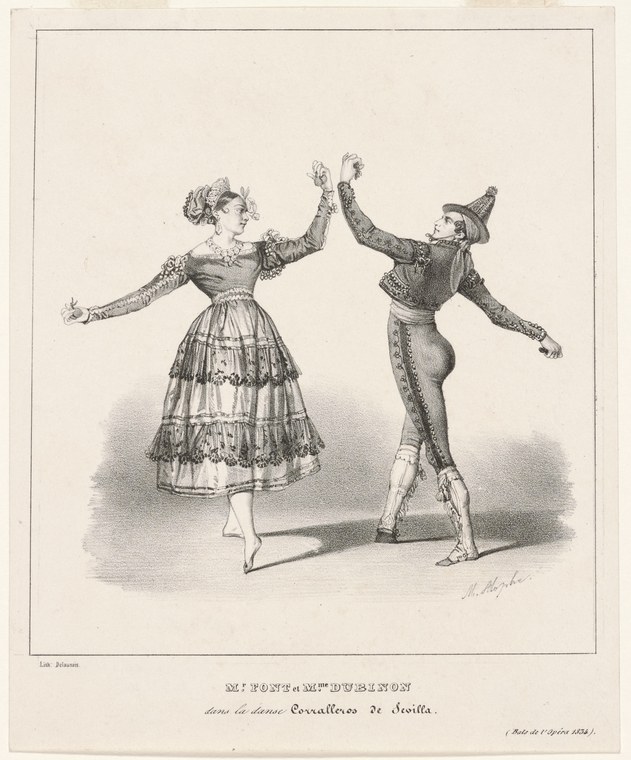
Mr. Font et Mme. Dubinon dans la danse Corralleros de Sevilla
Unknown artist
- Collection:
- Prints depicting dance
- Source:
- New York Public Library
- Rights:
- Public domain — free to use, share and adapt.
- Recorded as:
- Public Domain
This print is documentary evidence of how a Spanish regional dance was performed and circulated in the mid-nineteenth-century European theater, and of which dancers achieved enough celebrity to be immortalized in lithographic prints. For dance historians, it is a rare named record of professional performers and a visual account of the Corralleros as a theatrical dance, showing the posture, gesture, and style expected of its performers.
What you are looking at
A man and woman face each other in a moment of flirtatious interaction, their arms raised and hands nearly touching at the height of the woman's shoulders. The woman wears an elegant dress of the 1840s–50s with a fitted bodice, full skirt with horizontal pleating or gathering at the hem, and puffed sleeves; her hair is styled in the period fashion with curls piled atop her head. The man wears a short jacket, fitted trousers, and a hat; his physique is distinctly theatrical, with the exaggerated musculature and silhouette typical of mid-nineteenth-century male dancer portraiture. Both figures are caught mid-gesture, leaning slightly toward each other with bent knees and raised heels, suggesting upward spring or suspension. The composition isolates the couple against a plain background with light shadow beneath their feet, emphasizing the moment of contact and the playful dynamic between them. The style and clothing place this firmly in the mid-nineteenth century, and the title text—in French—indicates this depicts a specific Spanish dance performed by named professional dancers.
The dancing
Both dancers are shown in a lifted, rising posture with bent knees and weight distributed through the balls of their feet. The woman's arms are extended at shoulder height, elbows slightly bent, with hands reaching toward the man's raised hands; the man mirrors this arm position. Their torsos are held upright despite the knee bend, and their heads are turned toward each other in profile or three-quarter view. The spacing between them—close but not touching—and the mutual gesture of the raised hands suggest a moment of mutual approach or playful courtship rather than a formal hold. The artist has rendered the figures with anatomical clarity and a sense of dynamic tension.
The dance depicted
This print depicts the Corralleros de Sevilla (or Corraleras), a Spanish regional dance from Andalusia. The title identifies the dancers as Monsieur Font and Madame Dubinon, who were professional performers of the period. The Corralleros was a folk dance associated with courtship and social gathering, typically performed by couples in a lively, flirtatious manner. The raised-hand gesture and the posture of approach shown here are characteristic of the dance's interactive, playful nature. The dance belongs to the broader tradition of regional Spanish dances and would have been part of the popular theatrical dance repertoire of mid-nineteenth-century Paris and Europe.
How it was made
This is a lithograph, a planographic printing technique that allowed for fine tonal gradation and detail; the subtle shading visible on the figures' bodies and the careful rendering of fabric texture confirm this process. Lithography was the dominant medium for theatrical dance portraiture during the 1840s–50s, as it permitted rapid production and wide circulation of images of celebrated performers. The technique's ability to capture both the figure's anatomical precision and the mood of a moment made it ideal for marketing dancers to the urban theater-going public. The inscription at the bottom—including the title, dancers' names, and publication information—is typical of commercial theatrical prints of the period.
About this work
This is a mid-nineteenth-century lithographic print documenting a performance by two professional dancers of the Corralleros de Sevilla, a Spanish regional courtship dance. The work captures a specific moment of flirtation and mutual approach, with both dancers shown in a lifted, suspended posture that emphasizes the dance's liveliness and the performers' virtuosity. As a theatrical print, it belongs to the substantial European trade in dance imagery—portraits of celebrated performers that circulated in cities like Paris and London, allowing audiences to collect and remember favorite dancers. The print testifies both to the popularity of Spanish regional dance in the nineteenth-century theater and to the professional status of dancers like Font and Dubinon, who were famous enough to be commemorated in named, dated prints.
How to look at it
Attend to the moment chosen: not a rigid pose but a fleeting gesture of approach and mutual interest, with both dancers caught in the lift and rise that gives the dance its energy. The artist has frozen the dancers at the moment of highest suspension, emphasizing the elevation and the playful tension between them. Notice too the costume detail—the woman's dress and hairstyle place this squarely in the 1840s–50s, and the man's exaggerated musculature and sleek silhouette reflect the aesthetic of mid-century male dancer portraiture. The plain background and the light shadow beneath their feet focus attention entirely on the figures and their interaction.
The artist
The artist is not recorded in the catalogue. The print bears only a signature in the lower right that is not fully legible in reproduction. Theatrical dance prints of this period were produced by numerous printmakers, many of them now obscure; they were commercial products made rapidly and in quantity for public sale, and attribution was often secondary to the novelty and celebrity of the subject.
The period
The mid-nineteenth century saw intense European enthusiasm for Spanish and other regional folk dances, both as theatrical entertainment and as a route to the 'exotic' and 'authentic.' Spanish dances—among them bolero, fandango, and regional variants like the Corralleros—were staples of the commercial theater in Paris, London, and other major cities. This enthusiasm was part of the broader Romantic movement's interest in folk culture, national character, and the sensual and passionate qualities attributed to Spain and southern Europe. Professional dancers, often trained in classical ballet, also performed these regional dances, and successful performers of Spanish dances could achieve considerable fame and become subjects of portraiture and print culture.
Where it lives
This lithograph is held in the New York Public Library's collection of prints depicting dance. It is a commercial theatrical print, one of many such works produced for public sale and circulation in nineteenth-century Europe.
Dance in this work
Questions about this work
What is the Corralleros de Sevilla?
The Corralleros (or Corraleras) is a traditional Spanish regional dance from Andalusia, associated with courtship and social interaction. It is characterized by lively, flirtatious movement between male and female partners, with raised-hand gestures and a playful, interactive quality. In the nineteenth century, it became a popular theatrical dance performed by professional dancers in European cities.
Who were Font and Dubinon?
Monsieur Font and Madame Dubinon were professional theatrical dancers active in the mid-nineteenth century. Both performed in the commercial theaters of Europe, and their celebrity was sufficient to merit a named and dated lithographic print. Beyond this print and any references in historical theater records, little may be known about their individual careers.
Why was Spanish dance so popular in nineteenth-century theater?
Spanish dance appealed to European Romantic tastes through its association with passion, authenticity, and the exotic. Spain and southern Europe were imagined as sources of sensuality and folk authenticity, and regional dances like the Corralleros offered performers and audiences a route to these qualities. The dances were also genuinely lively and visually striking, making them effective theatrical entertainment.
What does the posture in this print tell us about how the dance was performed?
The lifted posture, bent knees, and raised heels suggest that the Corralleros involved elevation and spring—a lively, buoyant quality. The raised-hand gesture and the close approach between partners indicate the flirtation and mutual interaction at the heart of the dance. The artist has chosen the moment of highest lift and closest approach, emphasizing both the dancers' skill and the dance's spirited, interactive character.
More dance artwork





