49 works in this view — arrow keys or swipe to move between them.
Dance in Art
Valse orientale
Unknown artist
- Collection:
- Prints depicting dance
- Source:
- New York Public Library
- Rights:
- Public domain — free to use, share and adapt.
- Recorded as:
- Public Domain
This work shows how the waltz—the dominant European social dance—was repackaged as spectacle through costume and orientalist framing, revealing the period's simultaneous fascination with 'exotic' cultures and its confidence in absorbing them into European ballroom practice. For historians of dance, this is a rare visual record of the character waltz as a theatrical and social genre, a format that has largely disappeared from the ballroom repertoire but shaped 19th-century performance.
What you are looking at
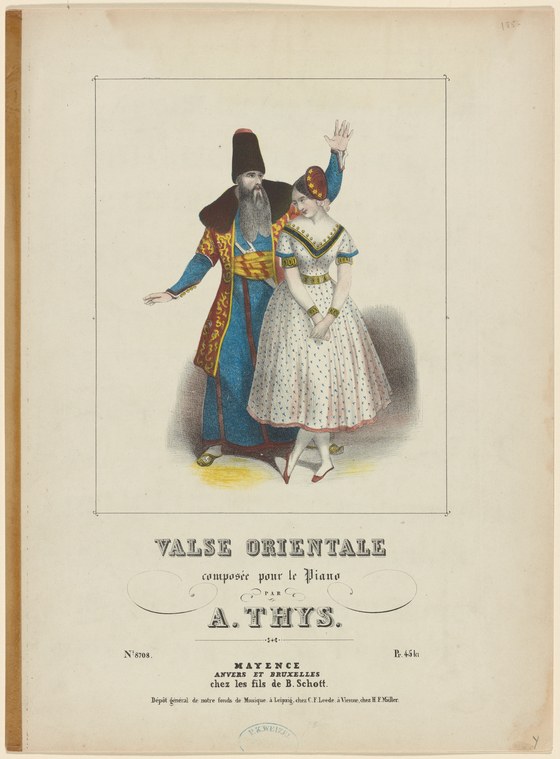
This hand-colored engraving shows two dancers in a moment of intimate interaction, positioned center-stage against a plain background with subtle shading suggesting depth. On the left stands a tall figure in elaborate Eastern European or Russian costume: a dark tall hat (a traditional cylindrical kokoshnik or similar style), a blue tunic with a richly embroidered or decorated red-gold panel running down the front, and a voluminous red-brown overcoat or caftan with gold patterning at the hem. The figure's posture is open and gestural, one arm extended in invitation. On the right, a woman in a white chemise-style dress trimmed with blue ribbon and embroidered detail stands turned toward the first figure, her right arm raised in response. Her pose is receptive and graceful, weight shifted slightly, suggesting the moment just before or during a turn. Both figures wear soft dancing shoes. The composition captures a formal yet warm moment of encounter—the valse orientale in a state of aesthetic presentation rather than energetic movement.
The dancing
The male dancer stands in an open, welcoming frame with his body angled toward his partner and one arm extended in a courtly gesture. His posture is upright and formal. The female dancer responds with a raised arm and a turned body, her torso tilted slightly back in a classical ballroom frame, her weight balanced and poised. The two figures are separated by a small space but oriented toward each other, suggesting they are either about to join or are in an elegant moment of the dance. The holds and body angles indicate a stylized, theatrical version of partner dancing rather than vigorous footwork.
The dance depicted
The title *Valse orientale* and the Eastern European costume explicitly identify this as a waltz with orientalist styling, a fusion genre popular in 19th-century European ballrooms and theatrical entertainment. The waltz was the dominant social and theatrical dance of the period, and adding 'orientale' to the title indicates a costume-driven theatrical performance rather than a concert-hall work. The raised arm of the female dancer and the open posture of the male are consistent with the waltz frame, though here the emphasis is on elegance and spectacle rather than the rotational momentum that defines the dance. This is a character waltz or theatrical interpretation rather than a demonstration of ballroom technique.
How it was made
This is a hand-colored engraving or lithograph, as indicated by the fine linear detailing visible in the figures, the composition lines at the margins, and the characteristic flattening and clarity typical of 19th-century print reproduction. The coloring—applied by hand to the printed base—shows deliberate tonal choices: the warm gold of the embroidery, the cool blue of the woman's trim, the muted background. The print medium allowed this image to circulate widely as a theatrical souvenir, promotional material, or parlor illustration, reaching audiences beyond those who could attend the live performance. The relatively small size and the format (typical of sheet music covers or album prints of the period) suggest this was a mass-produced commemorative or promotional object.
About this work
This engraving documents a theatrical waltz costume and character from the 19th century, when orientalist themes were fashionable in European ballroom and stage dance. The *Valse orientale* represents a specific genre of entertainment: the character dance or national dance, where ballroom forms (here the waltz) were dressed in exotic costume and styling to create an illusion of otherness while remaining fundamentally European in structure. The image preserves not the technique of the dance but its theatrical presentation—the moment of courtly encounter, the luxury of the costume, the formality of the frame. It is both a document of what audiences saw and an artifact of 19th-century European orientalism and its appetite for imagined Eastern exoticism performed within ballroom convention.
How to look at it
Attend to the stillness of the pose: this is not a moment captured mid-rotation or mid-turn, but rather a composed, almost statuesque presentation—a moment chosen to display costume and courtly bearing rather than technique. The woman's raised arm and the man's extended gesture are theatrical rather than functional ballroom elements; they speak to an audience beyond the dance itself. Note how the Eastern European costume of the male figure contrasts with the simplified white chemise of the female figure: she is 'domesticated' and available, he is the exotic visitor or character. This visual economy—the male marked as other, the female as neutral European—is typical of orientalist staging and worth questioning as you look.
The artist
The artist is not recorded. The engraving bears a publishing mark indicating it was issued by Mayence (Mainz) through the Schott music publishing house in Brussels, a firm active in 19th-century European music and dance print production. This suggests the work was created for commercial distribution, likely as a cover or illustration for the waltz composition itself, and that it reflects professional theatrical or ballroom practice rather than an individual artist's interpretation.
The period
The 19th century saw the waltz become the dominant ballroom dance across Europe, imported from Vienna and adapted by every nation and subculture. Simultaneously, European interest in orientalism—the aesthetic and political fantasies projected onto the East—was reaching its height in visual art, literature, and performance. Character dances and national dances were standard features of ballroom evenings and theatrical performances; dancers would perform a Spanish bolero, a Russian trepak, a Turkish or Egyptian waltz. These were rarely authentic representations but rather European inventions dressed in imagined foreign costume, satisfying the appetite for novelty and exoticism without challenging ballroom technique or social convention. The print medium and the Schott publishing house's involvement suggest this was commercial entertainment for a literate, affluent European audience with access to ballroom dancing or at least to images of it.
Where it lives
The work is held in the New York Public Library's prints collection, catalogued under 'Prints depicting dance.' It was issued by Mayence (Mainz) and published through Schott, Brussels, suggesting it was a commercial theatrical or music-publishing product intended for European distribution.
Dance in this work
Questions about this work
What is a 'valse orientale'?
A character waltz or theatrical waltz performed in orientalist costume, popular in 19th-century European ballrooms and stage performances. It was a waltz—the dominant European ballroom dance of the period—repackaged with imagined Eastern European, Russian, Turkish, or Middle Eastern costume and styling. The dance itself remained the waltz structure, but the visual presentation and named 'character' made it a novelty act within ballroom entertainment.
Who danced this, and where would you have seen it?
Professional dancers and skilled amateurs performed character waltzes at ballroom evenings, theatrical performances, and public dancing halls. This particular work was likely a commercial illustration or advertisement, issued by a music publisher and intended for audiences who either attended such performances or purchased the music for amateur performance at home.
Is the costume historically accurate?
No. The costume is an orientalist fantasy—a European invention of what Eastern European or Russian dress might look like, crafted for theatrical effect rather than ethnographic accuracy. Such costumes were common in 19th-century European entertainment and say more about European aesthetics and desires than about any actual culture.
What kind of physical skill would this have required?
The waltz itself required training in ballroom technique: controlled rotation, frame, rise and fall, and the ability to lead and follow smoothly in closed position. However, the theatrical version shown here places less emphasis on speed or technical brilliance and more on elegance, courtly bearing, and the visual impact of costume. Theatrical character waltzes often prioritized presentation over virtuosity.
More dance artwork





