49 works in this view — arrow keys or swipe to move between them.
Dance in Art
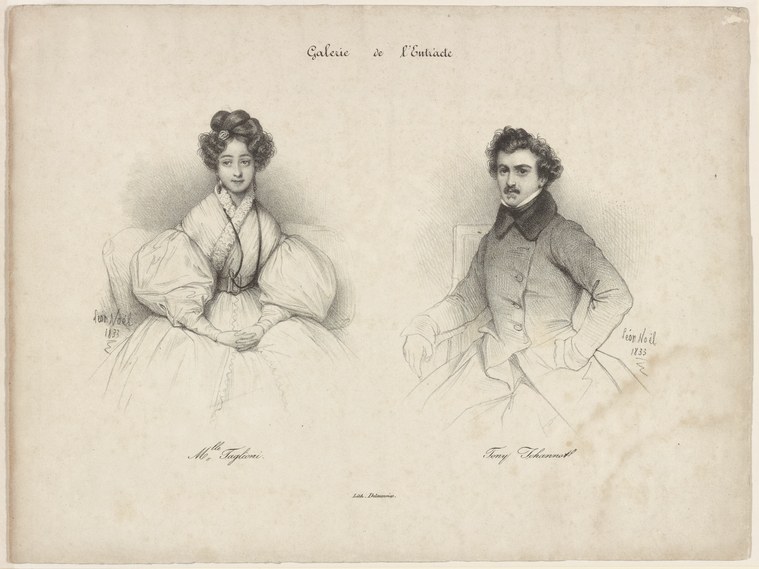
M'lle Taglioni, Tony Johannot
Unknown artist
- Collection:
- Prints depicting dance
- Source:
- New York Public Library
- Rights:
- Public domain — free to use, share and adapt.
- Recorded as:
- Public Domain
This portrait preserves the physical reality of Taglioni at the height of the Romantic ballet era—not as an idealized stage figure but as a woman of her time, and in the costume that a contemporary would have recognized as stylish and refined. It documents how Romantic dancers were publicly represented: elevated but human, elegant but not exaggerated. For dancers and historians, it shows how one of ballet's foundational figures was seen by her peers and public.
What you are looking at
Two figures occupy this portrait sheet: on the left, a woman in an elaborate white dress with voluminous sleeves characteristic of 1830s fashion, seated or reclining with an elegant, composed demeanor; on the right, a man in dark coat and collar, positioned in a contemplative pose. The woman's costume—particularly the gathered, puffed sleeves and fitted bodice—belongs to the Romantic era of the 1830s. Both figures are rendered in fine pencil or ink line work against a cream ground, with subtle shading that gives them presence and substance. The composition places them as a pair, suggesting they may be related by subject matter (performer and admirer, or two roles from a single work), though they occupy separate spaces within the frame. The title inscription identifies them as 'M'lle Taglioni' and 'Tony Johannot,' with the French heading 'Galerie de l'Etude' indicating this is part of a portrait collection.
The dancing
The woman reclines in a relaxed, almost languid pose, her weight shifted into the back of the seat, her arms loosely arranged. The man stands or sits upright, weight more alert and concentrated. Neither figure exhibits the dynamic physical extension of an active dancer; instead, both are posed for portraiture—the mode of a formal likeness rather than action. The woman's extreme shoulder and arm ease, the soft line of her neck, and the way her costume overwhelms her frame all speak to a studied elegance meant to convey refinement and theatrical presence off-stage.
The dance depicted
Marie Taglioni (1804–1884) was the most celebrated dancer of the Romantic ballet era, famous for her roles in works such as *La Sylphide* (1832). This portrait likely dates to the 1830s or early 1840s, when she was at the height of her fame. The inscription 'Tony Johannot' may refer to a companion portrait or to a male artist or admirer; without additional context, the exact relationship is unclear. The image does not depict Taglioni dancing; rather, it presents her as a public figure—a celebrity of the stage captured in the formal portrait mode of her era. The delicate, refined treatment of her person reflects how Romantic-era dancers were pictured: ethereal, composed, and separated from the physical effort of performance.
How it was made
This work is executed in fine pencil or ink line drawing with subtle tonal work, likely a lithograph or engraving. The technique allows for the sharp definition of facial features and the intricate rendering of costume detail—the lace, the fabric weight, the geometry of the sleeves. The fineness of line and the uniform cream ground suggest a commercial print process intended for circulation; this is not a one-off sketch but a reproducible image designed to be owned and displayed by admirers. The delicacy of execution reflects the print's purpose as a prestigious portrait of a celebrated performer.
About this work
This is a portrait sheet from a mid-19th-century French 'Gallery of Study' (Galerie de l'Etude), presenting two figures of the Romantic theatre era. At its center is Marie Taglioni, the most famous dancer of her time and the creator of the role of the Sylphide. She is shown not in performance but as a public persona—a celebrity of the stage in her street or salon dress. The companion figure (likely a fellow performer or cultural figure) situates this within the social and artistic networks of Romantic Paris. The work belongs to a broader culture of theatrical portraiture that served fans, rivals, and the dance world itself, documenting the human beings behind the legendary roles.
How to look at it
Notice how the artist has rendered Taglioni not in motion but in repose—a choice that speaks to the Romantic ideal of the dancer as a being of composed elegance rather than athletic display. The extreme fineness of her costume detail, the subtle tonal gradations in her face, and the way she occupies the frame all convey status and celebrity. Compare her pose and presentation to the male figure beside her; the gender difference in posture and dress reflects period conventions about how the sexes were portrayed in the theatre world. The work is a document of how Romantic ballet dancers were seen as romantic figures themselves.
The artist
The work is attributed to 'Tony Johannot' or may record him as a subject. Johannot (1803–1852) was a French artist and illustrator known for his book illustrations and romantic subjects; if he is the artist here, the work falls within his practice of depicting theatrical and literary personalities. The 'Galerie de l'Etude' (Gallery of Study) was a commercial portrait series, likely produced by a print publisher to capture images of celebrated performers and public figures. Such galleries were a standard form of celebrity portraiture in the 1830s–1840s.
The period
The 1830s and 1840s were the high Romantic period in ballet, when Marie Taglioni and works such as *La Sylphide* and *La Tarentule* redefined the art form around themes of the ethereal, the supernatural, and the transcendent. Simultaneously, lithography and fine engraving enabled the mass production of theatrical portraits, creating a new visual economy of fame. Dancers became international celebrities, and their images circulated in prints, books, and periodicals. The fashion visible in this portrait—the enormous sleeves, the refined silhouette—was current in the 1830s and signals Taglioni's status as a woman of fashion as well as a performer.
Where it lives
The work is held in the New York Public Library as part of a collection of prints depicting dance. It is part of a commercial portrait series (the 'Galerie de l'Etude') issued in the mid-19th century, designed for circulation and collection by theatre enthusiasts and cultural consumers.
Questions about this work
Is this portrait of Marie Taglioni actually Taglioni, or is it a generic 'study'?
The inscription identifies the figure as 'M'lle Taglioni,' indicating this is meant to be a specific likeness of the famous dancer. Romantic-era portrait galleries were typically drawn from life or from theatrical knowledge; they served a real fan base that knew the performers and would have recognized inaccuracy. However, the degree of likeness and whether this was taken from a sitting, a photograph, or an earlier portrait cannot be confirmed from the image alone.
Why is Taglioni not shown dancing?
Portrait galleries of the era typically presented performers in formal dress rather than in action. This conveyed social status and humanity; it also meant the portrait could circulate among fans without the limitations of costume-specific imagery. Showing Taglioni off-stage, in the refined dress she would have worn in society, positioned her as both artist and society figure.
What is the 'Galerie de l'Etude' and how common were such collections?
Portrait galleries were a major form of commercial print publishing in the 19th century, collecting images of celebrities—actors, dancers, politicians, writers—and selling them to the public. They functioned like modern fan merchandise or collectible trading cards, allowing admirers to own likenesses of their heroes. Such galleries were issued in Paris, London, and other major cities and were highly popular among theatre-goers.
More dance artwork





