49 works in this view — arrow keys or swipe to move between them.
Dance in Art
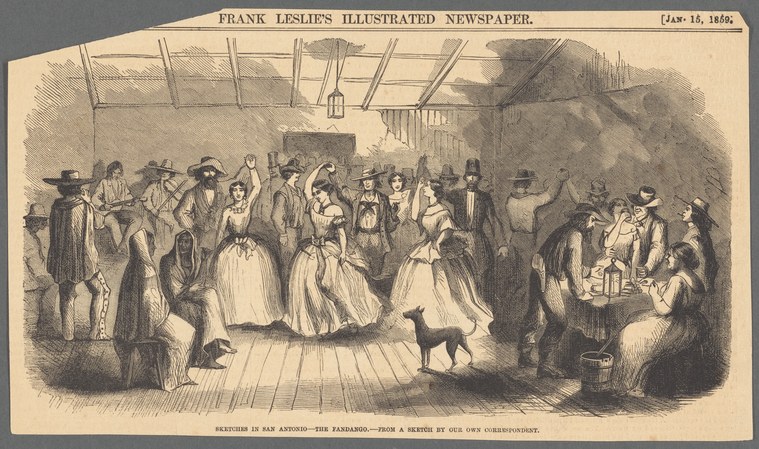
Sketches in San Antonio, the fandango
Unknown artist
- Collection:
- Prints depicting dance
- Source:
- New York Public Library
- Rights:
- Public domain — free to use, share and adapt.
- Recorded as:
- Public Domain
The fandango was central to Spanish and Spanish-American culture, and images of it in American publications mark the moment when Anglo-American audiences were encountering and documenting Mexican-American cultural practices. The image records not just the dance but its social context—the informality, the mixed-gender participation, the role of spectators—making it valuable evidence for understanding courtship, gender, and cultural contact in the nineteenth-century Southwest. For dance historians, it is among the few surviving contemporary visual records of how the fandango was actually danced in the Americas.
What you are looking at
A crowded indoor dance scene set in what appears to be a simple wooden structure or barn, with rough beams and posts visible overhead. The composition is dense with figures—men in dark suits and top hats, women in full white or light-colored dresses with wide skirts—arranged around a central dancing couple. The figures form a loose circle, creating a sense of social gathering and spectatorship. A small dark dog moves through the lower center of the scene. The lighting is soft and atmospheric, created through the engraving technique, with deeper shadows defining the wooden interior. The mood is one of lively social entertainment, with figures gesturing and watching the dancers at the heart of the composition.
The dancing
The central dancing couple occupies the visual focus: a woman in a full skirt with arms raised or extended, and a male partner. Their bodies are in motion—the woman's skirt is caught mid-movement, suggesting a spinning or rotational figure. The surrounding spectators lean inward, many with hands raised or gesturing in encouragement or participation. The poses suggest informality and social engagement rather than the rigid posture of formal ballroom dance. The male onlookers wear the standard dark dress of the period, while the women's voluminous skirts dominate the visual field.
The dance depicted
This depicts a fandango, a Spanish or Spanish-American social dance. The title specifies it is a scene from San Antonio, suggesting the Mexican-American context of the dance in the nineteenth-century American Southwest. The fandango was a couple dance with a reputation for vigor and flirtation, accompanied by music and often by hand-clapping from onlookers. The artist has captured the informality of social dancing—the spectators' active participation, the crowded interior space, and the central couple's animated motion all reflect the fandango's character as a participatory, courtship-centered dance rather than a performance piece. The composition emphasizes community engagement and the dance as a social event.
How it was made
This is a wood engraving or steel engraving, executed with fine parallel lines (hatching and cross-hatching) to create tone and form. The technique allows for detailed rendering of the crowded composition and the play of light across fabric and faces. The fineness of the line-work and the capacity to render subtlety suggest this was created for reproduction in a periodical—consistent with the header identifying it as appearing in Frank Leslie's Illustrated Newspaper, a major American illustrated weekly. The engraving technique permitted wide circulation of the image and made detailed documentary imagery economically viable for mass publication.
About this work
This engraving documents a fandango in San Antonio, Texas, as reported for Frank Leslie's Illustrated Newspaper in January 1866. It represents a moment of active social dance in the American Southwest, capturing both the movement of the central couple and the participatory culture surrounding them. The work belongs in a gallery of dance imagery because it documents an actual historical practice—the fandango as a living, community-centered dance form in a specific place and time—and does so with the particularity and social detail that engraving allowed. It is a primary source for the fandango as it was danced in the nineteenth-century American West, preserved through the medium of illustrated journalism.
How to look at it
Attend to the frozen moment: the woman's skirt is caught mid-spin, arrested by the engraver's line at a precise instant of motion. Notice how the artist has used the postures of the surrounding figures—the leaning bodies, the raised hands of the onlookers—to convey the energy and social excitement of the event. The composition is deliberately crowded, with no clear spatial recession; this is not a performance on a stage but a social gathering in a contained space. The engraver has used fine hatching to distinguish the textures of cloth, wood, and shadow, creating a sense of a specific, documented moment rather than a timeless dance. Look at the couple's relative positions and the woman's arm position to understand the character of the hold and movement in the fandango as danced here.
The artist
The work is credited to "our own correspondent," indicating it was sent to Frank Leslie's Illustrated Newspaper by an unnamed field correspondent or artist in San Antonio. Frank Leslie's Illustrated Newspaper (1855–1922) employed a network of correspondents, illustrators, and wood engravers to produce timely visual reporting from across the United States and the world. The newspaper's practice was to commission original sketches from correspondents on the scene, which would then be engraved in New York for publication. The artist's identity is lost, but their function was documentary—to capture newsworthy scenes for a mass audience.
The period
The image dates to January 1866, in the immediate aftermath of the American Civil War and during the period of Reconstruction and western expansion. The fandango had long been documented in American travel narratives and regional literature, but mid-nineteenth-century illustrated newspapers like Leslie's brought such scenes directly into American households. The dance was associated with Mexico and with the Spanish-speaking populations of the American West and Southwest—regions that were newly or recently incorporated into the United States. The image sits at the intersection of American imperialism, cultural curiosity, and the documentation of "exotic" regional practices for a national audience. In dance history, the fandango was undergoing change: it was becoming increasingly codified and performed (in Spain, it was developing as a concert and theatrical form), while in the Americas it remained primarily a social dance.
Where it lives
The work is held in the New York Public Library's collection of prints depicting dance. It comes from Frank Leslie's Illustrated Newspaper, vol. 21, no. 520 (January 15, 1866), where it appeared as a news illustration accompanying a report from San Antonio, Texas. Such periodical engravings represent a major and often overlooked archive of dance imagery from the nineteenth century.
Dance in this work
Questions about this work
What is a fandango?
The fandango is a Spanish couple dance known for its vigor, flirtation, and rhythmic complexity. In the nineteenth century, it was danced throughout Spain and the Spanish-speaking Americas as a social dance at fiestas, weddings, and community gatherings. It was typically accompanied by guitar, singing, hand-clapping, and often by castanets. The dance involves rapid footwork, turning, and an interactive dynamic between partners, with spectators often participating by clapping or singing.
Why was Frank Leslie's Illustrated Newspaper documenting dances in Texas?
Frank Leslie's was a major American illustrated weekly (1855–1922) that employed correspondents across the country to report on newsworthy scenes and curiosities. San Antonio in 1866 was a site of American interest due to its Mexican heritage, recent incorporation into the United States, and role in westward expansion. The fandango would have been of interest to Northern readers as an example of regional Spanish-American cultural practice.
How was this image made?
An artist or correspondent in San Antonio made a sketch or written description of the scene. This was sent to Frank Leslie's offices in New York, where it was handed to a professional wood or steel engraver. The engraver translated the sketch into a finely detailed engraving suitable for printing in the newspaper's pages. The engraved plate was then printed on a printing press, allowing thousands of copies to be distributed with each issue of the newspaper.
What does the image tell us about how the fandango was danced?
The central couple's position, the woman's raised or extended arms and spinning motion, and the informal, crowded setting all indicate that the fandango was danced in close, energetic contact with considerable rotational movement. The active role of spectators—their hand-raising and close attention—shows that the fandango was a participatory, social event rather than a performance to be watched passively. The informal interior setting reflects the fandango's role in everyday community life.
More dance artwork





