49 works in this view — arrow keys or swipe to move between them.
Dance in Art
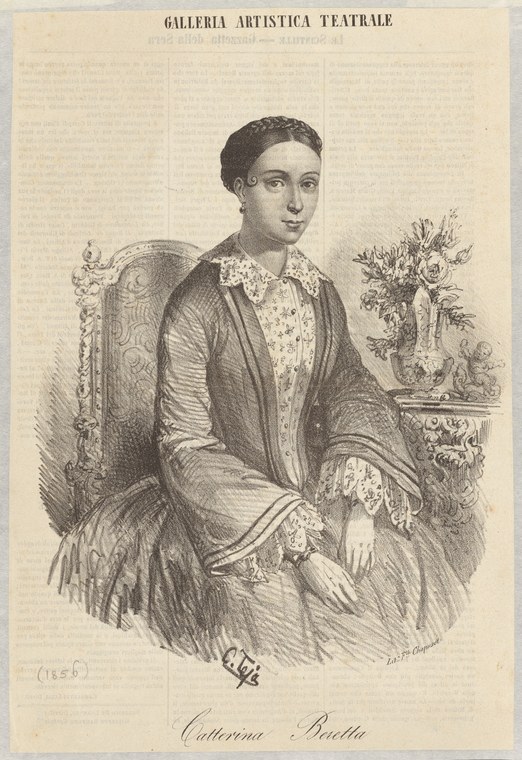
Catterina [sic] Beretta
Unknown artist
- Collection:
- Prints depicting dance
- Source:
- New York Public Library
- Rights:
- Public domain — free to use, share and adapt.
- Recorded as:
- Public Domain
This print is evidence of how professional dancers were commodified and circulated as objects of consumption in the nineteenth century, and how their public image was carefully managed to emphasize gentility and fashion rather than physical prowess or sensuality. For historians of dance, theatre, and visual culture, it demonstrates the channels through which performers built fame and shaped their public identity—not through action images but through still portraits that emphasize bearing, dress, and social status.
What you are looking at
A young woman sits in a richly appointed interior, posed as if for a social portrait. She wears a fashionable day dress of pale fabric with a patterned bodice and white lace collar, overlaid with a dark velvet or wool jacket with voluminous pagoda sleeves characteristic of 1850s fashion. Her dark hair is styled close to the head. She sits in a carved wooden chair with ornate scrollwork, her posture upright and graceful. Behind her stands an elaborate pedestal or console table bearing a vase of flowers—roses and other blooms in full arrangement. The composition is a three-quarter seated portrait, formally composed and flattering. The engraving technique renders fine detail in the drapery, especially the texture of the sleeves and the delicate patterning of the bodice. The overall tone is one of genteel elegance and theatrical refinement.
The dancing
The figure is stationary, seated with composed posture and proper carriage—the body and frame are those of a trained dancer at rest, not relaxed or casual. Her left arm rests lightly in her lap; her right arm hangs at her side. The chest is open, the head held high with the poise that comes from years of movement training. Her gaze is direct and frontal, meeting the viewer. The positioning and bearing suggest someone accustomed to being watched on stage, even in stillness.
The dance depicted
This is not an image of dance itself but of a dancer: a theatrical portrait of the nineteenth-century prima ballerina or opera dancer Catterina Beretta (the title spells her name as "Catterina"). The image documents how such performers were presented to the public off-stage—as fashionable, respectable society women of elegance and refinement. The pose and costuming are those of mid-Victorian theatrical portraiture, where a dancer's professional prestige and social status were conveyed through dress and bearing rather than through depiction of movement. The theatrical identity is confirmed by the publication context (Galleria Artistica Teatrale, visible at the top), which confirms this as a theatrical gallery print.
How it was made
This is a wood or steel engraving, likely produced for commercial distribution as a theatrical portrait print. The fine linear hatching and precise line work are typical of mid-nineteenth-century reproductive engraving, which allowed multiple impressions to be pulled and circulated to the public. Such prints were sold at theatres, in print shops, and by subscription, making them a primary means by which theatre-goers could own an image of performers they admired. The quality of the engraving—the careful rendering of fabric texture, the ornamental detail, the subtle modulation of tone—indicates this was a commercial professional work, not a casual sketch.
About this work
This is a theatrical portrait engraving of Catterina Beretta, a dancer of the mid-nineteenth century, presented in formal dress within a refined domestic interior. It belongs to the tradition of theatrical celebrity portraiture that flourished in the nineteenth century, when mass-produced engravings allowed theatre audiences to collect images of admired performers. The work documents not a moment of dance but the public persona of a professional dancer—the carefully constructed image of respectability, elegance, and fashionable modernity that was essential to a dancer's career and social standing in the Victorian era. Theatrical portrait engravings like this one reveal how dancers were marketed to the public and how the profession itself was positioned within respectable society.
How to look at it
Look at the posture and carriage: the upright spine, the open chest, the controlled placement of the limbs even in stillness. This is the bearing of someone trained in movement and aware of how the body reads to an audience. Notice how the fabrics are rendered—the engraver has lavished attention on the texture of silk, velvet, and lace, making the costume part of the performer's identity. The formal seated pose, the direct gaze, and the ornamental setting are all conventions of celebrity portraiture; they make the performer a woman of the world, not a body at work.
The artist
The artist is not recorded in the catalogue. The engraving was produced for Galleria Artistica Teatrale (Theatrical Artistic Gallery), a commercial publishing venture that produced portrait engravings of theatrical performers for sale to the theatre-going public. Such prints were typically the work of professional reproductive engravers whose names are often lost; the performer's name and celebrity mattered far more than the engraver's identity to the intended audience.
The period
This portrait dates to the mid-nineteenth century, an era when theatrical dance—particularly ballet—was becoming a respectable middle-class entertainment and when dancers themselves were climbing toward social respectability after centuries of association with disreputable performance. The fashionable dress, the refined domestic setting, and the formal portrait convention all served to present the dancer as a woman of taste and propriety, not as a body on display. This was also the height of Romantic ballet in Europe, when narrative ballet and dramatic performance were prized. The circulation of such prints was part of the mass culture of celebrity that industrial printing made possible.
Where it lives
This is a theatrical portrait print from the Galleria Artistica Teatrale, a mid-nineteenth-century commercial publishing series. The New York Public Library holds it as part of their collection of prints depicting dance. Such prints were mass-produced commodities, sold at theatres and through print dealers, and are now scattered across public collections.
Questions about this work
Is this a picture of someone dancing?
No. This is a formal portrait of a dancer at rest, not a depiction of dance itself. It shows how nineteenth-century professional dancers were presented to the public in non-performance contexts—dressed fashionably, posed with dignity and grace, and surrounded by the markers of refined taste and social respectability. The dancer's training is evident in the posture and bearing, but no movement is depicted.
Who was Catterina Beretta?
She was a professional performer of the nineteenth century, significant enough to be included in a commercial theatrical portrait gallery. Beyond what this image tells us—her fashion sense, her period, and her professional status—biographical details are not provided in the catalogue record. She belonged to the world of theatrical performance, likely as a dancer or actress, at a time when such women were becoming increasingly visible figures in public culture.
Why are Victorian dancers shown in portraits like this rather than in action?
Because the goal was to present dancers and actors as respectable members of society, not as bodies in motion. The emphasis on elegant dress, refined setting, and proper bearing was a deliberate strategy to elevate theatrical performers socially and commercially. Action images might have emphasized the physical display that made performance controversial; still portraits, by contrast, presented the performer as a person of taste and refinement.
More dance artwork





