49 works in this view — arrow keys or swipe to move between them.
Dance in Art
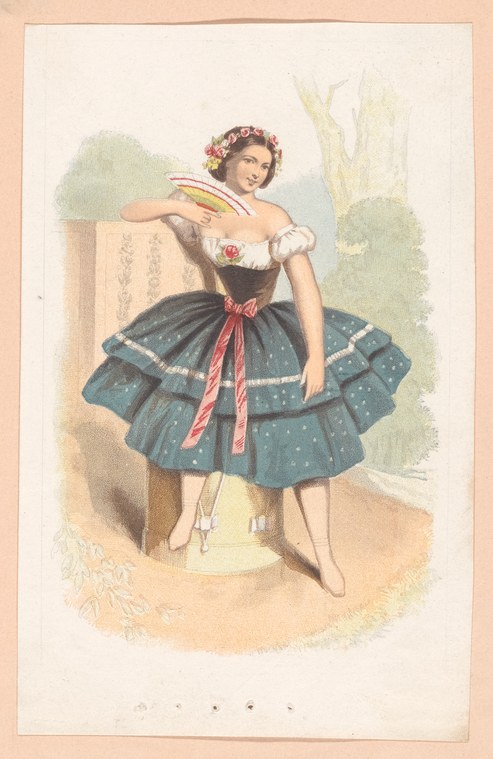
A ballerina in a folk costume
Unknown artist
- Collection:
- Prints depicting dance
- Source:
- New York Public Library
- Rights:
- Public domain — free to use, share and adapt.
- Recorded as:
- Public Domain
This print preserves evidence of how 19th-century audiences understood and consumed folk dance imagery, and how theatrical convention shaped the visual presentation of regional identities. The careful documentation of costume details—the specific construction of the pleated skirt, the floral crown, the wheat sheaf—suggests the image's use as a practical reference for dancers, costumers, and choreographers rather than as fine art.
What you are looking at
A young woman in folk costume stands in a classical pose against a softly rendered landscape background. She wears a dark blue skirt with horizontal white polka dots and deep pleats or flounces that extend from the hip, creating a voluminous silhouette. Her upper body is dressed in an off-shoulder white chemise with puffed sleeves and red trim at the neckline. A wreath of flowers crowns her dark hair, and she holds a wheat sheaf or similar harvest implement across her body at shoulder height. Her posture is upright and formal, with her weight centered and her gaze directed toward the viewer. The setting suggests a rural or pastoral context, with sketchy green foliage visible behind her. The overall composition is a three-quarter-length portrait presented within a vignette-style oval frame, typical of popular prints of the 19th century.
The dancing
The dancer stands in a frontal, static pose rather than mid-movement. Her shoulders are squared, her right arm extended to hold the wheat sheaf, and her left arm rests at her side. The silhouette is symmetrical and formally arranged, emphasizing the volume and construction of the skirt. Her expression is serene and her body tension minimal—this is a presentation of costume and character rather than a capture of active dancing. The posture suggests a dance ready to begin or a costumed figure posed for documentation rather than caught mid-performance.
The dance depicted
This appears to be a costume study for a folk or regional dance, possibly European in origin given the Central or Eastern European character of the dress and the wheat harvest motif. The specific dance cannot be identified with certainty from the static pose alone, but the costume and setting suggest regional festival or harvest dances common in 19th-century theatrical and popular representations. The presence of the wheat sheaf and floral crown indicates a harvest or agrarian theme, which was a frequent subject of Romantic-era dance and folk costume imagery. The work documents a character type—the folk maiden—rather than demonstrating actual dance technique or movement.
How it was made
This is a hand-colored lithograph or colored print, as evidenced by the soft chromatic gradations, the use of pale washes in the background, and the delicate tinting of the figure. The technique allowed mass circulation of costume designs and character studies, making them affordable for theatrical reference, popular entertainment, and amateur study. The style of coloring and composition is characteristic of mid-19th-century popular prints, particularly those produced for theatrical audiences or as costume documentation. The medium's accessibility and decorative appeal made such prints standard fare in parlors and theaters across Europe and America.
About this work
This is a costume print documenting a folk dance character type, likely from the mid-19th century. The image preserves a popular theatrical representation of European folk identity, specifically the harvest maiden or regional peasant dancer. The work sits within the substantial tradition of printed dance documentation that served theatrical, educational, and entertainment purposes during the Romantic era—a period when folk costume and rustic subjects fascinated European and American audiences. It represents not a specific historical dance but a stock character that appeared across multiple regional folk dance traditions.
How to look at it
Observe how the artist has constructed the skirt: the horizontal pleats or flounces and their geometric regularity suggest both the structure of the garment and the visual effect it would create in motion. Notice the careful attention to textile detail—the polka dots, the white bands, the red trim—which indicates this is a costume study meant to guide reproduction. The static pose is deceptive; the costume itself is designed for movement and spectacle. The vignette format and soft background place the figure in a timeless, theatrical space rather than a specific location, emphasizing the character type over documentary realism.
The period
The 19th century saw an explosion of Romantic interest in folk culture, regional identity, and peasant life, especially following the rise of nationalism across Europe. Dance, in particular, became a vehicle for expressing regional character and authentic (or imagined) national traditions. Lithography and hand-colored prints democratized access to these images, making costume studies and character portraits widely available. Theatrical producers drew heavily on such printed references to create visually convincing folk dance scenes, and popular prints of dancers and costumes circulated widely as souvenirs and educational materials. The emphasis on costume and static presentation reflects an era when visual documentation of dance was primarily costume-based rather than movement-based.
Where it lives
The work is held in the New York Public Library's collection of prints depicting dance. It is one of many such popular prints that circulated widely in the 19th century, suggesting multiple printings and broad availability rather than a rare or unique object.
Dance in this work
Questions about this work
Is this a real folk dance or a theatrical invention?
Likely both. The costume shows genuine folk elements—the harvest theme, regional styling, and construction details—but the static pose, formal presentation, and vignette framing indicate this is a theatrical character study rather than documentation of an actual performance. Popular prints often blended authentic regional costume research with theatrical convention and Romantic aesthetics.
What would this figure's dance have looked like?
That cannot be determined from the static pose. However, the voluminous pleated skirt would create dramatic visual effects in motion—the pleats would swing and catch light with turns and rotations. The upright posture and formal bearing suggest dignified, structured movement rather than wild or acrobatic dancing. Such prints were often used as costume references by dancers and choreographers who learned the actual steps through other means.
Where is this style of costume actually from?
The combination of elements—the polka dots, the style of embellishment, the floral crown—suggests Central or Eastern European origin, possibly Czech, Slovak, Hungarian, or Polish. However, 19th-century theatrical costume often mixed and romanticized regional elements, so this may represent an idealized or composite rather than historically specific regional dress.
More dance artwork





