49 works in this view — arrow keys or swipe to move between them.
Dance in Art
The dancing lesson
Unknown artist
- Collection:
- Prints depicting dance
- Source:
- New York Public Library
- Rights:
- Public domain — free to use, share and adapt.
- Recorded as:
- Public Domain
The engraving documents the cultural anxiety around dancing masters and ballroom instruction: the figure of the affected, physically exaggerated master was stock material for Victorian and earlier satire, suggesting real tension between the claims of dance instruction and its actual effects. For historians, the image is valuable evidence of how dance teaching was understood by the general public—as a subject of mockery rather than admiration—and how dance manuals and instruction were circulated and consumed.
What you are looking at
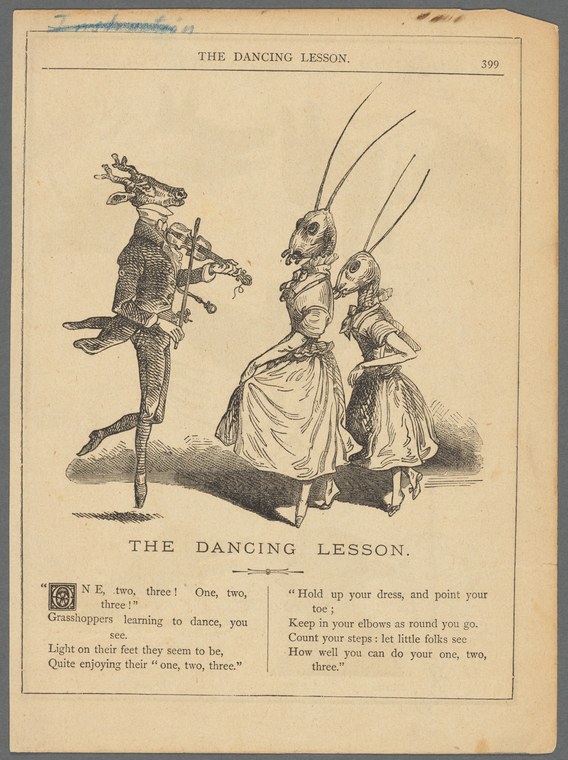
A comic engraving depicting a dancing master instructing three grasshoppers in ballroom dance. The instructor, an anthropomorphic insect in formal dress playing a violin, stands on one leg in an exaggerated pose typical of caricature. Two female grasshoppers in billowing skirts stand before him, their long antennae extended upward; a third smaller figure peers from behind. The composition is spare—set against a blank ground—and the figures occupy the lower half of the page. The scene captures a moment of pedagogical absurdity: the master's posture is impossibly twisted, one leg bent and raised, as if demonstrating an impossible step, while the pupils attend with the gravity of serious students. The engraving is accompanied by verse printed below, addressing the lesson directly.
The dancing
The master figure stands in an exaggerated, unstable attitude—one leg sharply bent and lifted, the torso twisted, suggesting both the affected mannerism of a dancing master and deliberate physical comedy. The two female grasshoppers are positioned upright and facing him, their postures formal and attentive, their skirts cut in contemporary fashion and rendered with linear hatching. The master holds a violin in one hand, violinist's posture maintained despite the contorted body. No closed holds or partner contact is shown; the instruction is demonstrational and observational rather than participatory.
The dance depicted
This is not a depiction of an actual dance style but a satirical illustration of dancing-master culture. The verse below—counting "One, two, three!"—suggests the basic pedagogical method of the era: counting out time and requiring pupils to follow the master's movements by imitation. The choice of grasshoppers as pupils is a deliberate joke about their natural jumping and hopping motion, which would be contrary to the refined, controlled carriage demanded by ballroom dance. The work mocks both the pretentiousness of dance instruction and the gap between the master's exaggerated self-presentation and the absurdity of teaching insects to dance.
How it was made
This is a wood engraving or steel engraving, identified by the fine parallel lines (hatching) used to model form and the linear precision of the composition. The technique allows for sharp detail and permits mass reproduction, suggesting this was a popular print circulated in periodicals or as a standalone broadside. The method was standard for satirical and humorous illustration in the 19th century and reaches a wide general audience rather than collectors of fine art. The printed verse below integrates image and text in the manner of comic annuals and satirical journals.
About this work
This is a satirical engraving mocking the conventions of ballroom dance instruction in the 19th century. Rather than depicting an actual dance, it uses animal caricature to ridicule the pretension of dancing masters and their students. The master's absurd posture and the incongruity of grasshoppers as pupils—insects whose physiology is the opposite of ballroom refinement—are the engine of the comedy. The work belongs in a history of dance because it reveals what contemporaries found laughable about dance pedagogy: the formality, the counting, the master's self-important display, and the willing submission of pupils to impossible ideals of grace.
How to look at it
Attend to the master's pose: the impossible angle of his body, the lifted leg, the twisted torso—deliberately rendered as neither a natural stance nor a ballroom position, but as exaggerated affectation. Compare his contorted frame with the upright, orderly posture demanded of his pupils, the female grasshoppers in their neat skirts. Notice too the violin: the master insists on musicianship and formal accompaniment as part of his authority. The choice of insects is crucial—grasshoppers' natural movement is jumping and hopping, the opposite of the controlled, grounded carriage of ballroom dance, making the entire lesson absurd. The blank ground and isolated figures focus all attention on the bodily comedy.
The period
Ballroom dance instruction was formalized and commercialized from the 18th century onward, with dancing masters occupying a recognized (if sometimes mocked) professional role. By the 19th century, the dancing master had become a stock figure in satire, often depicted as vain, physically affected, and preoccupied with trivial refinements of posture and counting. The engraving sits within a long tradition of illustrated satire targeting instructors and pretense; animal caricature was a popular vehicle for such humor. The verse accompanying the image reflects the oral, counted nature of ballroom instruction—"One, two, three!"—which remained the pedagogical standard from the Georgian period through the Victorian era.
Where it lives
The work is catalogued within the New York Public Library's collection of prints depicting dance. It is held as a single-leaf engraving, likely published independently or as part of a satirical periodical or annual of the 19th century. The collection reflects a broad interest in documenting visual representations of dance across media and genres.
Dance in this work
Questions about this work
Is this actually about how ballroom dancing was taught?
No—this is satire. The exaggerated posture and the choice of grasshoppers as students are meant to mock ballroom instruction, not document it. However, the counting ("One, two, three") does reflect the actual pedagogy of the period. The satire depends on readers recognizing the real conventions of dance teaching and finding them ridiculous.
Why grasshoppers?
Grasshoppers are creatures that naturally jump and hop—the opposite of the controlled, grounded bearing demanded by ballroom dance. The joke is that no instruction could overcome the creature's nature. It's a visual pun on the disconnect between the master's aspirations and his pupils' physical reality.
What does the verse say?
The printed text below the image includes the master's counted instruction ("One, two, three! One, two, three!") and his directions to his pupils: "Hold up your dress, and point your toe; / Keep in your elbows as round you go, / Count your steps; let little folks see / How well you can do your one, two, three." This reflects actual ballroom teaching language.
More dance artwork





