49 works in this view — arrow keys or swipe to move between them.
Dance in Art
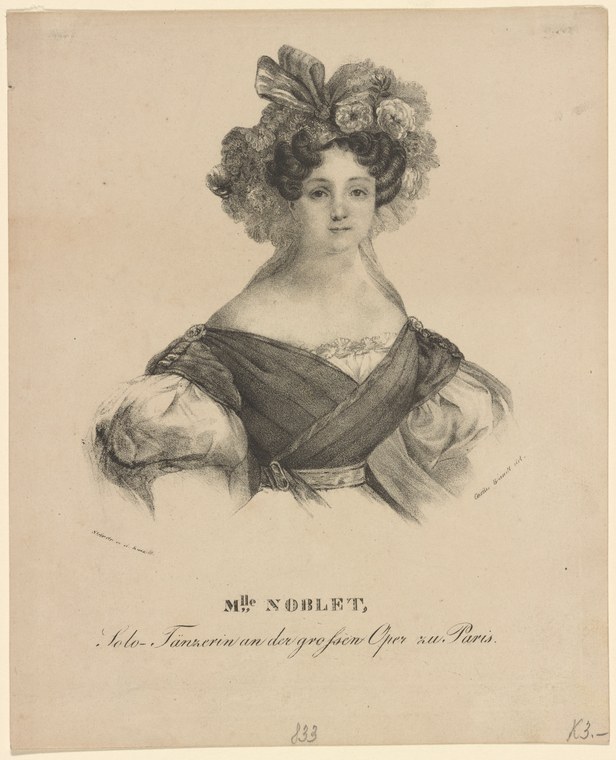
Mlle. Noblet, Solo-Tänzerin an der grossen Oper zu Paris
Unknown artist
- Collection:
- Prints depicting dance
- Source:
- New York Public Library
- Rights:
- Public domain — free to use, share and adapt.
- Recorded as:
- Public Domain
This image testifies to the fame and visibility of named female dancers during the Romantic era and to the print culture surrounding the Opéra. It shows how individual dancers—not just companies or choreographers—were subjects of public portraiture and collecting, a crucial part of how dance became a profession and dancers became celebrities.
What you are looking at
A bust-length portrait of a young woman, elegantly dressed in the fashion of the early 19th century. She faces the viewer with a composed, refined expression. Her dark hair is styled in the Regency fashion, gathered and curled at the crown with a decorative ribbon or bow threaded through it. Her bare shoulders and upper chest are exposed, while a dark draped shawl or fichu crosses her body, and the puffed sleeves of her dress are visible at the shoulders. The technique is that of a fine engraving or lithograph, rendered with delicate cross-hatching to suggest form and fabric texture. The background is plain, directing all attention to the sitter's face and upper body.
The dancing
The figure is presented as a static, frontal bust portrait—not depicting a dancer in motion but rather the likeness of a named performer. The slightly upturned gaze and calm, frontal orientation follow the portrait convention of the era. There is no indication of dance posture, weight distribution, or active movement in the body, which is shown only from the neck upward.
The dance depicted
This is not a depiction of dance itself but a portrait of a named dancer: Mlle. Noblet, identified in the inscription as a solo dancer ('Solo-Tänzerin') at the Paris Opéra. The work documents her identity and status during an era when the Opéra was the summit of European theatrical dance. It does not show her dancing, but rather serves as a record of her appearance and name, likely circulated among followers of the theatre or collected in portfolios of notable performers.
How it was made
The work is a lithographed or finely engraved portrait print, evidenced by the precise linear hatching, the tonal gradation achieved through parallel lines, and the characteristic appearance of mid-19th-century printmaking. The delicate rendering of fabric and skin, the strong detail in facial features, and the inscription in printed type all point to professional reproductive print work, probably produced in Paris. Such prints were affordable, widely circulated, and served as promotional or commemorative objects for opera-goers and dancers' admirers.
About this work
This is a portrait print of Mlle. Noblet, a professional ballerina at the Paris Opéra in the early 19th century. Rather than capturing her in performance, it presents her as a named, celebrated artist—a record of her identity and professional status rendered in the refined graphic language of Regency-era portraiture. The work belongs in a dance archive not because it shows dancing, but because it documents the person: it is evidence of how dancers were celebrated, circulated, and remembered in their own time.
How to look at it
Attend to the careful rendering of the sitter's face: the calm gaze and refined expression convey the dignity expected of a leading female dancer of her era. Notice the elegance of the drapery and the attention to the texture of fabric and hair—the print aims to capture not movement but presence, status, and beauty. The inscription below transforms the image from anonymous portrait into a celebrity record: this is a named person, a professional artist of reputation.
The artist
The artist is not recorded. The style and execution suggest a professional Parisian printmaker working in the 1820s–1840s, skilled in the reproductive print trades that supported the theatre world and its public.
The period
This portrait dates to the era of early Romantic ballet, when the Paris Opéra under the direction of Louis Véron and later choreographers was establishing itself as the centre of European dance. Dancers like Marie Taglioni and other soloists were becoming celebrated public figures, and prints of notable performers were marketed to enthusiasts. The fashion visible here—the Regency hairstyle and neoclassical drapery—anchors the work to the 1820s–1830s. During this period, lithography and fine engraving were the chief means of circulating images of performers, creating a visual record of individual dancers before photography.
Where it lives
The work is held in the New York Public Library's collection of prints depicting dance. It is part of a broader archival effort to document performers, theatrical fashion, and the visual culture of dance.
Questions about this work
Is this a portrait of a real dancer?
Yes. The inscription identifies her as Mlle. Noblet, a solo dancer at the Paris Opéra. She was a professional performer of the early 19th century, but detailed biographical information about her is sparse. The print is a contemporary record of her name and appearance.
Why is she not shown dancing?
This is a portrait print, not a scene picture. Such prints served as keepsakes and promotional objects for opera-goers who wanted a memento of a celebrated performer. The format—a bust portrait with inscription—was standard for theatrical celebrity culture of the era.
What does the inscription mean?
It reads 'Mlle. Noblet, Solo-dancer at the great Opéra in Paris' (in German). The use of German suggests this print may have been made for or circulated in a German-speaking market, though it depicts a French performer.
How common were these prints?
Lithographed and engraved portraits of theatre dancers and singers were a thriving commercial business in early 19th-century Paris and across Europe. They were affordable prints, sold singly or in series, and collected by theatre enthusiasts. They are now valuable evidence of how dancers were celebrated in their own time.
More dance artwork





