49 works in this view — arrow keys or swipe to move between them.
Dance in Art
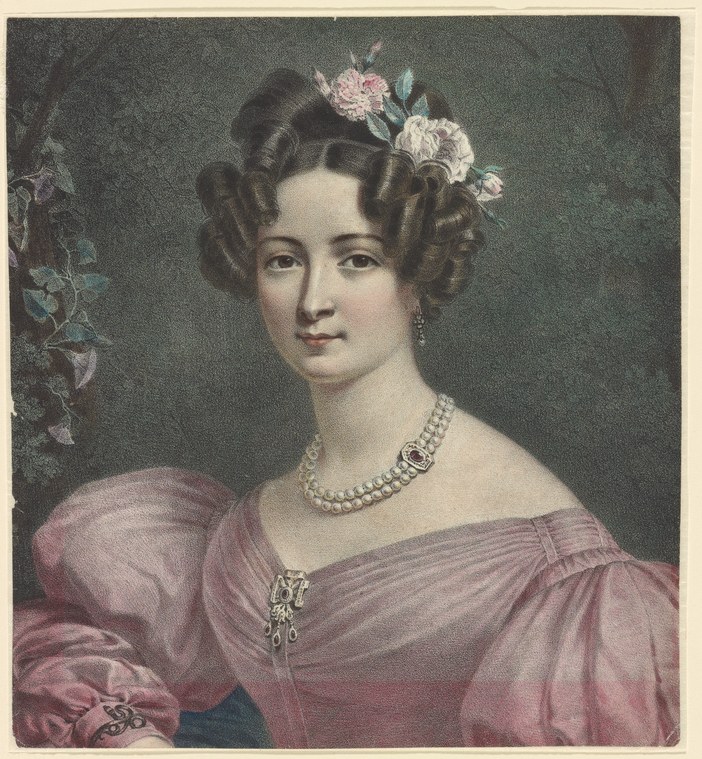
Melle. Taglioni
Unknown artist
- Collection:
- Prints depicting dance
- Source:
- New York Public Library
- Rights:
- Public domain — free to use, share and adapt.
- Recorded as:
- Public Domain
This lithograph documents how Taglioni was presented and consumed as a celebrity in her own time—not as a moving dancer but as a fashionable, elegantly dressed woman whose image could be purchased and displayed. It reveals the distinction between performance and portraiture in the Romantic era, when a dancer's cultural value extended beyond the stage into the print market and the drawing room.
What you are looking at
A young woman in a formal portrait, shown from the waist up against a dark neutral background with ivy visible on the left edge. She wears a pale pink silk off-shoulder dress with voluminous sleeves gathered at the wrists, characteristic of the 1830s–1840s. Her dark hair is dressed in long ringlets pinned on either side of her head, adorned with white flowers and pink ribbon. She wears a pearl necklace and a jeweled brooch at the center of her bodice. Her expression is calm and frontal, with a slight smile. The formal composition, luxurious fabrics, and careful attention to detail in both dress and jewels indicate a commissioned portrait of a woman of social standing. The soft, hand-colored lithograph technique gives the image a delicate, refined quality typical of fashionable portraiture of the period.
The dancing
A single seated or standing figure, presented in three-quarter profile turning toward the viewer. The pose is stationary and formal, with no active gesture or movement of the body. Her posture is upright and composed, her arms at rest. This is portraiture, not a dance image: the body shows no weight transfer, no frame, no footwork, and no positioning that would indicate any dance technique or moment of movement.
The dance depicted
This is not a dance image. It is a portrait of a woman, possibly the dancer Marie Taglioni based on the catalogue title, but the work itself depicts no dancing, no choreography, no movement, and no context of performance. The subject is posed static and formal in contemporary dress. While Taglioni was one of the most celebrated ballet dancers of the Romantic era, this portrait captures her as a fashionable young woman off stage, not as a dancer or in any dance-related moment.
How it was made
This appears to be a hand-colored lithograph, a medium that allowed rapid, affordable reproduction of fashionable portraiture for middle-class and wealthy audiences in the early 19th century. The soft tones, delicate handling of fabrics, and careful blending of colors are typical of the lithographic process with hand tinting. This technique enabled the creation of multiple prints from a single stone, making such portraits accessible to a wider audience than oil paintings and supporting a brisk market in celebrity likenesses of performers, aristocrats, and society figures.
About this work
This is a fashionable portrait lithograph from the second quarter of the 19th century, titled as depicting the dancer Marie Taglioni. It shows a young woman in silk and jewels, her hair dressed in the ringlet style of the 1830s–1840s, presented in the formal conventions of romantic-era portraiture. Though the subject's name invokes one of ballet's greatest figures, the work itself is not a dance image: it is a portrait of a celebrity off stage, capturing not her art but her social and material status. The image belongs in a dance archive not because it depicts dancing, but because it is part of the visual culture surrounding a major historical figure in ballet.
How to look at it
Attend to the dress itself: the pale pink silk and voluminous sleeves represent contemporary fashion, not stage costume or dancewear. The careful arrangement of flowers in the hair and the formal jewelry signal that this is a portrait for public consumption, made to circulate as a print. Notice the pose—frontal, stationary, designed for a still image—which is the opposite of the fluid, turned-out, buoyant deportment that would characterize a Romantic ballet image. The ivy on the left edge is a traditional portrait convention suggesting nature and taste, not context for the figure.
The artist
The artist is not recorded. The work is part of a broader 19th-century industry of lithographed celebrity portraiture produced rapidly and in series by workshops across Europe. Such prints were typically unsigned or attributed only to the publishing house, and many artists whose names would appear on the stone have been lost to attribution.
The period
This portrait belongs to the height of the Romantic ballet era (c. 1830–1850), when dancers like Taglioni achieved unprecedented celebrity status. Lithography had recently made portraiture affordable and reproducible, creating a new market for images of performers that made them visible to audiences far beyond those who could see them dance. This democratization of the celebrity image coincided with the cult of the Romantic prima ballerina—a figure of idealized beauty and grace presented through both performance and print culture. The elaborate dress and jewels in this portrait signal wealth and refinement; they also advertise the economic and social rewards of a successful stage career.
Where it lives
This work is held in the New York Public Library's collection of prints depicting dance. It is catalogued as a lithograph but neither artist, publisher, date, nor other identifying marks are recorded in the catalogue.
Questions about this work
Is this actually Marie Taglioni?
The catalogue title identifies it as 'Melle. Taglioni,' but without a signature, publisher mark, or date in the image itself, we cannot confirm attribution. The work could be one of many celebrity portraits of Taglioni published during her fame (c. 1830–1850), or it could be misidentified. It represents how the dancer was packaged and sold as a fashionable image, whether or not the portrait was made from life.
Why is this in a dance collection if there's no dancing?
This image is part of the visual and material culture of dance history. Lithographed portraits of dancers were how audiences who could not afford to buy a ballet ticket saw and possessed images of their favorite performers. As such, they are primary evidence for how dancers were marketed, idealized, and consumed as celebrities in their own time.
What does the pink dress tell us?
The pale pink silk and elaborate style are fashionable dress of the 1830s–1840s, not stage costume. They signal wealth, refinement, and contemporary style—qualities that enhanced Taglioni's prestige off the stage. Ballet costumes of the Romantic era were much lighter and more transparent, designed for movement; this dress emphasizes elegance and social status instead.
More dance artwork





