49 works in this view — arrow keys or swipe to move between them.
Dance in Art
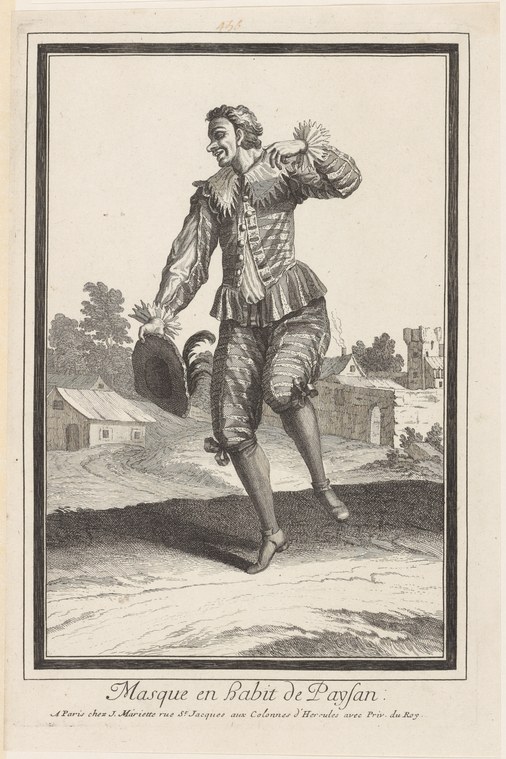
Masque en habit de paysan
Unknown artist
- Collection:
- Prints depicting dance
- Source:
- New York Public Library
- Rights:
- Public domain — free to use, share and adapt.
- Recorded as:
- Public Domain
This engraving documents peasant and carnival dance at a moment when printed imagery was beginning to systematically record performance practices that would otherwise leave no trace. It shows dance as lived and celebrated in villages and festival spaces, not in courts or theatres—a perspective rarely preserved. The energy and clarity of the image convey how 17th-century printmakers understood and valued the spectacle of popular movement.
What you are looking at
A single male figure dominates the composition, caught mid-leap in an exuberant pose of theatrical comedy. He wears the costume of a peasant or rustic character—a quilted or patterned jacket with voluminous sleeves, knee breeches, and stockings—typical of 17th-century commedia dell'arte or festival dress. His left leg is extended high behind him in an explosive jump; his torso twists and his arms spread wide in an attitude of comic delight or triumph. His face, rendered with clear expression, shows a broad grin. The background is a rural village scene with modest buildings, trees, and fields, establishing a countryside setting. The engraver has used fine cross-hatching and line work to suggest volume and movement, with darker shadows beneath the figure to anchor him in space. The entire composition is framed by a double border, common to printed works of the 17th century.
The dancing
A single dancer, airborne in a high, exuberant jump with one leg extended behind and arms spread wide. The torso is rotated, creating a twisted, dynamic silhouette. The weight is momentarily suspended; the landing foot (right) is planted but the left leg, raised high and back, and the lifted arm position suggest the peak moment of the leap. The posture is one of uninhibited joy and comic license, with no formal balletic frame or hold—instead a full-bodied expression of revelry.
The dance depicted
The costume, setting, and title suggest a peasant dance or rustic festival entertainment, likely a commedia dell'arte figure or carnival character. The masque or theatrical mask is hinted at in the exaggerated facial expression and the deliberate comic excess of the pose. This appears to be vernacular festive dance—a moment of joyous abandon rather than courtly or formal movement. The high, energetic jump and the twisting torso are consistent with folk celebration and village entertainment rather than any codified theatrical system. The image captures the spirit of early modern carnival or festival dance as performed by itinerant players and village entertainers.
How it was made
This is an engraving, executed with fine cross-hatching and precise line work to model form and suggest movement. The technique allowed for clear, reproducible imagery suited to circulation as a print in portfolios, collections, or broadsheets. The double border and French inscription below suggest it was a finished print intended for sale or distribution among collectors and scholars of contemporary manners and costume. Engraving was the standard reproductive medium for disseminating images of performance, dance, and costume across Europe in the 17th century, making such works widely accessible compared to drawings or paintings.
About this work
This is a 17th-century engraving depicting a moment of exuberant, comic peasant or carnival dance. The figure's explosive leap, twisted torso, and joyful facial expression capture the spirit of vernacular festival entertainment—precisely the kind of moment that artists and print-makers sought to record and circulate as both documentation of manners and as entertaining imagery in its own right. The work belongs to a rich tradition of printed images capturing commedia dell'arte, carnival, and popular festival customs in early modern Europe. It records not a codified dance form but a moment of spontaneous, ecstatic movement performed in the context of rural or carnival entertainment.
How to look at it
Attend to the moment the artist has frozen: the apex of the jump, where the figure is neither rising nor falling but suspended, arms spread, body twisted, face alight with comic glee. This is not a position held in a dance step but rather an instant of uninhibited release—precisely the kind of virtuosic, expressive moment that attracted engravers and audiences to popular performance. Note how the cross-hatching and line work create the impression of rapid, energetic motion even within the stillness of the print. The costume and setting ground the figure in a specific social and geographic context, marking this as peasant or village entertainment, not courtly dance.
The artist
The artist is not recorded in the catalogue. The style and technique are consistent with 17th-century French or Flemish engraving, and the French title and inscription suggest publication in France. Without signature or attribution, the work belongs to the vast corpus of anonymous popular prints and dance costume studies that circulated widely in this period, often produced by workshops rather than individually credited artists.
The period
In the 17th century, dance was undergoing significant codification and courtification in France and Italy, yet popular festival and carnival traditions remained vigorous and were increasingly documented in printed form. Dance prints served multiple purposes: they recorded exotic and rustic customs for educated collectors; they provided costume and pose references for painters and sculptors; and they functioned as entertainment in themselves, bringing scenes of festival and performance into domestic spaces. The masque tradition—blending music, dance, and theatrical costume—was flourishing across Europe, and commedia dell'arte troupes were traveling extensively, inspiring printmakers to capture the characters, costumes, and exuberant movement of these performers.
Where it lives
The work is part of the New York Public Library's collection of prints depicting dance, a collection that spans centuries and genres and serves as a primary resource for visual documentation of performance history. Such dance prints were often gathered into albums or portfolios by collectors interested in costume, manners, and performance, and this cataloguing reflects that scholarly tradition.
Dance in this work
Questions about this work
Is this a real dance step or just a funny pose?
It is likely both. The exuberant leap and twisted torso reflect real movement vocabulary of peasant dance and carnival performance, but frozen here in a moment of comic climax—the kind of uninhibited, expressive gesture that separates popular festival dance from the controlled, formalized steps of courtly dances. The artist has captured a recognizable performance moment rather than a technical instruction.
What does 'masque en habit de paysan' mean?
'Masque' refers to a masked character or theatrical performer; 'en habit de paysan' means 'in peasant dress.' The title indicates this is a character figure—likely a commedia dell'arte type or carnival performer—depicted in rustic costume. It is not necessarily a depiction of an actual mask, but rather of a theatrical or festive persona.
Why was this printed and distributed?
Dance and costume prints served multiple audiences: scholars and collectors of manners; painters and sculptors seeking pose and costume references; and the general public, who enjoyed seeing scenes of festival, performance, and exotic or rustic customs. Such prints were affordable, circulated widely, and brought the excitement of performance into homes and studios.
More dance artwork





