49 works in this view — arrow keys or swipe to move between them.
Dance in Art
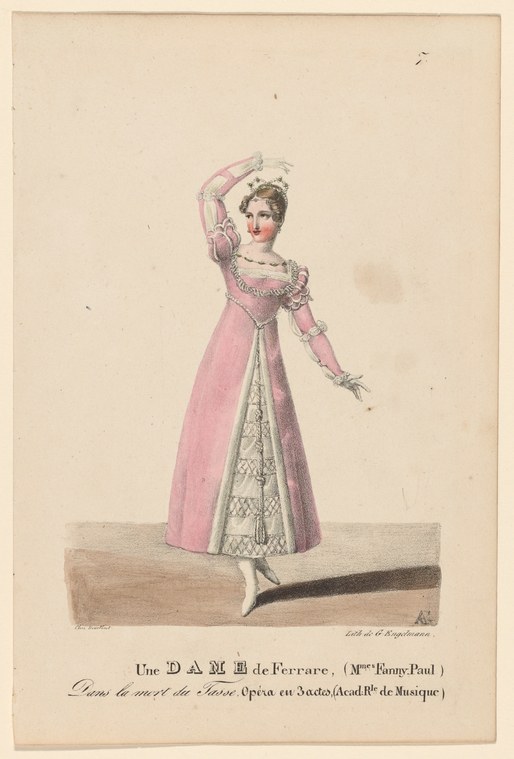
Une dame de Ferrare (Mmes. Fanny, Paul) dans La mort du Tasse, opéra en 3 actes
Unknown artist
- Collection:
- Prints depicting dance
- Source:
- New York Public Library
- Rights:
- Public domain — free to use, share and adapt.
- Recorded as:
- Public Domain
It shows the formal, restrained body language of early 19th-century Italian opera seria—a period and tradition often invisible in ballet-focused dance histories. The image preserves evidence of how professional performers on the operatic stage were trained to move, gesture, and present themselves, revealing the embodied conventions of a major theatrical tradition that intersected with and influenced the emergence of Romantic ballet.
What you are looking at
A woman in early 19th-century dress stands alone against a neutral background, posed in a moment of theatrical gesture. She wears a high-waisted gown in pink with white lace or patterned fabric visible at the hem and bodice, long sleeves gathered at the wrists, and a fashionably arranged bonnet or headpiece adorned with feathers or ribbons. Her right arm is raised gracefully, bent at the elbow with hand near her head in a pose of refined emotion—surprise, concern, or theatrical distress. Her left arm hangs at her side, the hand gesturing outward. She stands with her weight centered, looking toward the viewer with an expression of gentle intensity. The figure is rendered in hand-colored engraving, with careful attention to the fall of fabric and the delicate complexion typical of theatrical portraiture.
The dancing
The dancer stands in an upright, balletic frame with no visible turnout or academic ballet positioning. Her raised arm follows the line of theatrical acting convention rather than dance technique—the elbow is bent, the hand near the face in a gesture of emotion or address. The pose is stationary and portraiture-like rather than caught mid-movement. Her posture is refined and decorous, consistent with early 19th-century operatic or dramatic stage presence rather than virtuosic dance mechanics.
The dance depicted
This is not a dance in the modern sense, but rather a portrait of an opera singer or actress in a dramatic role. The title credits this as a performance in *La morte di Tasso* (The Death of Tasso), a three-act opera that premiered in 1817, likely this is from an early revival. The figure is posed in the dignified, emotionally expressive mode of opera seria, the formal Italian opera tradition. The raised arm and focused expression are conventions of dramatic declamation on the operatic stage, not dance steps. Early 19th-century opera involved stylized movement and formal gesture, but this is portraiture of operatic performance rather than a depiction of choreographed dance.
How it was made
This is a hand-colored engraving, a reproductive print technique widely used in the early 19th century for theatrical portraiture and fashion illustration. The fine linework of the engraving is visible in the dress detail and background, while watercolor or hand-applied color gives the figure immediacy and individuality. Engravings of this type circulated widely and inexpensively, making them the principal means by which audiences encountered images of celebrated performers. The technique allowed the portrait to reach a broad public and to be sold as souvenirs of famous performances.
About this work
This is a hand-colored engraving documenting a performance in *La morte di Tasso*, an early 19th-century Italian opera, executed in the theatrical portraiture tradition. It captures a moment of operatic stage presence—the refined gesture and emotional address of a soprano or mezzo in a dramatic role. The image belongs in a dance collection not because the work depicts choreography, but because it records the formal movement vocabulary and aesthetic conventions of the operatic stage, a primary context for dance and dancing bodies in the early 19th century. Opera and dance were inseparable practices in this period; operatic roles required trained movement and gesture, and many operatic performances included danced divertissements or corps de ballet. This portrait documents the aesthetic codes that governed theatrical movement before the Romantic ballet's emergence.
How to look at it
Notice the raised arm and its relationship to the body—it is not an extension of the torso in the way a ballet arm line would be, but rather a discrete gesture, bent and purposeful, communicating emotion to the audience. The face is as important as the body; the gaze and expression carry as much meaning as the pose. The hem of the gown reveals a glimpse of the ankle and foot, which stands flat and planted rather than on a pointed position. This is the vocabulary of operatic acting, where the body serves drama and character rather than abstract movement.
The artist
The artist is not recorded in the catalogue. The engraving is signed with a maker's mark at lower right that is not legible in reproduction. Hand-colored theatrical engravings of this period were produced in workshops across Europe—Italy, France, and Germany—and often circulated across borders. They were typically created by specialized theatrical portraitists working from live performance or costume studies, then hand-colored by a separate team. The work is representative of a vast commercial print industry built around celebrity performers and operatic tourism.
The period
This engraving dates to the early 19th century, a moment of radical change in European operatic and dance practice. Italian opera seria was giving way to Romantic opera and the emergence of the prima ballerina as a major star. The formal, courtly conventions of movement visible in this portrait—the controlled arm, the upright frame, the emphasis on the face and emotional expression—would soon be challenged by the ethereal, weightless aesthetic of Romantic ballet. Yet for a decade or more after 1820, opera and ballet remained intertwined on the same stages, and performers often crossed between both forms. This image captures operatic gesture on the eve of the Romantic transformation.
Where it lives
This is held in the New York Public Library's Prints collection, which acquired theatrical ephemera of this period in bulk. Hand-colored engravings such as this were sold at theaters, in print shops, and by street vendors as souvenirs and collectibles. They served much the function that playbills and photographs would later occupy.
Questions about this work
Is this a dancer?
This is an opera singer or actress portrayed in a dramatic role. She is not depicted performing dance steps, but rather in a pose of theatrical gesture and emotional address. The training of operatic performers included formal movement and deportment, and many operatic performances included dances or dancing corps members, so the boundary between opera and dance in this period was fluid. But this specific portrait documents operatic, not choreographed, performance.
What is La morte di Tasso?
A three-act Italian opera (The Death of Tasso) that premiered in 1817, with music by various composers. It was based on the life of Torquato Tasso, the 16th-century poet, and was popular in Italian and European theaters in the early 19th century. The opera seria tradition to which it belongs emphasized vocal virtuosity, formal gesture, and declamation over dance.
Why does the record say 'dame de Ferrare'?
Ferrara was Tasso's birthplace and a setting in the opera. 'Dame de Ferrare' indicates the character or role being portrayed rather than the performer's real identity. The names in parentheses—'Mmes. Fanny, Paul'—are the performers' names, but without more research it is not possible to connect them definitively to a specific production or revival.
What does the style of dress tell us?
The high-waisted gown, empire silhouette, and bonnet with feathers or ribbons are consistent with fashionable dress of c. 1815–1830. This may represent both the character's costume in the opera and the fashionable dress of the period, as opera costumes often reflected contemporary styles while suggesting historical or exotic settings through ornament and color.
More dance artwork





