49 works in this view — arrow keys or swipe to move between them.
Dance in Art
Le royaume des fees: quadrille
Unknown artist
- Collection:
- Prints depicting dance
- Source:
- New York Public Library
- Rights:
- Public domain — free to use, share and adapt.
- Recorded as:
- Public Domain
This work documents both the quadrille itself—the most important social dance of its era—and the machinery of its circulation: how it was notated, marketed, and consumed through commercial music publishing. For historians of dance and society, it is primary evidence of ballroom culture, gender roles in dance, and the relationship between theatrical spectacle and social practice. The image also reveals how the quadrille remained a living, evolving form, constantly reimagined through literary and narrative frames rather than a static historical artifact.
What you are looking at
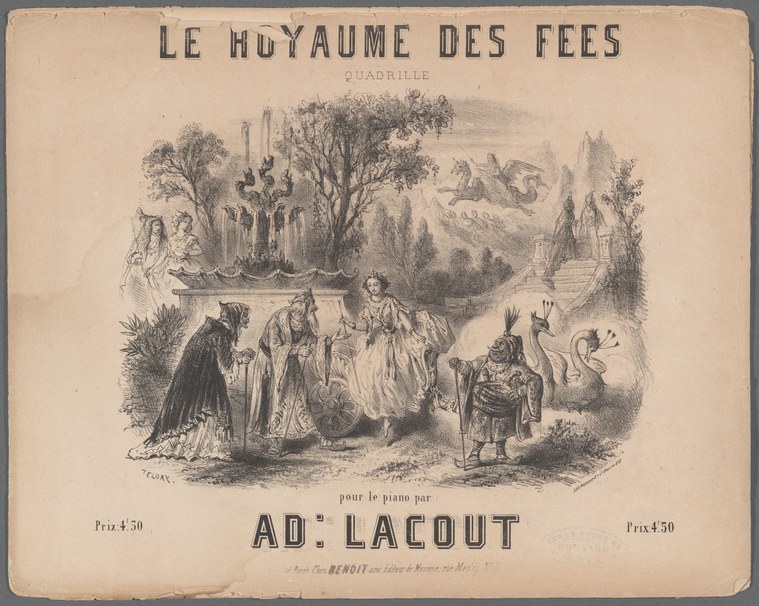
This is a richly detailed engraving depicting a fairy-tale scene titled *Le royaume des fées* (The Kingdom of the Fairies), with a quadrille danced as its central action. The composition is divided between foreground and background. In the foreground, four figures in elegant dress execute the formal steps of the quadrille—two women in long gowns with full skirts and two men in period costume. They stand in the characteristic squared formation of the dance. To the left, an older woman in a dark cape observes or directs the dancers; to the right, a small figure (possibly a child or magical creature) gestures with raised arms. The background dissolves into an atmospheric landscape of trees, architectural ruins with tall columns, and a castle or palace, rendered in soft engraved lines that suggest an enchanted realm. The entire scene is bathed in the tonal wash typical of mid-19th-century commercial prints, with careful cross-hatching creating depth and shadow. The title and artist credit appear at the bottom, along with the price (4.50 francs), marking this as a published print for the sheet-music market.
The dancing
The four dancers in the center maintain the formal closed holds and geometric spacing of quadrille formation. The nearest couple stands with the woman's full skirt occupying significant visual space, rendered in fine parallel lines. The dancers' posture is upright and restrained, typical of the period—no exaggerated movement or dramatic extension, but a sense of controlled elegance. The limbs are relatively straight, the frame compact and proper. The old woman on the left leans toward the dancers with a gesture suggesting authority or magical involvement. The small figure on the right raises both arms in a pose that reads as either celebration or supernatural direction, breaking the strict geometry of the dance formation.
The dance depicted
This depicts the quadrille, a highly formal social dance that dominated European ballrooms from the early 19th century through the Belle Époque. The quadrille was typically performed by four couples arranged in a square, executing a set sequence of figures with military precision and strict etiquette. The imagery shows the characteristic frame of the dance—couples facing each other or in promenade position, the women in full skirts that swept the floor and the men in formal dress coat or military uniform. The theatrical and fairy-tale framing—the castle, the magical observers—suggests this is a published piano reduction for quadrilles composed on literary themes, a popular commercial format of the period. The dancers are positioned in a moment of spatial transition between figures, captured in the middle distance of a scene rather than close-up, emphasizing the geometric and social order of the ballroom form.
How it was made
This is a wood engraving or steel engraving, evident from the fine parallel lines (hatching), the precise definition of form, and the overall reproductive clarity typical of mid-19th-century music-cover production. The artist has used tonal engraving to create atmospheric effects—the background figures and landscape fade into softer stippling and cross-hatching, while the foreground dancers are rendered in crisper, more defined lines. The technique allowed for mass production and wide circulation; this was a commercial product, affordable and consumed by the amateur music-making middle class. The title, composer credit (AD. LACOUT), and price printed directly on the plate confirm this is a published sheet-music cover, designed to be seen and handled by piano students and ballroom musicians. The engraving technique also lent itself to the romantic and narrative content here—the ability to render fine atmospheric detail made it ideal for decorative theatrical scenes.
About this work
This is a mid-19th-century engraved cover for a published piano-music arrangement of quadrille dances, composed by Adolphe Lacout. The quadrille was the dominant social ballroom dance of the era, and such published arrangements were a commercial staple, often wrapped in theatrical or literary narrative. The print shows the dance itself embedded in a fairy-tale setting, suggesting that this was a quadrille on a romantic or fantastical theme—a common marketing strategy to appeal to sentimental music consumers. The engraving preserves not only the formal choreography of the quadrille but also the conventions of mid-century music publishing, the gender presentation of ballroom dancers, and the cultural fantasy that surrounded social dancing among the European middle class.
How to look at it
Attend first to the dancers' frame and spacing—the quadrille's rigid geometry was as much a social statement as a choreographic fact, and the print captures that formal, almost architectural arrangement. Notice how the engraver has rendered the women's skirts in particular detail, using fine parallel lines to suggest both the volume of fabric and the movement implied in the dance. The background figures and ruins are rendered much more loosely, in softer tones, directing your eye back to the couple in the foreground. The theatrical frame—the castle, the magical figures—is typical of how 19th-century commercial music was sold: the dance itself was respectable and familiar, but the narrative packaging made it feel special and worth purchasing. The placement of the price at the bottom reminds us this was an object of consumption, not an autonomous artwork.
The artist
The composer Adolphe Lacout is not well documented in major reference works, but the presence of his name on the cover and the price in francs suggest he was a working musician of the French or Francophone commercial music world of the mid-19th century. His output appears to have been in the prolific genre of quadrille and dance music for piano, a category that produced hundreds of anonymous and semi-anonymous composers. The engraver is not attributed on this cover.
The period
The quadrille reached its peak popularity between 1840 and 1880, during the Second Empire and early Third Republic in France. It was danced in ballrooms across Europe and America, marking the height of formal social-dance etiquette. The mid-19th century saw an explosion of commercial music publishing, particularly for dance forms and theater music; publishers competed by offering novelty arrangements and narrative frames—quadrilles on themes from popular operas, novels, or fairy tales. This coincided with the growth of middle-class domestic music-making and the professionalization of the piano as an instrument of courtship and social display. The fairy-tale framing here reflects the broader Romantic cultural moment and the contemporary appetite for narrative and spectacle in all forms of entertainment.
Where it lives
This print is held in the New York Public Library's collection of prints depicting dance, part of the institutional effort to document the visual culture of movement. The print is a published commercial object, a piano-music cover for amateur and professional use, rather than a unique work of fine art. Its survival in a specialized dance collection reflects 20th-century curatorial interest in recovering the visual and material history of social dance.
Dance in this work
Questions about this work
What is a quadrille and why was it so popular?
The quadrille was a formal ballroom dance for four couples arranged in a square, performed to a fixed sequence of figures. It dominated European and American ballrooms from roughly 1830 to 1900, particularly among the middle and upper classes. It required no romantic contact between partners and emphasized precision, geometry, and social order—qualities that made it ideal for mixed-gender formal society. It was learned through instruction and performed at balls, assemblies, and private dances.
Who danced quadrilles and when?
Quadrilles were danced by educated, socially aspiring people of the middle and upper classes: merchants, professionals, minor nobility, wealthy merchants' daughters, officers. They were taught at dancing schools and performed at formal balls, charity events, and private parties. The dance was most prevalent from 1840 to 1880, though it persisted into the early 20th century among conservative circles.
What does the fairy-tale setting have to do with the dance itself?
Narrative frames were a marketing strategy for sheet music. A plain 'Quadrille No. 5' sold for 4 francs; a 'Quadrille from the Kingdom of the Fairies' was more appealing to amateur musicians and gift-buyers. The fantasy setting had no bearing on the actual choreography, which followed strict rules. It was pure packaging, designed to sell music to people who wanted both social utility and romantic sentiment.
How do you know this is a quadrille and not another dance?
The title explicitly states 'quadrille.' The composition also shows the characteristic four-couple formation and the formal, geometric spacing typical of the dance. The dress—women in full-skirted gowns, men in formal coat and trousers—and the ballroom setting are consistent with mid-19th-century quadrille culture, not Baroque dance or contemporary social forms.
More dance artwork





