49 works in this view — arrow keys or swipe to move between them.
Dance in Art
August Bournonville
Unknown artist
- Collection:
- Prints depicting dance
- Source:
- New York Public Library
- Rights:
- Public domain — free to use, share and adapt.
- Recorded as:
- Public Domain
Bournonville's codified method and aesthetic—characterized by quick footwork, épaulement, and a particular narrative and musical sensibility—shaped an entire national dance tradition and influenced ballet across Europe. A portrait of him serves as a document of how nineteenth-century dance culture preserved the memory of its makers, and as a visual anchor for understanding the person whose artistic choices continue to determine how dancers move.
What you are looking at
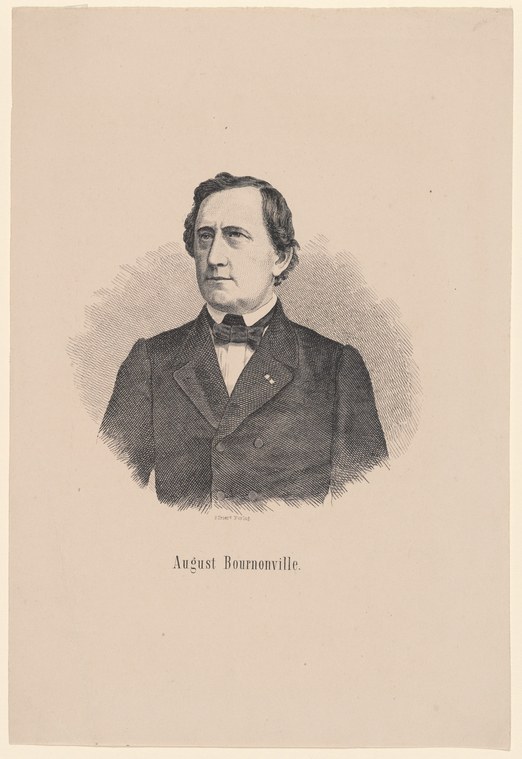
This is a portrait engraving of a single male figure, shown from the shoulders up against a plain beige background. The man is rendered in three-quarter view facing slightly left, with dark hair parted and swept back, and sharp, defined facial features. He wears formal nineteenth-century dress: a dark jacket with a notched lapel, a white shirt front, and a black bow tie. A small pin or badge is visible on the jacket. The engraving technique creates soft modeling through parallel lines of varying density, giving the face volume and the hair a lustrous quality. The composition is austere and frontal—the figure occupies the center of the frame with no gesture, no setting, no action. Below the portrait, in small capitals, is the name 'August Bournonville.'
The dancing
The subject is motionless and faces the viewer with a composed, serious expression. There is no body movement, no dance posture, and no indication of physical action. The shoulders are held straight; the arms are not visible. The image is a formal portrait, not a depiction of dancing or choreographic work.
The dance depicted
This is a portrait of August Bournonville (1805–1879), the Danish ballet master and choreographer who was one of the most influential figures in nineteenth-century dance. Bournonville was director of the Royal Danish Ballet and created a distinctive method and aesthetic known as the Bournonville style, which emphasizes lyricism, speed, and a particular use of épaulement. The image itself does not depict dance or demonstrate his technique; it is a commemorative portrait recording his appearance, likely made during his lifetime or shortly after. The image tells us nothing about his choreography or how his dancers performed.
How it was made
This is an engraving, a reproductive print technique using parallel lines and cross-hatching to create tone and model form. The soft, almost velvety finish of the face and the delicate gradations of the background suggest a skilled practitioner, probably working from a painted portrait or photograph. Engravings of this type were the standard way to circulate portraits of notable figures before photography became widely available for reproduction. This work would have been one of many such prints made to commemorate Bournonville, likely sold to audiences interested in dance history or performers trained in his method.
About this work
This is a formal portrait engraving of August Bournonville, the Danish choreographer and ballet master whose name is synonymous with one of the nineteenth century's most coherent and enduring approaches to classical ballet. The image records his face and bearing at a moment when his influence on European ballet was at its height. Though the work itself contains no choreographic content, Bournonville's historical significance justifies its inclusion in a dance archive: his legacy is visible in the technique and repertoire of the Royal Danish Ballet to the present day, and his method remains a living school of dance training.
How to look at it
This is a commemorative portrait, not an action image. The viewer should attend to the formality of the pose and dress, which places Bournonville within the professional and social hierarchy of his time—not as a performer, but as a master and director. The slight turn of the head and the direct gaze suggest authority and thoughtfulness. The simplicity of the composition emphasizes the face and the authority it represents, rather than any detail of costume or setting.
The artist
The artist is not recorded in the catalogue. The quality and finish of the engraving suggest a professional workshop, possibly Danish or European, active in the mid-to-late nineteenth century. The style and technique are consistent with commemorative portraiture of the period, likely made for circulation among ballet professionals and patrons.
The period
August Bournonville's career spanned the Romantic era of ballet and extended into the late nineteenth century. He worked during a period when ballet was moving away from the abstract spectacle toward narrative and character; his own ballets—La Sylphide (1836), Napoli (1842), and others—blended pantomime, character dance, and classical technique in ways that made ballet accessible and dramatically coherent. This portrait dates from a moment when dance was becoming an art form worthy of historical documentation, and when the names and faces of choreographers began to be recorded and circulated to the public.
Where it lives
The work is held in the New York Public Library's Prints collection under the subject heading 'Prints depicting dance.' It is a reproductive engraving of the type that would have been sold individually or in compilations of notable figures.
Questions about this work
Did Bournonville dance himself?
Yes. Bournonville trained as a dancer under his father and performed professionally in Copenhagen and Paris before becoming ballet master at the Royal Danish Theatre in 1830. He retired from performing in the mid-1840s to focus on choreography and direction.
What makes the Bournonville method different from other ballet training?
The Bournonville method emphasizes quick, precise footwork (petit allegro), a specific use of the upper body and arms (épaulement), and a musical lightness that contrasts with some other nineteenth-century schools. It was designed for the particular acoustic and spatial demands of the Royal Theatre in Copenhagen.
Are Bournonville's ballets still performed?
Yes. The Royal Danish Ballet maintains a core repertoire of his works, including La Sylphide, Napoli, and Kermesse in Bruges, which are performed internationally and have been filmed. His ballets are also taught in ballet schools worldwide as exemplars of Romantic ballet.
More dance artwork





