49 works in this view — arrow keys or swipe to move between them.
Dance in Art
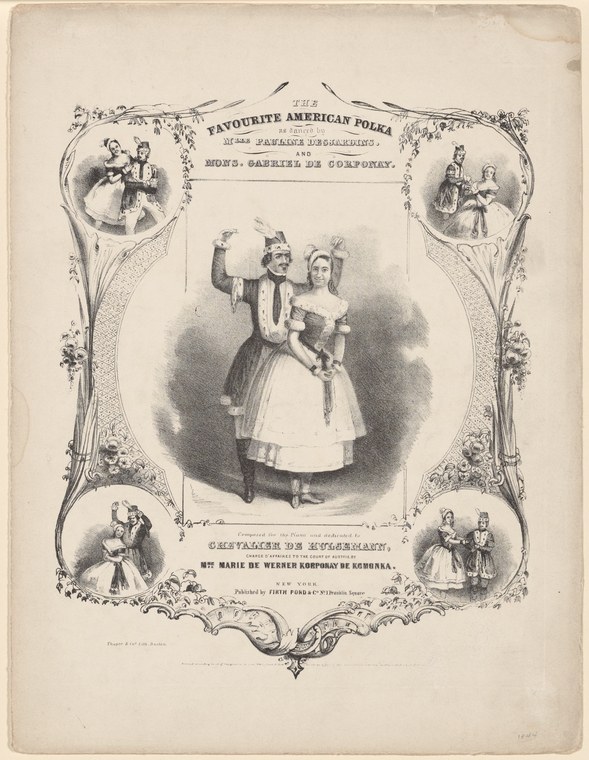
The favourite American polka as danced by Mlle Pauline Desjardins and Mons. Gabriel de Corponay
Unknown artist
- Collection:
- Prints depicting dance
- Source:
- New York Public Library
- Rights:
- Public domain — free to use, share and adapt.
- Recorded as:
- Public Domain
This image is one of the few visual records of how the polka was actually danced in the mid-nineteenth century by recognized professionals, showing the characteristic posture, energy, and partnering hold in precise detail. For dancers, historians, and teachers, it documents both the technical execution and the cultural status of the polka—not as a folk form, but as a fashionable, theatrical, commercially circulated social dance. The named dancers give it documentary weight; this is not an idealized or generic representation but evidence of a specific dance tradition as it was practiced and performed.
What you are looking at
This is a printed sheet-music cover or dance instruction broadside, ornately framed with decorative botanical borders and four smaller vignette scenes in the corners. The central composition shows two figures in mid-dance: a woman in a white dress with a fitted bodice and full skirt, and a man in dark formal attire with a light-colored vest, both captured in a dynamic forward-leaning posture typical of the polka. The woman's skirt is lifted and billowing, suggesting rapid movement, while the man's body inclines toward her. The four corner scenes appear to depict different phases or variations of the same dance, each showing couples in similar dress performing related movements. The entire composition is rendered in fine engraving with careful shading to suggest volume and motion. The decorative frame includes scrollwork, floral garlands, and ornamental flourishes typical of mid-19th-century commercial dance prints.
The dancing
Both central figures are in a closed or semi-closed ballroom hold, leaning forward into the movement with knees slightly bent, suggesting the energetic bouncing characteristic of the polka. The woman's right arm appears raised, her body oriented away from her partner at a diagonal angle, while the man's frame is open and reaching. The skirt momentum and the forward pitch of both torsos indicate rapid traveling movement across the floor. The corner vignettes show couples at various points in the step sequence, suggesting a multi-part choreographic phrase rather than a single frozen moment.
The dance depicted
This is unambiguously a polka, as stated in the title and confirmed by every detail of the image. The polka was one of the dominant social dances of the 1840s–1880s, and this print documents how Mademoiselle Pauline Desjardins and Monsieur Gabriel de Corponay performed it. The forward-leaning posture, the woman's lifted skirt, the couple's traveling orientation, and the bouncing energy all match period descriptions and choreographic notation for this dance. The inclusion of four corner vignettes suggests this was either a dance instruction sheet or a commemorative print of a specific performance or exhibition by these named dancers, likely for theatrical or dance hall circulation.
How it was made
This is a steel or copper-plate engraving, a technique that allowed fine detail, precise line work, and good tonal gradation through cross-hatching. The engraving technique was standard for music covers and dance instruction prints in the mid-19th century and allowed relatively inexpensive mass production, making such works accessible to the dancing public and dance instructors. The decorative frame and multi-panel composition suggest this was a commercially produced sheet-music cover, likely sold to customers who had attended a performance or purchased a polka as a fashionable parlor-room dance or music publication.
About this work
This is a mid-19th-century engraved broadside or sheet-music cover documenting the polka as performed or taught by two named dancers. It combines instruction or commemoration with commercial promotion, a standard format for disseminating fashionable social dances to the European and American public. The print captures the polka at a moment of peak popularity, when it had become both a ballroom staple and a theatrical spectacle. The named dancers suggest this was tied to a specific performance or reputation, making it a record of how the dance was actually executed by professionals of the era, not merely a generic illustration.
How to look at it
Pay attention to the forward lean and the bent knees—these show that the polka was not an upright, controlled dance like the waltz, but a bouncing, propulsive movement. The lifted skirt captures the moment of momentum, showing how the woman's weight and the man's leading created a traveling, almost athletic effect. The corner vignettes should be read as a choreographic sequence, showing how the couple progressed through the dance phrase. The decorative surround is not mere ornament; it indicates how the dance was packaged and sold, and to whom.
The period
The polka emerged in Bohemia in the 1830s and swept across Europe and America in the 1840s–1860s, becoming the dominant couple dance of the Victorian era. It replaced the waltz in many contexts and was seen as modern, energetic, and accessible to younger dancers and emerging middle-class ballroom audiences. Dance prints and sheet-music covers proliferated during this period, serving both as commercial products and as visual records of fashionable technique. By naming specific dancers, publishers capitalized on celebrity and the desire of amateurs to learn dances 'as performed by' recognized figures—making this a document of star pedagogy and the professionalization of social dance instruction.
Where it lives
This engraving is held by the New York Public Library as part of its collection of prints depicting dance. It is catalogued as a commercial broadside or sheet-music cover, a category that includes thousands of mid-19th-century dance instructional and promotional prints. Such objects were typically ephemeral, produced for immediate sale and use, so survival in an institutional collection indicates its significance as a record of popular dance practice.
Dance in this work
Questions about this work
Who were Pauline Desjardins and Gabriel de Corponay?
The catalogue record does not identify them beyond their names. They were professional dancers whose reputations were sufficient to put on a commercial dance print, suggesting they were either known in theatrical circles or were successful dance teachers. The practice of naming dancers on such prints was common in the mid-19th century and served to market the dance as authentic and professionally endorsed.
Why does the woman's skirt look so exaggerated?
The lifted, billowing skirt is not exaggeration—it is documentary. The polka involved rapid traveling and bouncing, and women's full skirts responded visibly to this movement. The engraver captured this as a key visual signature of the dance. The skirt lift also shows social propriety: full, uncontrolled exposure would have been scandalous, but the suggestion of movement through fabric displacement was acceptable and even desirable.
Why are there four smaller scenes around the border?
These likely represent different figures or variations within the polka phrase, or they may show the dance from different angles or moments in progression. Such multi-panel layouts were common in dance instruction prints, allowing viewers or students to follow a choreographic sequence. They could also serve to promote the dancers by showing them in multiple attitudes, as was done in theatrical engravings.
Is this a record of a specific performance?
It may be. The naming of the dancers and the commercial engraving suggest this was tied to a known event or to dancers with a recognizable reputation, but the catalogue does not specify a date, venue, or performance context. It is at minimum a record of how these named dancers were known to perform the polka, making it a document of their teaching or performance style.
More dance artwork





