49 works in this view — arrow keys or swipe to move between them.
Dance in Art
Jean Nicolas Servandoni: directeur de l'Opéra pour les décors
Unknown artist
- Collection:
- Prints depicting dance
- Source:
- New York Public Library
- Rights:
- Public domain — free to use, share and adapt.
- Recorded as:
- Public Domain
Servandoni was one of the most important figures in the professionalization of opera and ballet in the eighteenth century, whose designs and innovations directly shaped how dancers moved and what audiences saw. This engraving is evidence of his prominence as a named professional whose authority extended beyond performance into the material conditions of theatrical production.
What you are looking at
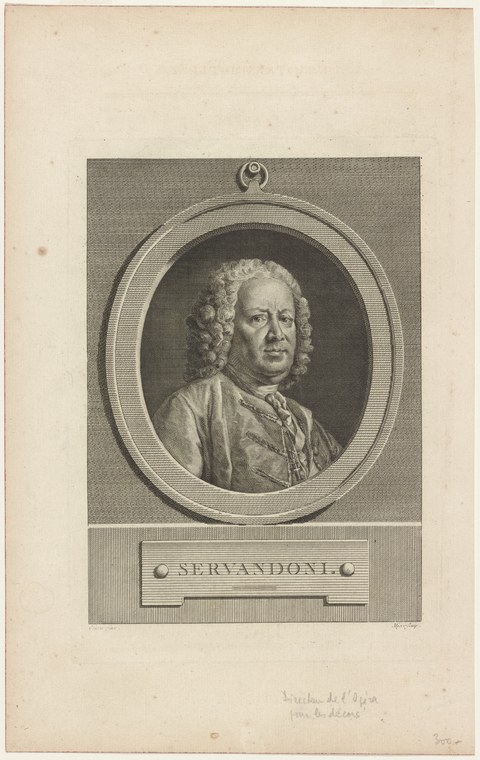
A three-quarter-length portrait bust rendered in engraved lines and fine cross-hatching against a dark background. The subject wears eighteenth-century dress: a formal coat with buttons and a white cravat at the neck, hair styled in the period fashion with curls at the sides. The head is turned slightly to one side, the gaze directed outward with a composed, professional bearing. The portrait is framed within a double oval border—a common device of the period—which sits atop a rectangular plinth bearing the inscription "SERVANDONI" in capital letters. A small loop or ring at the apex of the frame suggests this was designed as a print for hanging or binding into a volume. The engraving technique allows fine gradations of tone that model the face with restraint and dignity.
The dancing
This is a portrait, not a depiction of dance or dancers. A single male head dominates the composition, presented in a formal, stationary pose. There is no body movement, no dance frame, and no evidence of choreographic intention. The figure is conceived as a commemorative image rather than an active performer.
The dance depicted
This work does not depict dance. It is a portrait engraving of Jean Nicolas Servandoni, labeled as director of décor (stage design) for the Paris Opéra. Servandoni (1695–1766) was a legendary scenic designer and architect who revolutionized operatic spectacle through elaborate set designs, machinery, and lighting effects. While his work was central to opera production, the portrait itself shows a person, not a performance or choreography.
How it was made
This is a line engraving, executed with the burin to create the fine parallel hatching visible across the face and background. The technique allows precise tonal modeling and was the standard medium for reproductive portraiture in the eighteenth century. The engraving would have been printed in multiple impressions from a copperplate, making it an affordable and widely distributed form of commemoration. Such prints often appeared in collections of notable figures or in frontispieces to biographical or professional publications.
About this work
This is a commemorative portrait engraving of Jean Nicolas Servandoni, the influential French scenic designer and director of décors for the Paris Opéra in the eighteenth century. While Servandoni's work fundamentally shaped the visual spectacle of opera—through innovative set design, perspective scenery, and theatrical machinery—this portrait documents the man himself rather than his work or the dance and music that surrounded it. It is nonetheless a document of the operatic world and the infrastructure of professional dance production in the period.
How to look at it
This portrait should be read as a document of professional identity and status in the eighteenth-century operatic world. The formal oval frame and inscription are conventions that transform a portrait into a commemorative object—a record of achievement and authority. The restraint of the engraving technique, with its emphasis on line and careful modeling of tone, reflects the aesthetic values of the period: clarity, order, and the dignity of the individual. The slight turn of the head and outward gaze suggest a figure of measured authority and intelligence.
The artist
The engraver is not identified in the catalogue record. The print style and format are consistent with mid-eighteenth-century French portrait engraving, a period when reproductive prints of notable artists, architects, and cultural figures were routinely produced and circulated. The quality of execution suggests a competent journeyman engraver working in the standard idiom of the time.
The period
Servandoni's career (1695–1766) spanned the height of the Baroque and the transition into the early Classical period. The Paris Opéra of his time was engaged in continuous innovation in set design and theatrical machinery, driven partly by competition from other European courts and partly by the evolving tastes of audiences. Opera and ballet were increasingly professional enterprises with named directors, designers, and specialists. Servandoni's reputation was such that he merited a formal commemorative portrait, a mark of his status as a named professional rather than an anonymous craftsman.
Where it lives
The work is held in the New York Public Library's collection of prints depicting dance. The cataloguing as a dance-related image reflects the library's understanding of the operational context: Servandoni's work was integral to operatic and balletic spectacle, even though the portrait itself does not show dance.
Questions about this work
Who was Servandoni?
Jean Nicolas Servandoni (1695–1766) was a French scenic designer and director of stage décor for the Paris Opéra. He was one of the most celebrated and innovative stage architects of the eighteenth century, known for introducing sophisticated perspective scenery, dramatic lighting, and elaborate machinery to operatic production. His work fundamentally changed how opera and ballet were staged and seen.
Why is a portrait of a stage designer in a dance collection?
Because Servandoni's work as a scenic designer was inseparable from operatic and balletic performance. The visual framing of dance—the set, the lighting, the spatial context—shaped how choreography was experienced and understood. Servandoni's authority over the stage environment made him a crucial figure in the production of dance in his time.
What technique was used to make this print?
This is a line engraving, made by incising fine lines into a copperplate with a burin tool. The resulting plate could be inked and printed many times, making it a cost-effective way to circulate portraits and commemorate notable figures. Engraving was the dominant reproductive medium of the eighteenth century.
When was this engraving made?
The catalogue record does not specify a date. Based on the style and format, it was likely made in the eighteenth century, possibly after Servandoni's death in 1766 as a memorial portrait, or during his lifetime as a record of his prominence.
More dance artwork





