49 works in this view — arrow keys or swipe to move between them.
Dance in Art
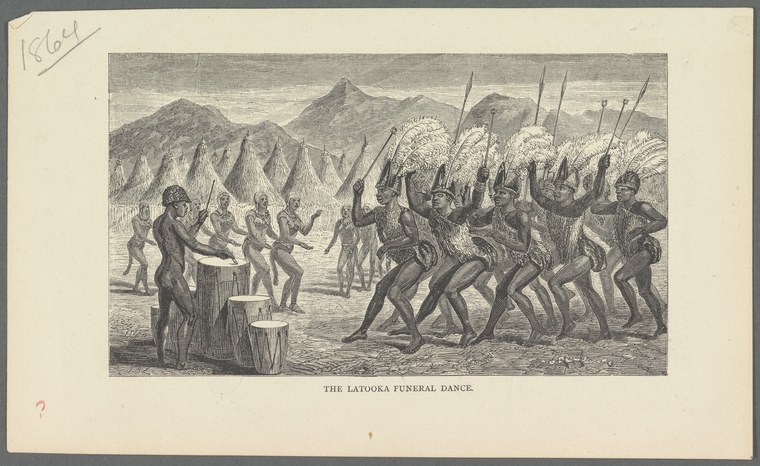
The Latooka funeral dance
Unknown artist
- Collection:
- Prints depicting dance
- Source:
- New York Public Library
- Rights:
- Public domain — free to use, share and adapt.
- Recorded as:
- Public Domain
This is among very few visual records of 19th-century Latooka ceremonial practices, providing evidence of ritual movement, spatial organization, and the role of objects (spears) in sacred dance. It reminds us that funeral rites across cultures have always integrated movement as a central element of mourning and spiritual practice, and that understanding this history requires reading colonial representations with both attention and skepticism.
What you are looking at
An engraved scene of a Latooka funeral ceremony, depicting a large gathering of figures in a mountainous landscape. In the foreground, a European or colonial figure stands elevated on what appears to be a platform or block, observing the proceedings. To the right, a substantial group of indigenous people are arranged in loose formation, many carrying long spears or poles held vertically. The figures are rendered largely unclothed or minimally dressed, in the conventions of 19th-century ethnographic illustration. The background shows steep, angular mountains rendered in sharp lines typical of wood engraving. The composition suggests ceremonial movement and gathering rather than a linear procession—the figures cluster and interact rather than form a single processional line.
The dancing
The dancers move with varied postures—some upright and still, others in dynamic, bent-knee positions suggesting active engagement. Many hold their spears vertically, suggesting these are ritual objects as much as weapons. The bodies show little coordination in the classical ballroom sense; instead, the composition conveys individual expressive movement within a communal gathering. The inclusion of the observing European figure establishes this as a scene filtered through colonial perspective, framing indigenous movement for external consumption.
The dance depicted
This depicts a Latooka funeral ceremony, a sacred ritual of the Latooka (or Latuka) people of present-day South Sudan and Uganda. The dance forms part of funerary rites intended to honor the deceased and facilitate their passage. The image shows the characteristic use of spears as ritual implements and the gathering of community members in what appears to be an outdoor ceremonial space. The varied body positions and the central role of the spears suggest this is an active, participatory ritual rather than a formalized choreography with standardized steps.
How it was made
This is a wood engraving, identifiable from the fine parallel hatching lines, precise linear rendering, and the characteristic black-and-white tonal range. The technique allowed for mass reproduction and circulation in periodicals and illustrated books of the 19th century, making this likely a documentary or ethnographic illustration intended for a broad reading public. The sharp delineation of form and the stylized treatment of anatomy reflect both the technical constraints and the aesthetic conventions of Victorian natural-history illustration.
About this work
This wood engraving documents the Latooka funeral dance, a sacred ceremonial practice of an East African community, as recorded and transmitted through 19th-century European ethnographic representation. The work belongs to a vast archive of colonial-era illustrations that attempted to document indigenous practices for European audiences, recording movement practices that might otherwise have left no visual trace. It sits at the intersection of dance history and colonial visual culture, revealing both something genuine about ceremonial movement and the limitations of the colonial eye observing it.
For dance historians, the image offers rare visual evidence of East African ceremonial practice in the 19th century, even as it must be read critically as a mediated representation. The prominence of spears, the outdoor setting, the gathered community, and the varied but coordinated body positions all carry information about how these rituals were structured and experienced.
How to look at it
Note the positioning of the European observer—this is not a neutral documentation but a framed perspective. Observe how the bodies move: the bent knees, the varied arm positions, the way individuals seem to occupy space without rigid formation. The spears are not incidental but central to the movement, suggesting the dance is object-based ritual rather than pure body movement. The outdoor mountain setting anchors this as a real place, not a studio or theatrical space, even as the stylized rendering reminds you this is a translation through European artistic convention.
The period
The engraving dates from an era of intense European ethnographic illustration and collection, when explorers, missionaries, and naturalists systematically recorded indigenous peoples and practices for publication in journals, books, and museums. Wood engraving had become the dominant medium for mass-produced illustration by the mid-19th century, allowing detailed scenes to be reproduced in large editions. This work reflects the Victorian hunger for documentation of 'exotic' cultures, a hunger that was both scholarly and commercial, and that inevitably distorted what was being represented.
Where it lives
The work is held in the New York Public Library's collection of prints depicting dance. It belongs to a broader collection of illustrated ethnographic and travel literature from the 19th century, the documentary visual heritage of European colonial engagement with African societies.
Dance in this work
Questions about this work
Who were the Latooka?
The Latooka (Latuka) were a pastoral people of the Nile region in present-day South Sudan and Uganda, documented extensively by 19th-century European explorers and missionaries. They were known as skilled herders and warriors, and their cultural practices, including elaborate funeral rituals, were recorded in colonial travel narratives and illustrations.
What role does the spear play in this dance?
The spear appears here as a ritual object integral to the ceremony, not merely a weapon. In many African cultures, spears are lifted, held, and moved in ceremonial contexts as part of honoring the dead and invoking spiritual presence. The verticality of the spears in this image may represent both the reaching toward ancestors and the assertion of community presence.
Why is there a European figure in the scene?
The observing European figure reveals this as a colonial representation—a moment captured for an external audience rather than documentation from within the culture itself. It reminds us that what we are seeing is filtered through the perspective, assumptions, and artistic conventions of the illustrator and the European public for whom it was made.
How reliable is this as a record of actual practice?
The image captures something real about the gathering and movement, but the stylization, the colonial framing, and the medium of wood engraving all shape what we see. It should be read as evidence of 19th-century European *perception* of the ritual, not a transparent window onto the practice itself. Historical context and comparative sources are essential for fuller understanding.
More dance artwork





