49 works in this view — arrow keys or swipe to move between them.
Dance in Art
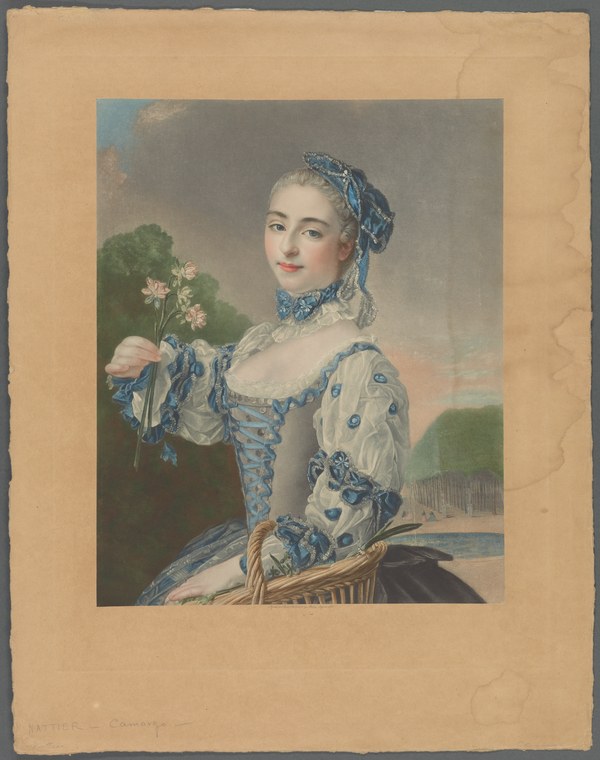
La Camargo, dame de la cour de Louis XV
Unknown artist
- Collection:
- Prints depicting dance
- Source:
- New York Public Library
- Rights:
- Public domain — free to use, share and adapt.
- Recorded as:
- Public Domain
La Camargo was a pivot figure in ballet history—a dancer who pushed the technical boundaries of the form (introducing higher jumps and faster turns) while her image was circulated in the conservative language of court portraiture. This print shows how innovation in dance was packaged and consumed by its audience: as refined elegance rather than athletic daring. For historians and dancers, the work is evidence of how female dancers in the 18th century negotiated between technical ambition and aristocratic decorum.
What you are looking at
A young woman in elaborate 18th-century court dress stands in three-quarter view against a muted grey-green background, holding a posy of pink and white flowers. She wears a white silk gown with blue ribbon trim and ornamental buttons running down the bodice and sleeves; the skirt falls in a elegant line to the floor. Her pale blonde hair is dressed high and crowned with a blue silk bow and matching ribbon. A blue ribbon with dangling ends is wound through her décolletage. Her posture is graceful and composed, her gaze directed toward the viewer with the serene expression typical of court portraiture. A harp sits at her side, partly visible in shadow at the bottom right. The setting is indeterminate—the background suggests neither interior nor landscape, keeping focus entirely on the figure. The print is hand-colored with delicate watercolor tones, the modeling of her face and the play of light on silk handled with considerable refinement.
The dancing
The woman stands in a relaxed but dignified contrapposto, her weight settled on her right leg with her left foot forward and slightly turned. Her right arm holds the flowers at waist height, the elbow bent softly. Her left arm hangs at her side with the hand visible, palm forward, in the studied elegance of court convention. Her shoulders are dropped and open. The posture conveys neither movement nor tension—this is a formal presentation of the person rather than a capture of dance in action, though every element of carriage and line reflects the training in movement that defined aristocratic bearing.
The dance depicted
This is a portrait of a court dancer or performer in the costume and setting of Louis XV's reign. The presence of the harp and the formal theatrical framing suggest she was a professional or semi-professional musician-dancer of the mid-18th century. The elegant restraint of her pose and the refinement of her dress indicate the balletic, courtly aesthetics of the period—dance at the French court was an art of grace, control, and aristocratic bearing rather than energetic action. No specific dance is depicted; instead, the image records the cultivated deportment that such training produced. The title identifies her as Camargo, likely the celebrated dancer Marie Anne de Cupis, known as La Camargo, who revolutionized ballet technique in the 1720s–1740s by introducing higher jumps and faster footwork while still maintaining the aristocratic elegance this portrait embodies.
How it was made
This is a hand-colored engraving or mezzotint on laid paper, mounted on a buff board. The fine line work and stippled modeling of the face and drapery are consistent with 18th-century commercial reproductive printmaking, likely from the mid-18th century. Hand-coloring of prints in this period was done by specialized workshops after the engraved plate had been pulled; the color is applied in light washes, allowing the underlying engraving to remain visible and to structure the forms. The technique allowed such portraits to be produced in multiple copies for circulation in aristocratic collections and among theater enthusiasts, making the subject's image accessible far beyond those who could attend court or theater performances.
About this work
This is a formal portrait of a mid-18th-century court dancer, printed and hand-colored in the commercial print tradition that served the aristocracy and theater public of Louis XV's France. The work documents not a moment of dance but the ideal of courtly grace that trained dancers embodied in their bearing and presentation. The subject—identified in the title as La Camargo—was a historical innovator who expanded the technical vocabulary of French ballet while remaining bound by the aesthetic conventions of aristocratic elegance. The portrait records her in this tension: a performer of new possibilities constrained by the formal language of court portraiture. The work belongs in a dance gallery because it captures how the body of a celebrated dancer was seen and valued at a particular moment, and because that vision shaped what ballet would become.
How to look at it
Look at the posture: the settled, composed weight; the gentle turn of the hips; the careful placement of the hands. Nothing here is in action, yet everything speaks of training and control. The portrait freezes the dancer in a moment of formal presentation, not in the midst of a step or jump. The convention at work is the court portrait tradition—the subject presents herself for the viewer's appreciation as a cultivated person, a woman of rank and accomplishment. The flowers and the harp are attributes that signal her status as a performer and a lady. The elegance of the engraving itself—the delicate line, the refined coloring—is part of what the portrait asserts: that this dancer belongs to an elite world of taste and refinement.
The artist
The artist is not recorded in the catalogue. The print is characteristic of French commercial reproductive engraving of the mid-18th century, a practice in which celebrated performers and courtiers were portrayed for a market of prints that reached educated and affluent households. Such prints were often made after oil paintings and were colored by hand in workshops. The style and finish suggest a major reproductive house, but without a signature or inscription, attribution must remain uncertain.
The period
This portrait dates to the height of the Rococo, when the French court and its aesthetic dominated European culture. In dance, this was the era of the Opéra-Comique and the early Opéra de Paris, when ballet was transitioning from the noble, formal pantomime of the Baroque into a faster, more technical form. La Camargo's career (1726–1751) coincided with this shift; she was celebrated for her lightness, speed, and brilliant footwork. Yet the portraiture of the period remained rigorously formal and courtly. The print medium allowed such images to be mass-produced and widely circulated among the aristocracy and the theater public, making the dancer's image a commodity and an emblem of taste and refinement.
Where it lives
The work is part of the New York Public Library's collection of prints depicting dance, a broad typological holding that includes commercial portraits, theatrical scenes, and instruction prints from the 17th century to the modern era. The print is catalogued only by title and subject; no artist, date, or medium are recorded, suggesting it entered the collection as part of a larger acquisition or gift of portrait prints.
Questions about this work
Who was La Camargo?
La Camargo (Marie Anne de Cupis, 1710–1770) was a French ballet dancer celebrated in the 1720s–1740s for her technical innovation and lightness. She famously shortened her skirts to show off her footwork and was known for jumps and turns that broke with the slower, more formal style of earlier French ballet. She retired early and was much celebrated in prints, poems, and paintings during her lifetime.
Why does she have a harp?
The harp was an attribute associated with refined femininity and courtly accomplishment in 18th-century portraiture. It signals that the subject is not only a dancer but a cultivated person, likely accomplished in music and the arts. It was a common convention in portraits of performers and court ladies, rather than evidence that she necessarily played the harp professionally.
Is this a representation of an actual dance?
No. This is a formal portrait in which the subject presents herself in an elegant, composed posture. It records the trained bearing and courtly grace that a celebrated dancer embodied, but it does not depict a specific dance, step, or choreographed moment. It is a portrait of a person, not a dance scene.
Why is this print hand-colored?
Hand-coloring was the standard way to add color to engraved or mezzotint prints in the 18th century. The engraved plate was printed in black ink, and then watercolor washes were applied by hand or in specialized workshops. This was labor-intensive but affordable enough to produce multiple copies for a market of educated collectors. The color added both value and liveliness to the print.
More dance artwork





