49 works in this view — arrow keys or swipe to move between them.
Dance in Art
Danske Billeder [selections]
Unknown artist
- Collection:
- Prints depicting dance
- Source:
- New York Public Library
- Rights:
- Public domain — free to use, share and adapt.
- Recorded as:
- Public Domain
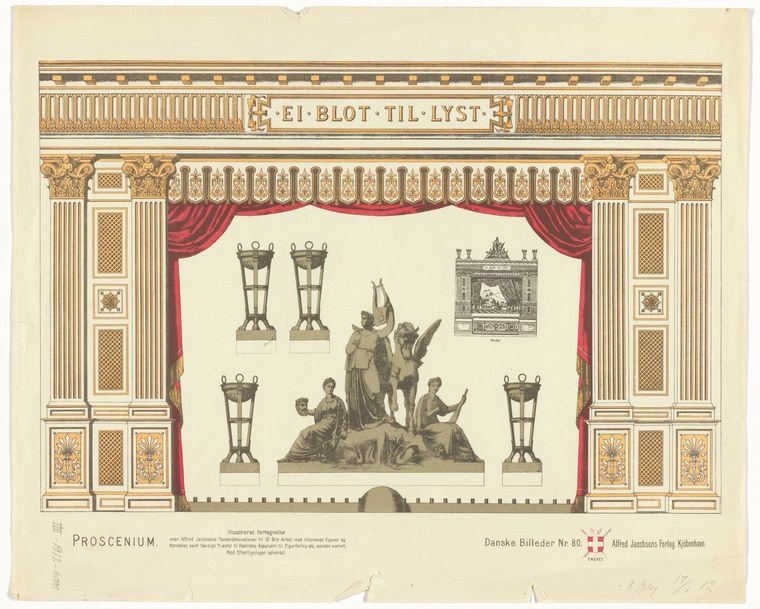
Tableau vivant was a significant performance form in 19th-century theater, opera, and civic pageantry, and one that directly influenced how dancers and choreographers conceived of grouping, framing, and sculptural stillness on stage. This print is documentary evidence of how such performances were staged, lit, and framed architecturally—information rarely captured in written sources. It also shows the intersection of classical allegory, monumental sculpture, theater design, and public memory-making in Danish culture during a period when these boundaries were fluid.
What you are looking at
This is a theatrical proscenium scene, a print from a Danish series (Danske Billeder / Danish Pictures), depicting an allegorical or commemorative tableau vivant on a stage. The composition is symmetrical and formal: a central sculptural group shows a female allegorical figure in classical drapery, standing elevated among attendant putti or cherubs, flanked on either side by four tall ornamental torch-like vessels or candelabra. The stage is framed by an ornate architectural proscenium with neoclassical details—fluted pilasters, decorative capitals, and a scalloped valance. Heavy red damask curtains drape the upper frame. In the upper right corner, a smaller engraved view shows an architectural monument or public building, suggesting this tableau commemorates a historical event or civic occasion. The entire print is rendered in a restrained palette of tan, grey, red, and cream, with fine line work characteristic of 19th-century reproductive engraving.
The dancing
The central female figure stands in a stately contrapposto pose with one arm raised in a gesture of blessing or proclamation, the other extended downward in a gesture of benevolence. She wears flowing classical drapery and a headdress or crown. The four putti surrounding and supporting her are positioned in attitudes of devotion or service—some kneeling, others gesturing upward—creating a composition of hierarchical stability. The ornamental vessels flanking this group are purely decorative and architectural rather than functional dance props, emphasizing ceremony and state occasion over movement.
The dance depicted
This is not a record of dance in the active sense—no dancers are shown executing steps, poses, or holds. However, the work depicts an allegorical or commemorative 'living picture,' a form of staged tableau vivant that was a prestige genre in 19th-century civic ceremony and theatrical entertainment. Such tableaux, though static and sculptural in their final presentation, were performed and arranged by costumed figures in formal poses meant to evoke classical art and virtue. The print documents the mise-en-scène of such a performance, showing how the stage was arranged and costumed, but not choreography or movement itself.
How it was made
This is a hand-colored engraving (or possibly a steel-engraved reproduction with hand tinting), characteristic of mid-to-late 19th-century Danish print production. The fine parallel line work in the architectural and ornamental details is typical of reproductive engraving, which allowed for wide circulation and public accessibility. The Danish publisher's mark ('Danske Billeder Nr 80. Mittet Kunstforlag Kjøbenhavn') appears at the bottom, indicating this was part of a numbered series of views of Danish life, architecture, and public events intended for a middle-class domestic audience. The hand coloring—particularly the rich red of the curtains—would have been added by hand after printing, making each copy slightly unique.
About this work
This engraving documents a staged allegorical tableau vivant, a performance form that bridged visual art and civic ceremony in 19th-century Denmark. The print records not a dance but a formal, sculptural presentation of costumed figures arranged on a theatrical stage, likely commemorating a specific historical, architectural, or patriotic occasion. It belongs in a dance history archive because tableau vivant was a recognized performance mode in which trained actors and supernumeraries occupied carefully composed poses and groupings, and because such works influenced both balletic mise-en-scène and the broader vocabulary of theatrical spectacle. The work is also significant as evidence of how mid-class Danish civic culture was documented and circulated through popular prints—showing what kinds of staged events were considered worth preserving and selling as cultural artifacts.
How to look at it
Pay attention to the spatial framing: the proscenium stage, the architectural enclosure, and the symmetrical arrangement all emphasize order, formality, and the deliberate distance between performer and viewer. The central figure's pose is not captured mid-movement but held as a permanent sculptural statement—the raised arm and flowing drapery are meant to evoke classical statuary and engravings. The smaller engraved view in the upper right suggests that this tableau was designed to honor or commemorate a specific building or event, so the figures and their arrangement carry symbolic meaning beyond mere decoration. The red curtains and ornamental vessels frame the scene as a theatrical event, not a natural occurrence.
The period
Tableau vivant reached its peak popularity in Europe during the mid-to-late 19th century, particularly as a form of amateur home entertainment and as a prestige element of grand opera and royal ceremony. The allegorical subject matter and neoclassical aesthetic in this print reflect the persistent influence of academic art and antiquarian revival on performance culture. In Scandinavia, such civic and commemorative tableaux were part of nation-building visual culture, used to evoke historical continuity and moral virtue through the body and classical drapery. The symmetrical, architectural composition of this tableau is typical of how such performances were orchestrated—as living recreations of historical or allegorical artwork, with every gesture and pose predetermined and held.
Where it lives
This print is part of the Danske Billeder (Danish Pictures) series, published by Mittet Kunstforlag in Copenhagen as a numbered collection (No. 80) of topical Danish scenes and public events. The New York Public Library holds this series as a documentary record of 19th-century Danish civic culture and performance.
Questions about this work
Is anyone actually dancing in this image?
No. The image shows a static, sculpted tableau vivant—a posed group of costumed figures arranged on a theatrical stage. Tableau vivant was a performance form, but the moment captured here is one of stillness and formal arrangement, not movement or choreography. The performers held these poses for the duration of the viewing.
What is a tableau vivant?
A tableau vivant (living picture) was a popular 19th-century performance form in which costumed actors arranged themselves in carefully composed poses to recreate a famous painting, historical scene, or allegorical moment. It combined elements of visual art, costume, lighting, and theater. Though the performers were living and costumed, the defining characteristic was immobility—they held their poses like statuary, and the beauty lay in the composition and framing rather than in dance or continuous movement.
Why would this be in a dance archive?
Tableau vivant was a recognized performance mode that employed trained performers and shared conventions of stage composition, grouping, and spectacle with dance and theater. Choreographers and dancers of the era were influenced by tableau vivant aesthetics, particularly the use of sculptural stillness, hierarchical grouping, and allegorical narrative expressed through the body and costume. Documenting how these performances were staged helps us understand the visual and kinesthetic vocabulary of 19th-century theatrical performance.
What does the smaller engraving in the corner show?
The smaller architectural view in the upper right appears to document a specific building or monument that this tableau was designed to commemorate or honor. It suggests that this was not a generic allegorical scene but a performance created for a particular civic or patriotic occasion, linking the living figures onstage to architectural and historical memory.
More dance artwork





