49 works in this view — arrow keys or swipe to move between them.
Dance in Art
Danske Billeder [selections]
Unknown artist
- Collection:
- Prints depicting dance
- Source:
- New York Public Library
- Rights:
- Public domain — free to use, share and adapt.
- Recorded as:
- Public Domain
This design reveals the theatrical environment and aesthetic principles that shaped how ballet and other staged dances were presented and perceived in the 19th century. The architectural grandeur, the framed stage, the relationship between audience and backdrop, and the principles of sight-line and decoration all governed how choreography was composed, costumed, and understood. Understanding the theatre building itself is essential to understanding the dance.
What you are looking at
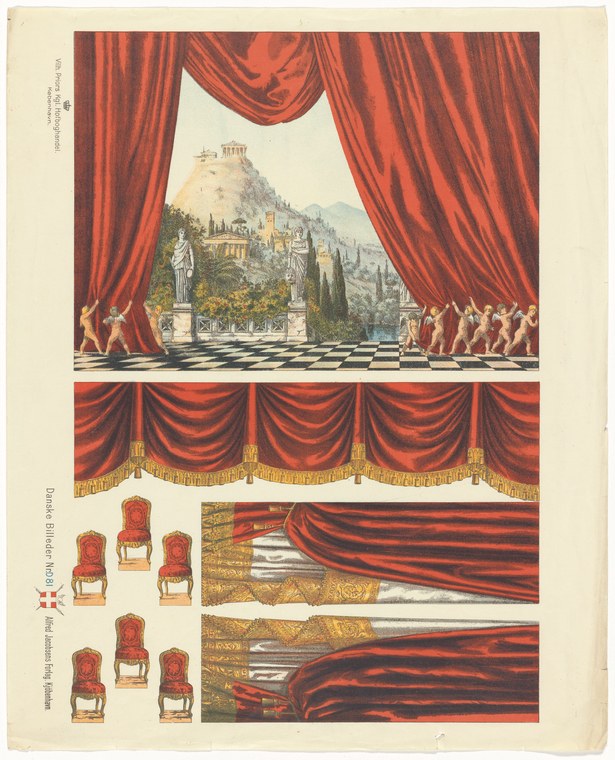
This is a theatre design print showing an ornate proscenium arch framed by deep red velvet curtains with gold tasseled swags. Through the opening, a painted backdrop depicts a Mediterranean or Eastern European hillside town with a fortress or castle structure atop a steep rise, surrounded by cypress trees and fortified walls descending the slope. The stage floor visible in the foreground features a bold black-and-white checkered or geometric pattern. On either side of the stage, small classical statues or figures in terracotta tones are positioned as if flanking the performance space. The entire composition presents a theatrical interior design, rendered in hand-colored lithographic or chromolithographic technique with rich jewel tones—the deep crimsons and golds of the drapery dominate, set against pale cream paper. Below the main stage view, the print includes detailed technical drawings of theatre seating arrangements (shown in elevation) with ornate red upholstered chairs arranged in symmetrical groups, demonstrating the furniture and spatial planning for a period theatre.
The dancing
No dancers are shown in this image. The small classical figures flanking the stage are sculptural ornaments rather than performers, positioned statically as architectural elements. The focus is entirely on the theatre space itself—its dimensions, sightlines, and decorative scheme—rather than on human movement or dance technique.
The dance depicted
No dance is depicted in this work. This is a theatre design or stage set document, not a record of performance. It shows the architectural and decorative framework within which theatrical performances, including dance, would have taken place, but does not capture any dancing bodies or choreography.
How it was made
This is a hand-colored chromolithograph or lithographic print, as evidenced by the careful registration of color blocks, the slight variations in ink density, and the texture visible in the reproduction. The technique allowed for mass production of detailed architectural documentation with rich color rendering, making it suitable for circulation among theatre designers, managers, and patrons. The inclusion of both elevation views and technical drawings alongside the decorative perspective suggests this served as a practical working document as well as a display piece.
About this work
This is a theatre interior design print, almost certainly from the 19th century, documenting a Continental European playhouse interior. The title *Danske Billeder* ('Danish Pictures') indicates it may be part of a portfolio of Danish architectural or decorative design examples, though the aesthetic—the Italianate hillside backdrop, the style of the furnishings—suggests it depicts a theatre on the Continent rather than in Denmark. The print serves as a record of mid-to-late 19th-century theatrical aesthetics: the massive proscenium frame, the luxurious drapery, the classical ornament, and the careful attention to audience sightlines and comfort. It belongs in a dance gallery not because it shows dance, but because it documents the physical and visual world in which theatrical dance was performed during a formative period in ballet's history.
How to look at it
Observe the relationship between the framing (the massive proscenium, the weight of drapery) and the painted world beyond it. Note how the checkered floor creates geometric perspective, drawing the eye into the landscape. The small classical figures are positioned to suggest human scale and sightlines. The technical drawings below are as important as the decorative perspective above: they reveal that this is a functional document, showing how many spectators could be accommodated and from what angles they could see the stage. The theatre is designed as a frame, a viewing apparatus, not merely as a decorated room.
The period
The 19th century saw rapid expansion and modernization of European theatre buildings. The rise of the proscenium arch theatre, standardization of stage machinery, and investment in comfort and sightlines for paying audiences reflected broader changes in theatrical practice and economics. This period coincides with the flourishing of Romantic ballet (1830s–1850s) and the gradual professionalization of dance. The Classical and Renaissance revival ornament visible here was fashionable in theatre design from the mid-19th century onward, reflecting both eclecticism and a desire to lend cultural prestige to theatrical spaces.
Where it lives
The work is catalogued as part of NYPL's print collection under the title *Danske Billeder* (Danish Pictures), suggesting it is one sheet in a larger portfolio or series of Danish design documentation. The collection is identified as depicting dance, though this particular print is architectural rather than choreographic.
Questions about this work
Is there any dancing shown in this print?
No. This is a theatre design document showing the architectural and decorative framework of a playhouse interior. It records the setting *in which* theatrical dance would have been performed, not a performance itself.
Why is this in a dance collection?
The theatre building itself is part of dance history. The stage design, sightlines, framing, and spatial proportions all governed how dancers moved and how audiences saw them. Understanding the physical theatre is essential to understanding the choreography and aesthetics of the period.
What period is this theatre design from?
Based on the style of the drapery, ornament, furnishings, and chromolithographic technique, this appears to be a 19th-century design, most likely mid-to-late 1800s. The aesthetic aligns with the height of Romantic theatre architecture.
What do the drawings at the bottom show?
Technical elevation views of the theatre seating, showing how spectators would be arranged and the sightlines available from different positions. This was a practical concern for theatre managers and architects, ensuring good views of the stage from all paid seats.
More dance artwork





