49 works in this view — arrow keys or swipe to move between them.
Dance in Art
Danske Billeder [selections]
Unknown artist
- Collection:
- Prints depicting dance
- Source:
- New York Public Library
- Rights:
- Public domain — free to use, share and adapt.
- Recorded as:
- Public Domain
For historians of 19th- and early 20th-century Danish public life and institutions, this image is valuable documentation of Tivoli's cultural role and the visual conventions of civic ceremony and institutional display. For dance historians, it is useful as contextual material showing the settings and social formations within which dance was performed, rather than as documentation of dance technique or practice.
What you are looking at
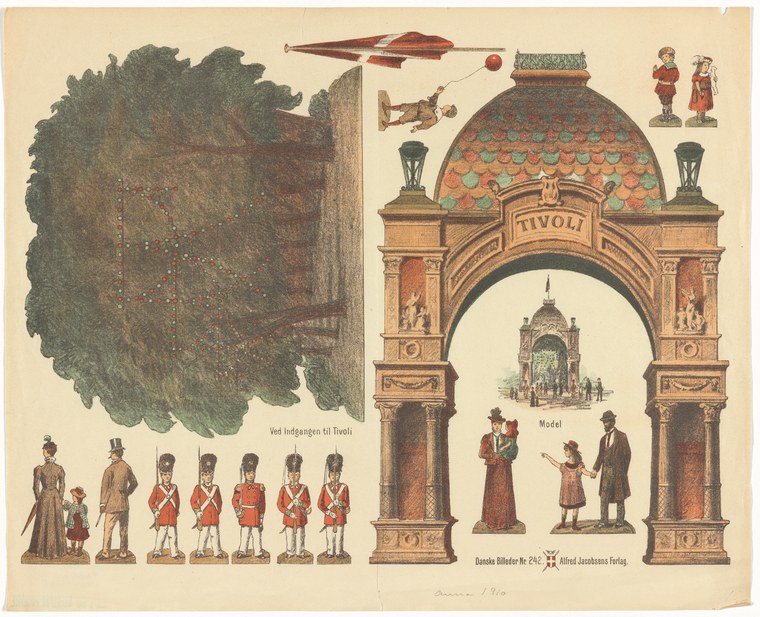
This is a composite print showing Danish theatrical and ceremonial life, likely from the 19th century. The dominant feature is a large ornate archway labeled "TIVOLI" with a domed, tiled roof in red and green. Through the arch we see a formal garden or parade ground with figures in 19th-century dress and what appears to be a ceremonial or theatrical gathering. To the left is a substantial tree with dense foliage. Above the arch float two airships or zeppelins—one cigar-shaped, one more angular—suggesting a modernizing industrial context. In the upper right are small figures in period costume: a soldier or guardsman in uniform and what appear to be civilians. Below the arch stand figures in formal dress: a woman in a long red gown, a child, and a man in dark coat and top hat, arranged as if witnessing or participating in a formal moment. Along the bottom left are seven standing figures in various 19th-century dress—military uniforms, formal coats, and civilian clothes—arranged in a line as if presented for inspection or display. The print style is hand-colored, with muted earth tones, greens, and reds, typical of 19th-century chromolithography.
The dancing
The figures are posed rather than captured in motion. The group along the bottom stands in formal, vertical alignment with neutral posture and minimal gesture—a parade or presentation stance. The three figures beneath the arch (woman, child, man) stand in a relaxed domestic grouping, not in any dance hold or frame. The airship figures above are static. There is no evidence of weight transfer, rotation, or the physical engagement characteristic of dance. The bodies are upright, separated, and oriented toward viewing rather than toward each other in partnering.
The dance depicted
This print does not appear to depict dance in the conventional sense. The figures are arranged for display, inspection, or ceremony rather than in movement. The setting suggests a public institution (Tivoli Gardens, a famous Copenhagen amusement park) or civic occasion, and the formal costumes and rigid postures suggest military or official ceremony. The airships place this in a moment of technological transition, likely early 20th century despite the 19th-century styling of some costume elements.
How it was made
This is a chromolithograph—a color printing process popular for popular prints and theatrical ephemera in the late 19th and early 20th centuries. The technique allowed for distributed colored images without hand-painting and was ideal for commemorative, institutional, and tourist imagery. The hand-coloring is evident in the careful separation of green foliage, red roof tiles, and flesh tones. The medium suggests this was produced for broad circulation, perhaps as a souvenir, theatrical program cover, or promotional print for Tivoli.
About this work
This is a composite print celebrating Danish public life and the Tivoli institution in Copenhagen. It is not primarily a dance document but rather an institutional and ceremonial image—a visual anthology of Danish civic dress and public gathering. It belongs in a dance archive only tangentially, as evidence of the settings and occasions (public gardens, civic ceremonies) where dance and social entertainment occurred, rather than as evidence of dance practice itself. The image documents the visual and social context in which entertainment was consumed rather than the entertainment itself.
How to look at it
Attend to the arrangement and posture of the figures: none are in motion or in partnered contact. The formal symmetry and linear presentation suggest civic ceremony or official display rather than spontaneous entertainment. The Tivoli archway functions as a symbol of a specific institution and moment rather than as a dance venue. The airships are deliberate anachronisms, implying a commentary on progress and modernity alongside historical costume. The overall composition is didactic—presenting types and scenes rather than telling a narrative or freezing a moment of action.
The period
The print dates to a period of rapid modernization in Denmark and Europe. The presence of airships alongside 19th-century formal dress suggests the 1900s–1920s, a moment of technological transition. Tivoli Gardens, founded in 1843, had become Denmark's premier public entertainment venue. The formal military and civilian costumes reflect the rigid class and gender conventions of the period. Chromolithography was the dominant medium for popular prints and theatrical ephemera during this era, before photographic reproduction became universal.
Where it lives
This is part of a series titled "Danske Billeder" (Danish Pictures), held by the New York Public Library. The print is one of a suite of popular prints documenting Danish life, institutions, and culture, likely produced for educational or promotional distribution.
Questions about this work
Is there any dance depicted in this print?
Not in any formal sense. The figures are arranged in static, ceremonial postures rather than in movement or in dance holds. The print documents the institutional and civic context of Danish life rather than dance practice.
What is Tivoli, and why is it the focal point?
Tivoli Gardens in Copenhagen, founded in 1843, was Denmark's principal public amusement park and cultural venue. It is depicted here as a symbol of Danish modernity and entertainment culture. Dance and music were central to Tivoli's programming, though this particular print does not show those activities.
What do the airships signify?
The airships (zeppelins) are markers of technological modernity and progress. Their presence alongside 19th-century formal dress creates a visual commentary on the period of transition in which this print was made—likely the early 1900s, when airship travel was emerging as a symbol of the future.
Who are the figures in the lineup at the bottom?
They appear to be representatives of different social classes and professions in Denmark: soldiers, officials, and civilians in various period costumes. They are presented in a didactic arrangement, as types or examples rather than as individuals in a narrative.
More dance artwork





