49 works in this view — arrow keys or swipe to move between them.
Dance in Art
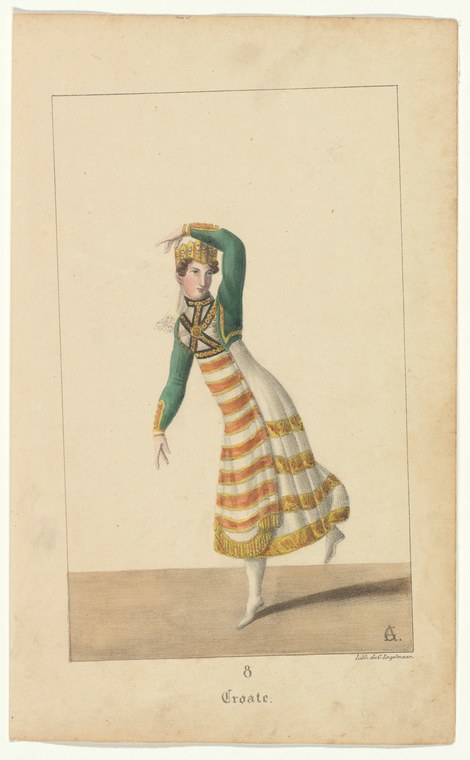
Dancers in Croatian costume
Unknown artist
- Collection:
- Prints depicting dance
- Source:
- New York Public Library
- Rights:
- Public domain — free to use, share and adapt.
- Recorded as:
- Public Domain
This work is a rare surviving document of early 19th-century theatrical costume practice and the visual culture of 'national' or regional representation in European dance and theater. It reveals how Romantic-era entertainment used costume, particularly elements of Eastern European dress, to convey exotic or regional character, making it essential for understanding both the history of costume design and the politics of cultural representation on the stage.
What you are looking at
A single female figure stands in a theatrical pose against a plain cream background. She wears a striking costume combining European and Eastern European elements: a fitted bodice with golden trim and crossed lacing across the chest, and a skirt composed of horizontal stripes in orange and cream with deep pleats and a gold-trimmed hem. A long green hood or headdress drapes from her head down her back. Her blonde hair is visible at the face. She stands with her weight on one leg in a relaxed contrapposto, her arms hanging naturally, her head turned slightly toward the viewer. The figure is rendered with careful attention to fabric—the striped skirt shows dimensional folds and movement, suggesting the garment's volume and weight. The style of the print and the hand-coloring in watercolor or gouache suggests this is a theatrical costume study, possibly from the early 19th century.
The dancing
A single dancer stands in a neutral, almost demure pose with weight shifted to one leg and arms at rest. There is no active movement captured—no turn, leap, or extended line. The body is upright and composed, the stance more presentational than dynamic. This is a figure study rather than action study, designed to display costume rather than demonstrate technical skill or virtuosity in movement.
The dance depicted
The costume is identified as 'Croate' (Croatian) in the text beneath the image, indicating this is a theatrical representation of Croatian regional dress rather than a depiction of a specific named dance style. It appears to be a costume design or reference image for theatrical use, possibly for a ballet, opera, or pantomime of the early 19th century that incorporated regional or 'exotic' European costumes. The static pose and presentation suggest this is archival documentation of a costume design rather than a capture of a moment in actual dance. The image belongs to a tradition of theatrical type-casting where national or regional identity was conveyed through costume.
How it was made
This is a hand-colored engraving or aquatint on paper, evident from the fine linear work defining the figure's contours and the controlled application of watercolor or gouache over the printed line. The technique allowed for mass production of costume reference images for theatrical companies and costume makers. The careful modeling of light and shadow on the striped skirt and the precise articulation of the bodice trim suggest this was made by a skilled theatrical costume illustrator, likely for circulation among theater professionals. The quality and style indicate professional workshop production rather than casual sketching.
About this work
This is a hand-colored theatrical costume study labeled as a Croatian costume, dated to the early 19th century based on style. It documents a stage costume combining elements of Croatian regional dress with Romantic-era theatrical conventions. The image belongs to a tradition of European printmaking that produced costume reference guides for theaters—visual archives of national types and regional identities as they were reimagined for the stage. Such prints were essential tools for costume makers, dancers, and producers, and they shaped how European audiences understood and consumed representations of non-Western and regional identities. This example shows the high technical quality of professional costume documentation of the period.
How to look at it
Pay attention to the construction of the costume: the layering of the green hood, the fitted bodice with its precise geometric trim, and the engineering of the pleated skirt. The artist has shown how the striped fabric catches light and falls in folds, conveying both the weight of the material and the silhouette it creates. The neutral pose is intentional—it presents the costume as an object to be studied and replicated rather than as a moment of performance. The hand-coloring, applied after printing, demonstrates the labor involved in producing these reference images for theater professionals.
The artist
The artist is not recorded. The style and quality suggest a professional theatrical costume illustrator working in the early 19th century, likely in a major European theater city such as Vienna, Prague, or Paris. The hand-coloring may have been applied by a different artisan than the engraver. The work bears a signature mark 'Lith D' or similar in the lower right, which may indicate the technique or printer rather than the artist's name.
The period
This costume study dates to the Romantic era of European theater (c. 1815–1840), when ballet and opera experienced a surge in popularity and theatrical productions increasingly incorporated spectacular costumes and sets. The early 19th century saw growing European fascination with regional and non-European cultures, which manifested in costume and dance as 'national' types and exotic settings. At the same time, the technical sophistication of printmaking—particularly colored engraving and lithography—made theatrical documentation and publicity more refined and widely circulated. Costume reference prints like this one were mass-produced for professional use and also served as collectible images for theater enthusiasts.
Where it lives
This work is held in the New York Public Library's collection of prints depicting dance. It is part of a larger archive of theatrical costume documentation spanning the 18th–20th centuries, reflecting the library's role in preserving materials related to performance history.
Questions about this work
Is this a picture of someone actually dancing?
No. This is a costume study—a reference image for theatrical use. The figure stands in a neutral pose designed to display the garment rather than capture a moment of movement. Such prints were made for costume makers, dancers, and producers to consult when building or performing in a particular costume.
What is a Croate costume?
In early 19th-century European theater, 'Croate' referred to costumes derived from or inspired by Croatian regional dress. Theater makers used such costumes to signal national or regional identity or exoticism. The costume in this image combines actual elements of Croatian folk dress—the striped skirt and hood—with theatrical conventions, making it a hybrid rather than a historically accurate reproduction.
Why was this hand-colored?
The engraving was printed in black line, then hand-colored with watercolor or gouache to show the exact colors performers would wear. This made the image useful for costume makers sourcing fabrics and dyes. Hand-coloring also made each print unique and more valuable to collectors, and it allowed for variation if multiple versions were needed.
Where would this have been used?
Prints like this circulated among theater professionals—costume makers, wardrobe departments, dancers, and producers. They also appeared in bound volumes of costume designs and were sold to theater enthusiasts and collectors. They served both practical and commercial purposes.
More dance artwork





