49 works in this view — arrow keys or swipe to move between them.
Dance in Art
The dancing lesson
Unknown artist
- Collection:
- Prints depicting dance
- Source:
- New York Public Library
- Rights:
- Public domain — free to use, share and adapt.
- Recorded as:
- Public Domain
This page documents a now largely forgotten tradition of parlor entertainment that was central to nineteenth-century social life and children's education in gesture and visual performance. It shows that the boundary between dance, theater, and parlor games was fluid, and that understanding movement and its visual representation was valued as a social skill.
What you are looking at
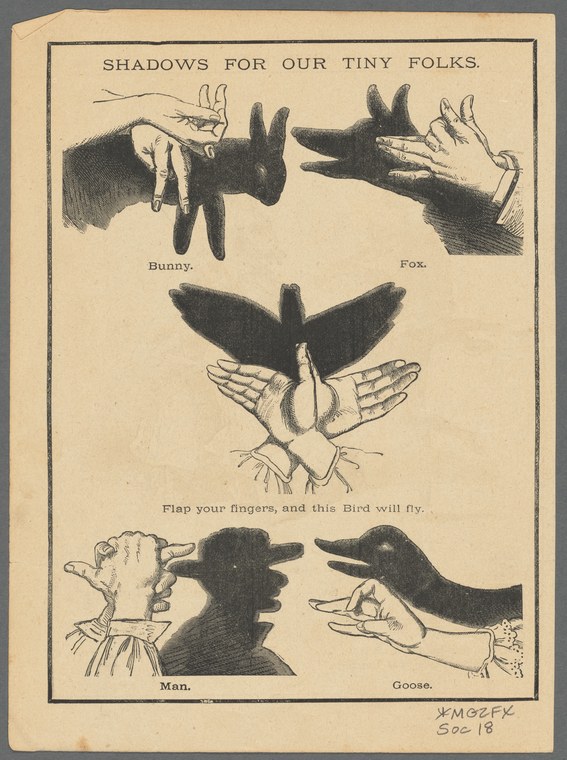
This is a printed instructional page titled "Shadows for Our Tiny Folks," showing five hand-shadow silhouettes arranged vertically on a cream ground. Each shadow is produced by hands held between a light source and a surface, casting dark profiles against the pale background. At the top, two hands create a rabbit (bunny) with ears erect, and to its right, a fox with pointed snout. In the center, two hands held vertically with fingers spread create a bird in flight, with the instruction below reading "Flap your fingers, and this Bird will fly." At the bottom, the left shows a profile of a man's head and shoulders, while the right displays a goose with a long neck. The hands themselves are rendered in careful detail, showing the exact finger positions and angles needed to produce each shadow form. This appears to be a page from a children's instructional or entertainment book, likely from the late nineteenth or early twentieth century.
The dancing
The work depicts not dancers but hands in specific positions, rendered in precise detail to teach children how to create shadow puppets. Each hand or pair of hands is positioned to cast a recognizable silhouette—ears extended upward for the bunny, fingers spread to suggest feathers for the bird, a particular curl and angle to suggest the fox's pointed features. The bird shadow explicitly invites movement: the instruction to "flap your fingers" indicates that this is meant to be a dynamic, animated form rather than a static pose.
The dance depicted
This is not a depiction of dance, but rather an instructional guide to shadow puppetry, a form of performance that has theatrical and sometimes dance-like qualities. Shadow puppetry was a popular parlor entertainment and children's amusement in the nineteenth and early twentieth centuries, often performed at parties and gatherings. The emphasis on the bird's animation—achieved by moving the fingers to make the shadow appear to fly—suggests that the intended use was as a form of brief, playful performance art. While not dance in the strict sense, shadow puppetry occupied a similar cultural space as entertainment and required an understanding of gesture, timing, and illusion.
How it was made
This is a black-and-white wood engraving or similar relief print on cream paper, a technique well-suited to the high-contrast requirements of shadow imagery. The precise rendering of the hands and the clean, bold silhouettes of the shadows suggest careful preparation and skilled execution. The technique's affordability and reproducibility made it ideal for children's instructional books, allowing the image to circulate widely in printed form. The clarity and directness of the line work are characteristic of late Victorian and Edwardian printing for a popular audience.
About this work
This is an instructional page from a children's book teaching the performance art of shadow puppetry through five hand-shadow examples. The work belongs in a dance and performance gallery because shadow puppetry was a recognized form of parlor entertainment that required understanding gesture, timing, and the relationship between body position and visual effect. The page captures a moment in the history of amateur theatrical performance, when such entertainments were common features of social gatherings and children's amusement. The emphasis on animation—particularly the instruction to make the bird fly—shows that these shadows were meant to move and perform, not merely to appear as static images.
How to look at it
The viewer should attend first to the precision of the hand positions shown—each is a frozen moment that encodes the entire gesture needed to produce the shadow. The contrast between the detailed, naturalistic rendering of the hands and the bold, simplified silhouettes of the shadows they cast is the key visual tension in the work. The instruction on the bird—to "flap your fingers"—is crucial: it invites the reader to animate the static image in their imagination or performance, understanding that these are blueprints for movement and time, not finished performances.
The period
Shadow puppetry and shadow play were experiencing a revival in Victorian popular culture. The tradition had deep roots in Asian theater (particularly Indonesian and Chinese forms), but also existed in European folk culture. In the nineteenth century, it became fashionable as a drawing-room entertainment, a form of amateur theater that required no special equipment beyond a candle or lamp, a white surface, and willing hands. Instructional books and pages like this one became common, published for families and schools. The same period saw growing interest in children's entertainment and instruction, with an emphasis on activities that combined play, learning, and performance.
Where it lives
The work is held in the New York Public Library as part of its collection of prints depicting dance. The marking "XMG2FK 50c18" appears to be the library's cataloging system.
Questions about this work
Is this actually dance?
No, it is shadow puppetry, a form of performance art and entertainment. It belongs in a dance gallery because it shares dance's concern with gesture, movement, timing, and the visual expression of an idea through the body. Like dance, shadow puppetry requires an understanding of how position translates to image, and how stillness and movement together create meaning.
How would someone actually use this page?
A child or adult would hold the page up or study it carefully, then position their hands between a light source (a candle, lamp, or window) and a white wall or cloth to cast their own shadows. By matching the hand positions shown, they could make the shadows appear to move and perform.
When was this made?
The catalogue record does not provide a date, but the printing technique, paper, and style suggest the late nineteenth or early twentieth century. This was the heyday of instructional books for children's parlor entertainments.
Why would dancers care about this?
Shadow puppetry and dance both explore how the body and its position create meaning for an observer. Understanding this tradition illuminates the history of movement-based entertainment and the cultural values placed on physical expression and amateur theatrical performance.
More dance artwork





