49 works in this view — arrow keys or swipe to move between them.
Dance in Art
Fond de féerie
Unknown artist
- Collection:
- Prints depicting dance
- Source:
- New York Public Library
- Rights:
- Public domain — free to use, share and adapt.
- Recorded as:
- Public Domain
This print reveals the relationship between theatrical dance and the broader machinery of spectacle in the 19th century. Dancers in féerie did not stand alone but were embedded in a visual and technical apparatus—processions, transformations, cascading ornament—that the stage itself orchestrated. Understanding dance history requires seeing not only the trained dancer's body but the architectural and scenic systems that framed and contextualized it.
What you are looking at
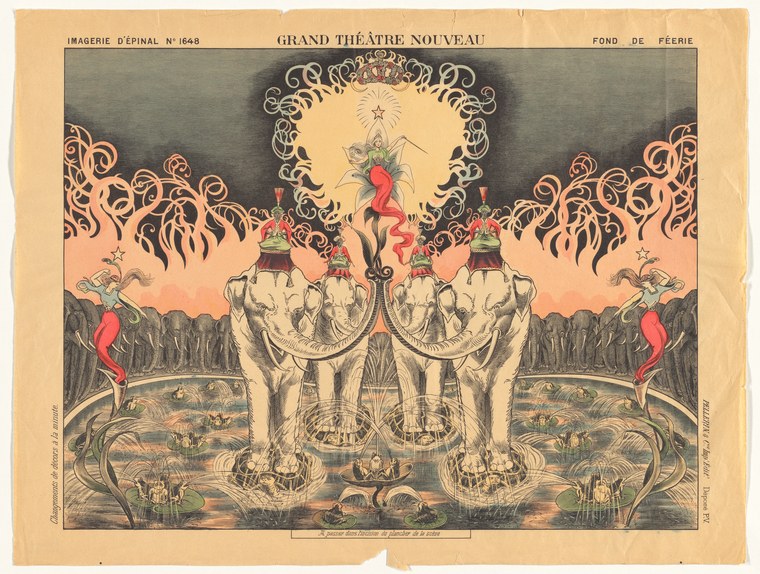
This is a theatrical fantasy vision centered on two monumental elephants parading in stately procession. Each elephant wears an ornate ceremonial caparison—a draped cloth laden with flowers and architectural ornament—and is mounted by a seated figure in flowing robes. The elephants stand in mirror symmetry, their bodies impossibly interlocked at the middle as if merged into a single fantastical beast. Behind and above them rises an elaborate proscenium arch adorned with curling Art Nouveau ornament and a central image of a luminous figure or goddess in robes and a star-topped crown. The background is filled with dense ranks of onlookers in silhouette, creating the effect of a vast amphitheater or circus crowd. Tendrils of ornamental foliage extend from the arch frame like living vines or theatrical drapery. The whole composition radiates outward from a central focal point, using deep perspective and symmetry to suggest both Eastern grandeur and fin-de-siècle theatrical spectacle. The color palette alternates warm peaches and flesh tones against cool gray-blacks, with touches of red ribbon and gold, creating a dreamlike nocturnal atmosphere.
The dancing
The two riders sit upright in formal, stationary poses atop the elephants, their bodies passive and ceremonial rather than actively dancing. Their posture is vertical and dignified, without the flexed joints, weight shifts, or directional momentum that would indicate bodily performance. The onlooking crowd forms a stationary frame rather than participants; no individual dancers are visible in the mass. This is a spectacular pageantry or procession, not a social dance or ensemble movement.
The dance depicted
This image does not depict dance in the conventional sense. It portrays an elaborate theatrical or ceremonial procession—a *féerie* (fairy spectacle or opulent fantasy scene)—a genre of spectacular theatrical production popular on the Parisian stage in the late 19th century. The elephants, riders, architectural ornament, and massed audience belong to the visual vocabulary of pantomime, circus, and grand opera stagecraft rather than to dance proper. If dancers participated in such a scene, they would have formed part of the crowd or served the spectacle, not been its central focus.
How it was made
This is a colored engraving or print, likely hand-colored after engraving or produced by chromolithography, a process that allowed multiple colors to be layered and printed in registration. The fine linear detail in the ornament and crowd, the tonal modeling in the elephants and drapery, and the ability to achieve both delicate linework and broad color fields point to a high-quality late-19th-century print technique. The header credits 'IMAGERIE D'ÉPINAL' (Épinal imagery), identifying it as coming from the legendary printmaking workshops of Épinal in eastern France, which specialized in hand-colored engravings and broadsheets for popular consumption.
About this work
This is a theatrical design or record of a *féerie*—a spectacle production from the Grand Théâtre Nouveau in Paris. The print documents the visual grandeur and fantastical machinery of these elaborate stage entertainments that dominated the Parisian stage in the fin-de-siècle period. While not a dance scene per se, it captures the aesthetic world in which dance existed: a world of architectural splendor, synchronized visual spectacle, and collaborative performance spectacle. The Épinal print tradition made such images available to the popular audience, allowing people who had not seen the production to imagine its splendor.
How to look at it
Attend to the relationship between the central figures—the elephants and their riders—and the architectural frame that surrounds them. Notice how the proscenium arch, the radiating ornament, and the massed crowd all focus attention toward the procession, making the viewer complicit in the act of spectatorship. The symmetry and stillness of the scene suggest a moment of formal display or unveiling rather than active movement. The ornamental profusion—flowers, scrollwork, drapery—shows how the stage itself was as much a performer as any human body.
The artist
The work is credited to the Imagerie d'Épinal, the printmaking enterprise based in Épinal, France, which from the early 19th century onward produced hand-colored engravings and lithographs for popular distribution. These images—of historical events, theatrical productions, military campaigns, religious narratives, and folk tales—reached a mass audience and defined visual culture for working and rural France. No individual artist is named in the catalogue record.
The period
The féerie flourished on the Parisian stage, especially at the Châtelet and other popular theaters, between the 1870s and 1910s. These productions were a synthesis of pantomime, ballet, spectacular stagecraft, acrobatics, and tableau vivant—a visual rather than narrative form that prioritized transformation, machinery, and opulent design. Dancers in a féerie were often corps members or acrobatic performers, outnumbered by actors, machines, and scenic effects. The fin-de-siècle period saw an explosion of interest in the Orient and in exotic spectacle; elephants, palaces, and ceremonial processions were stock elements of the genre. This print documents that world.
Where it lives
The print is held in the New York Public Library's collection of dance-related prints. It is catalogued as part of the library's broader visual documentation of theatrical and performance history, likely acquired as evidence of stage design and spectacle production rather than as a primary dance document.
Questions about this work
Is this a dance scene?
Not primarily. This is a theatrical *féerie*—a spectacular stage production featuring scenery, machinery, processions, and pageantry. Dancers may have been part of the ensemble or corps, but this image documents the architectural and scenic spectacle that framed them, not a choreographed dance itself.
What is a féerie?
A féerie was a type of spectacular theatrical production, hugely popular in Paris from the 1870s onward, that combined pantomime, ballet, acrobatics, and elaborate stage machinery to tell fantastical stories of transformation and wonder. They were designed to dazzle the eye rather than to tell a coherent narrative, and they prioritized visual spectacle over text or character.
What is the Épinal print tradition?
The Imagerie d'Épinal was a renowned printshop in the French town of Épinal that produced hand-colored engravings and lithographs for popular distribution from the early 1800s onward. Their images reached a mass audience and shaped how ordinary French people saw the world—recording historical events, theatrical triumphs, folk tales, and contemporary wonders in accessible, colorful form.
More dance artwork





