49 works in this view — arrow keys or swipe to move between them.
Dance in Art
The cachucha: sung by Madame Vestris
Unknown artist
- Collection:
- Prints depicting dance
- Source:
- New York Public Library
- Rights:
- Public domain — free to use, share and adapt.
- Recorded as:
- Public Domain
The cachucha was a pivotal moment in the theatricalization of Spanish dance and a direct ancestor of later flamenco and Spanish dance in theatrical contexts. This print is visual evidence of how the dance was understood, taught, and marketed to non-Spanish audiences in the early 19th century—and how it was shaped by the conventions of Romantic-era theatrical performance. For dancers and historians, it documents a style and a moment: the precise stance, the arm positions, the emotional register of the performance, and the kind of body and training the dance demanded.
What you are looking at
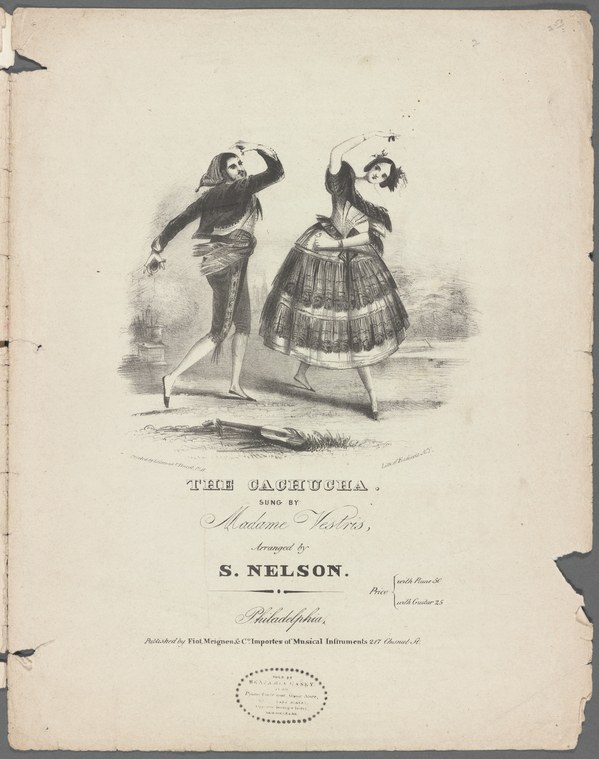
A theatrical scene in a stylized interior setting showing two figures in dynamic poses. On the left, a male dancer in dark tailcoat and light breeches leans backward with one arm raised to his head in a gesture of exertion or abandon, his body weight thrown into an energetic position. On the right, a female dancer in a full, elaborately gathered skirt with decorative striping and a fitted bodice strikes a confident pose with both arms raised and head tilted. The floor is suggested by a simple line, and the background is left minimal, focusing attention on the figures. The style is a lithographic or engraved theatrical print with fine linework and careful tonal gradation characteristic of early 19th-century music and dance publicity materials.
The dancing
The male figure's pose suggests a moment of vigorous exertion—his torso arches backward with his weight on one leg, his free arm reaching toward his head. The female dancer is more upright and grounded, her posture open and presentational, with raised arms framing her face. Both figures display the high energy and dramatic extension typical of theatrical performance. The spatial relationship suggests they are performing separately but in concert, rather than in a coupled hold, which is consistent with Spanish dance forms.
The dance depicted
This print documents the cachucha, a Spanish solo or paired dance that became a major attraction of European theatres in the 1830s–1840s, particularly through the performances of dancer Madame Vestris mentioned in the title. The cachucha was known for its energetic, flirtatious character, rapid footwork, and dramatic arm movements. The print captures the essence of the dance as theatrical spectacle—the dynamic asymmetrical poses, the combination of technical display and dramatic gesture, and the interaction between the two dancers. The image shows the dance as a vehicle for individual performance and romantic narrative rather than a formal pattern or couple's dance.
How it was made
This is a lithographic print, as evidenced by the characteristic crayon-drawn line quality and the soft tonal modulation typical of early 19th-century music-hall and theatre publicity. Lithography allowed rapid, inexpensive production of promotional images with fine detail, making it ideal for advertising theatrical performances. The medium permitted both precision in costume detail and the fluid expression of movement necessary to capture the dance's character. The print would have been produced for distribution as sheet music cover art or theatre publicity, reaching a broad middle-class audience interested in fashionable entertainment.
About this work
This is a theatrical print advertising a performance of the cachucha, a Spanish dance that became one of the defining attractions of the 1830s–1840s European stage. The print documents not the dance as a folk tradition but as a theatrical spectacle, packaged and performed by celebrity dancers like Madame Vestris for metropolitan audiences. It is one of numerous prints that circulated to promote theatrical performances and music, and it preserves the aesthetic moment when Spanish and Latin American dance forms entered the mainstream of European theatrical culture. The image captures both the technical demands of the dance—the dynamic balance, the control of the body's weight—and its theatrical appeal: the combination of energy, flirtation, and exotic glamour that made it irresistible to audiences.
How to look at it
The print freezes a moment of maximum expression and energy rather than a neutral pose, which was typical of theatrical dance publicity. Notice the asymmetry of the two figures—they are not in unison or a formal pattern, but each occupied with their own gesture and dynamic. The male dancer's arched back and reaching arm convey exertion and abandon; the female dancer's raised arms and open posture convey confidence and control. The artist has chosen a moment that conveys the dance's character—spirited, dramatic, demanding—rather than its technical content. Look at the costume detail: the gathering and striping of the female dancer's skirt, which would have caught the eye and the light in performance, and the tailcoat of the male dancer, which situates the dance within a theatrical rather than vernacular context.
The artist
The artist is not recorded. The engraving or lithography was likely produced by a London-based music and dance print publisher—these firms employed skilled artisans who specialized in theatrical publicity and sheet music cover design. The work is attributed to S. Nelson as arranger of the music (printed at the bottom), suggesting the image accompanied a published piano arrangement of the cachucha for domestic performance.
The period
The cachucha achieved European theatrical fame in the 1830s, particularly following the London stage success of Spanish dancer Manuela Montez and other performers. It arrived at a moment when Romantic-era audiences were fascinated by exoticism, gender spectacle (the dance showcased female performers in an unusually active and autonomous role), and the theatrical possibility of folk and national dances. This coincided with a boom in lithographic music publishing, which brought images of fashionable dances into middle-class homes. The same period saw the emergence of Romantic ballet and the codification of pointe work, but the cachucha occupied a different theatrical space—closer to popular entertainment and novelty than to classical dance.
Where it lives
The print is held in the New York Public Library's collection of prints depicting dance, part of its broader holdings in theatrical and music history materials. It was likely issued as sheet music cover art or theatre publicity material for a London publisher, circa 1830s–1840s, though the exact date of issue is unknown.
Dance in this work
Questions about this work
What is the cachucha and why did audiences care?
The cachucha is a Spanish dance that became a sensation on the European stage in the 1830s–1840s. It was energetic, flirtatious, and showcased individual performers (especially women) in a starring role. For Romantic-era audiences fascinated by exoticism and new kinds of theatrical spectacle, the cachucha offered novelty and a form of performance that was neither classical ballet nor folk entertainment, but a hybrid.
Who was Madame Vestris?
Madame Vestris (Lucia Elisabetta Bartolozzi, 1797–1856) was an Italian-born performer who became one of London's most celebrated theatrical stars. She was known for her singing, her acting, her dance abilities, and her business acumen—she eventually ran her own theatres. She danced the cachucha and helped popularize it among London audiences.
How is the cachucha related to flamenco?
The cachucha is a Spanish dance, but it is not a traditional flamenco form. In the 19th century, Spanish dances including the cachucha, bolero, and others were theatricalized and promoted internationally as national spectacles. Later, some of these forms influenced or merged with flamenco tradition. Modern flamenco includes reference to these 19th-century theatrical forms, but they are distinct histories.
Why is this image a lithograph?
Lithography was the dominant technology for mass-producing images of theatrical performances and popular music in the 1830s–1840s. It was faster and cheaper than engraving, allowed fine detail, and produced images that could be printed in bulk and distributed as sheet music covers or theatre advertisements. Almost all theatrical dance publicity from this period survives as lithographic prints.
More dance artwork





