49 works in this view — arrow keys or swipe to move between them.
Dance in Art
M'lle. [Louise] Lamoureux, the celebrated danseuse [with accompanying article]
Unknown artist
- Collection:
- Prints depicting dance
- Source:
- New York Public Library
- Rights:
- Public domain — free to use, share and adapt.
- Recorded as:
- Public Domain
This item is significant only as evidence of how dance was integrated (or not) into the editorial and illustrative strategy of mid-nineteenth-century American illustrated periodicals. If an article about M'lle. Lamoureux does appear elsewhere on this page or in this issue of Ballou's, examining the separation between dance criticism and architectural documentation illustrates the different regimes of representation available to the periodical press.
What you are looking at
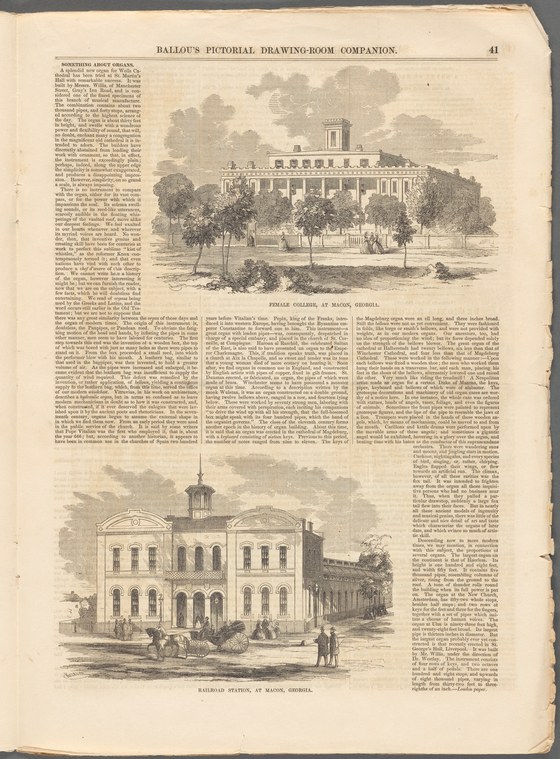
This is a page from Ballou's Pictorial Drawing-Room Companion, a mid-nineteenth-century periodical, containing two wood-engraved architectural views with accompanying letterpress text. The upper illustration shows Roanoke College at Salem, Virginia—a three-story Greek Revival building with a cupola, set among mature trees on a broad lawn, with small figures of people scattered in the foreground suggesting the scale and institutional character of the campus. Below it is a second engraving of a smaller public building, identified as the Raisom Depot in Macon, Georgia—a two-story brick structure with a central cupola, again rendered in the precise linear style typical of mid-nineteenth-century wood engraving. The page is densely printed with small-type article text flanking and below the images, characteristic of the publication's format as an illustrated newspaper for educated American readers. The condition is consistent with age: paper has yellowed, and the surface shows wear.
The dancing
The human figures visible in both images are rendered at small scale appropriate to architectural illustration, showing them as incidental elements that establish spatial context and the social function of these buildings rather than as subjects of detailed study. In the Roanoke College view, several figures stand or walk in the lawn and pathways, their posture upright and formal, dressed in period clothing typical of the 1850s. None display movement suggestive of dance; all are stationary or engaged in leisurely pedestrian movement.
The dance depicted
These are not dance images. The title and accompanying article concern M'lle. Louise Lamoureux, described as a celebrated danseuse, but the architectural engravings on this page do not depict her or any dancing. The architectural subjects—an educational institution and a public building—have no apparent connection to dance, performance, or theatrical activity. The figures visible in the landscape are ordinary pedestrians in everyday dress and posture.
How it was made
Both images are wood engravings—a relief-printing technique in which an image is carved into the end grain of a boxwood block, allowing it to be printed alongside type. This technique was the standard for periodical illustration from the 1820s through the 1880s and was ideal for rapid reproduction and circulation in newspapers and magazines. The fine parallel lines and careful cross-hatching visible in both images are characteristic of professional wood-engraving work, suggesting these were prepared by experienced commercial illustrators. Wood engraving's economy and durability made it the dominant medium for illustrated periodicals like Ballou's, which reached a mass audience.
About this work
This is a page from an American periodical, Ballou's Pictorial Drawing-Room Companion, dated to the mid-nineteenth century and held in the New York Public Library's collection of prints depicting dance. However, the page itself contains no depictions of dance. The two wood-engraved architectural views—of Roanoke College and a building in Macon, Georgia—are documentary illustrations of American institutional and civic architecture, typical of the publication's content. The catalogue record appears to conflate the page as a whole with an article about a dancer that may appear elsewhere in the same periodical or issue.
How to look at it
Approach this page as a document of periodical design rather than as a dance image. Note how the two architectural engravings are integrated with letterpress text in a dense, economical layout typical of the era. Examine the engraver's technique—the fineness of the parallel lines and the precision of the architectural rendering—which suggests these were expensive blocks prepared by skilled professionals. If seeking information about M'lle. Lamoureux, check whether an article or image related to her appears elsewhere on this page or in adjacent pages.
The artist
The wood engravings are unsigned but represent the work of professional commercial illustrators working for a major American periodical. Ballou's Pictorial Drawing-Room Companion, founded in 1855, employed staff artists and contracted with independent engravers to produce illustrations at a high standard. The technique and finish of both images are consistent with American wood-engraving practice of the 1850s–1860s, though the catalogue record does not name the engraver or artist responsible for these particular blocks.
The period
Mid-nineteenth-century American illustrated periodicals like Ballou's (founded 1855) brought wood-engraved imagery into middle-class households on a weekly basis. The publication mixed reportage, entertainment, and cultural documentation—including coverage of theatrical performers and entertainers—with architectural and topographical views of American institutions. The presence of images of Roanoke College and Macon buildings suggests the periodical's audience included readers with regional interests in Southern education and infrastructure. By mid-century, photographic reproduction was not yet economically practical for periodical illustration, so wood engraving remained the primary technology for distributing images at scale.
Where it lives
This page is held in the New York Public Library's collection of prints depicting dance. The cataloguing suggests the entire page was indexed under the dance collection, likely because of the mention of a dancer in the associated text, despite the images being purely architectural. The object is a page from Ballou's Pictorial Drawing-Room Companion, an American illustrated weekly periodical.
Questions about this work
Is there actually a dancer shown on this page?
No. The two images are wood engravings of buildings in Virginia and Georgia. If an article about M'lle. Louise Lamoureux appears on this page, it is presented as text rather than as an illustration of her performing or posing.
What is Ballou's Pictorial Drawing-Room Companion?
An American illustrated weekly periodical published from 1855 onward, known for combining news, entertainment, and cultural coverage with wood-engraved illustrations of events, institutions, and notable people. It reached middle-class and educated readers.
Why is a page of architectural images in a dance collection?
The catalogue record appears to have been created from the text content of the page rather than from visual analysis of the images. The presence of an article about a dancer may have prompted the entire page to be indexed as dance-related material.
Who engraved these buildings?
The images are unsigned, and the catalogue record does not identify the engraver. Professional wood-engravers working for Ballou's in the 1850s–1860s produced images at this standard, but attribution would require archival research.
More dance artwork





