49 works in this view — arrow keys or swipe to move between them.
Dance in Art
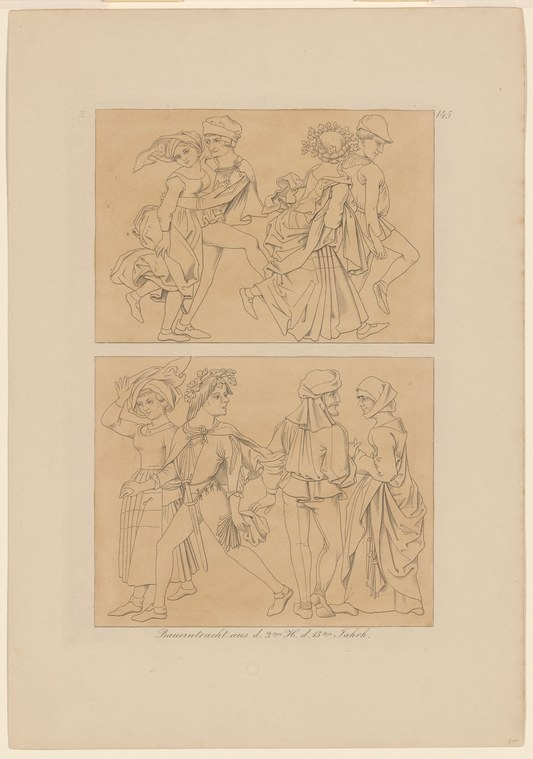
Bauerntracht aus d. 2ten H. d. 15ten Jahrh
Unknown artist
- Collection:
- Prints depicting dance
- Source:
- New York Public Library
- Rights:
- Public domain — free to use, share and adapt.
- Recorded as:
- Public Domain
These drawings preserve visual evidence of peasant dancing and social custom from the 15th century, a period from which few reliable depictions of folk or communal dance survive. The artist's attention to body position and gesture rather than costume alone indicates that movement and celebration were the subject, not merely dress, making this a rare documentary record of how ordinary people danced outside the court.
What you are looking at
Two framed pen drawings on a single sheet depict peasant life and costume from the second half of the 15th century, the inscription at lower left reading "Bauerntracht aus d. 2ten H. d. 15ten Jahrh" (peasant dress from the 2nd half of the 15th century). The upper scene shows five figures in animated interaction: a man in the left foreground, his body twisted and arm raised, engages with a woman in a long gown and head covering; two additional figures flank them, and a fifth figure at the right appears to gesture or dance. The lower scene presents a different group of six figures, including a man in armor or quilted dress on the left in an active pose, a woman in flowing drapery beside him, and four other figures in various postures of engagement. The drawing style is brisk and exploratory, with light pen lines defining the figures against the cream paper. The costumes are rendered with careful attention to period dress: long gowns with voluminous skirts, head coverings, tunics, and what appear to be pointed shoes. The composition emphasizes social engagement and movement rather than narrative stillness.
The dancing
The figures are drawn with elastic, expressive lines that convey energy and motion. In the upper scene, the man on the left shows an exaggerated twisted posture with raised arm, suggesting vigorous movement or celebration; the woman beside him maintains an upright stance in formal dress. The lower scene includes a figure in armor whose dynamic stance—with weight shifted and body angled—suggests active engagement, possibly dancing or demonstrating movement. The drawings emphasize vertical extension and asymmetrical weight distribution, with arms and legs placed to suggest action across multiple planes. The artist has captured individuals in relation to one another rather than in formal partner holds.
The dance depicted
These appear to be figure studies or documentation of peasant social customs and festival behavior from 15th-century German or Northern European culture. The energetic postures, raised arms, and twisted body positions suggest festive dancing or celebration, possibly village merrymaking or carnival behavior. The presence of both genders in animated proximity, the gesture-rich poses, and the apparent lack of formal choreography point toward folk or social dancing rather than court dance. Without clearer narrative context or identifying inscriptions beyond the dress notation, the specific dance type cannot be determined, though the visual evidence suggests communal celebration or revelry typical of seasonal peasant festivals.
How it was made
These are pen drawings on laid paper, executed with the loose but assured line work characteristic of Northern European Renaissance draftsmanship. The technique—quick, exploratory pen strokes with minimal shading—suggests preparatory study or finished sketch rather than a highly resolved composition. The two separate framed compositions on a single sheet suggest this may be a page from a larger study series or costume book documenting social types and dress. The reproduction in this collection indicates the image has been printed or photographed for wider circulation, making it accessible as historical documentation of 15th-century visual culture.
About this work
This double-scene drawing documents peasant costume and social behavior in the second half of the 15th century, likely from a German-speaking region of Northern Europe. The energetic poses and gesture-rich figures suggest the artist was recording not only dress but also the embodied customs of festival celebration and social dancing among rural populations. The work belongs to a tradition of ethnographic or costume documentation that served both artistic study and social record—visual evidence of how ordinary people moved, dressed, and gathered.
For a gallery of dance in art, the drawings matter as rare visual evidence of folk or peasant dancing from a period when such customs were rarely deemed worthy of formal artistic attention. The artist chose to record movement—the twisted spine, the raised arm, the dynamic stance—rather than static costume display, suggesting that the actual practice of dancing and celebration was central to what they wished to preserve.
How to look at it
Notice first the twisted and angled body positions—the way the artist has caught the figures mid-gesture rather than in repose. Observe how the pen line itself conveys motion: the raised arm, the shifted weight, the turned torso all suggest captured action rather than posed arrangement. The contrast between the formal gowns (which fall straight) and the irregular, energetic postures of the bodies within them creates visual tension that conveys the dynamism of social dancing. Look at how the figures relate to one another across the composition: they are engaged in a shared social space, not arranged for formal presentation.
The period
The late 15th century in Northern Europe was a moment when Renaissance artists and scholars began systematically documenting social types, costumes, and everyday customs. Northern artists in particular—working in a tradition descended from the Flemish primitives—showed sustained interest in rendering the material culture and social behavior of rural and urban working people. This was also the period of the earliest German and Flemish costume books, which served both as artistic reference and as ethnographic record. Simultaneously, court dance was becoming increasingly formalized and documented; these peasant studies may represent an artist's effort to capture the uncodified, gestural dance practices that existed in parallel to the elaborate choreography of noble entertainment.
Where it lives
The drawing is part of the New York Public Library's collection of prints depicting dance, held as part of their broader print and drawings collections. The work survives as a page-based study, likely part of a larger costume or society documentation project.
Dance in this work
Questions about this work
What does the title mean?
"Bauerntracht aus d. 2ten H. d. 15ten Jahrh" translates as "Peasant dress from the 2nd half of the 15th century." The inscription labels these as costume studies with a historical period marker, indicating the artist was documenting authentic dress from that era.
Are these people actually dancing, or just in fancy dress?
The animated postures—twisted spines, raised arms, shifted weight—strongly suggest active movement and celebration rather than static costume display. The artist chose to draw these figures in motion, not standing still, indicating that the practice of dancing or festive gesture was part of what they wished to record.
Why are there two separate scenes on one page?
This format suggests the page is either part of a larger study series or a systematic documentation of different social groups or occasions. Pairing two scenes allowed the artist to show variation in composition, costume, and interaction while maintaining focus on the theme of peasant social custom.
What can we learn about 15th-century peasant dance from this?
The drawings show that peasant celebration involved vigorous, gesture-rich movement without apparent formal choreography. The proximity of men and women, the emphasis on raised arms and twisted postures, and the animated spacing suggest social or circle-based dancing quite different from the symmetrical, controlled movements documented in court dance of the same period.
More dance artwork





