49 works in this view — arrow keys or swipe to move between them.
Dance in Art
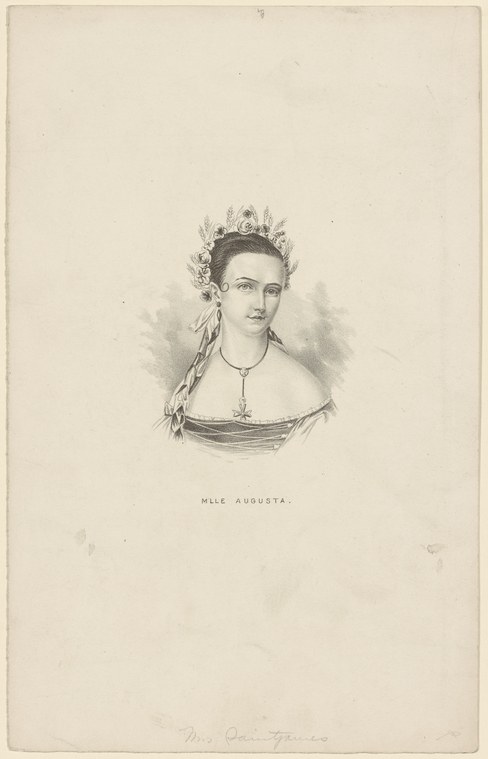
Mlle. Augusta
Unknown artist
- Collection:
- Prints depicting dance
- Source:
- New York Public Library
- Rights:
- Public domain — free to use, share and adapt.
- Recorded as:
- Public Domain
This print preserves the identity and likeness of a professional performer whose name survives in the title but whose biographical record may not. Such portraits are primary evidence of who performed, how they were costumed, and how theatrical celebrities were commodified and consumed by 19th-century audiences. The engraved portrait format reveals the economics and publicity apparatus of stage performance in this period.
What you are looking at
A bust-length portrait of a young woman in three-quarter view, rendered in fine engraving or lithographic technique. She wears an ornate jeweled crown or tiara and her dark hair is arranged with a long braided plait or ribbon trailing down her back. Her bare shoulders emerge from what appears to be a draped garment in a classical style, with a thin chain or necklace at her throat. The background is empty and neutral, rendered with light hatching to suggest volume. The entire image is delicately finished with fine parallel lines, typical of 19th-century reproductive printmaking. The woman's gaze is direct and frontal, her expression composed and dignified, with fine facial features rendered in careful detail.
The dancing
A single figure, shown from the shoulders up in frontal or near-frontal orientation. The head is held upright with a composed, serene expression. Both shoulders are visible and bare, suggesting a classical or operatic costume. The figure is static and posed rather than in motion, the body completely still and formally arranged.
The dance depicted
This is not a depiction of dance in motion. The title identifies the subject as 'Mlle. Augusta,' likely a professional dancer or performer of the 19th century whose name warranted a portrait publication. The classical drapery, tiara, and formal pose suggest a theatrical performer—possibly an opera dancer, a prima ballerina, or a celebrated stage artist of the Romantic or Second Empire era. The print format indicates this was a publicity or commemorative image, circulated among audiences interested in theatrical personalities. Without additional documentation, the specific genre in which Augusta performed cannot be determined from the image alone.
How it was made
This is a steel engraving or fine lithograph, likely dating to the mid-19th century based on the technique and printing conventions. The image shows the fine parallel hatching and delicate tonal gradations characteristic of reproductive intaglio or lithographic portraiture of the period. Such prints were produced in quantity and distributed commercially—as sheet music covers, theatrical programmes, or independent portrait cards sold to audiences. The technique allowed for precise rendering of facial features and costume details, making it suitable for celebrity portraiture.
About this work
This is a formal printed portrait of a 19th-century theatrical performer named Augusta, presented in the style of a publicity print or engraved celebrity image. The subject's identity and the genre of her performance remain unconfirmed by the available record, though her costuming and the prominence of the portrait suggest she was a notable stage figure of the Romantic or mid-Victorian era. The image belongs in a dance gallery not because it depicts dance itself, but because it documents the celebrity culture around professional performers—the way theatrical dancers were marketed, remembered, and circulated to the public through engraved portraiture.
How to look at it
Look at the precision of the facial rendering and the careful articulation of costume details—the jewels of the tiara, the delicate chain, the play of light and shadow across the shoulders. These elements reveal the printmaker's investment in making Augusta recognizable and memorable as an individual. The formal frontality and composed expression follow conventions of celebrity portraiture: the subject presents herself to the viewer as an object of admiration, not as a figure captured in a fleeting moment of performance.
The artist
The artist is not recorded in the catalogue, but the technical quality and style suggest a professional reproductive engraver or lithographer working within established commercial portrait conventions of the mid-19th century. Such works were often unsigned or attributed only to the subject, not the printmaker.
The period
This portrait dates to the era of Romantic ballet and the celebrity cult surrounding prima ballerinas—a period (roughly 1830–1860) when theatrical performers achieved unprecedented fame and visibility through prints, photographs, and publicity. Engraved and lithographed portraits of dancers and opera singers were collected objects, sold commercially, and often tipped into programmes or bound into theatrical albums. The classical costuming and formal pose reflect the aesthetic ideals of mid-19th-century theatrical culture, in which performers were presented as refined, elevated, and worthy of serious artistic commemoration.
Where it lives
The print is held in the New York Public Library's collection of prints depicting dance. The NYPL catalogue identifies it as a historical theatrical portrait, but provides no accession number, acquisition date, or prior provenance information in the available record.
Questions about this work
Who was Mlle. Augusta?
The catalogue provides only the name on the print. She was evidently a notable enough performer to warrant a published engraved portrait in the 19th century, suggesting she had some fame in theatrical circles, but the available record does not identify her profession, dates, or biography. Further research in theatrical archives, dance histories, or newspaper databases might establish her identity and career.
Is this a ballet dancer?
The classical costuming and the formal portrait convention suggest a theatrical performer of some kind—possibly ballet, opera, pantomime, or dramatic theatre. The tiara and drapery are consistent with Romantic-era ballet costume, but they were also worn by opera singers and dramatic actresses. Without additional documentation, the specific genre cannot be confirmed.
Why is this in a dance collection?
This portrait documents the celebrity culture and publicity apparatus surrounding theatrical performance in the 19th century. Even though it does not show dance in motion, it is valuable evidence of how dancers were marketed, identified, and remembered by audiences of the period. It preserves a name and a face that might otherwise be lost.
When was this engraved?
The technique and style suggest a date in the mid-19th century, most likely between 1830 and 1870. The catalogue record does not provide a specific date. Comparison with dated theatrical portraits from this era, or additional research in printer's records or publishing archives, might narrow the timeframe.
More dance artwork





