49 works in this view — arrow keys or swipe to move between them.
Dance in Art
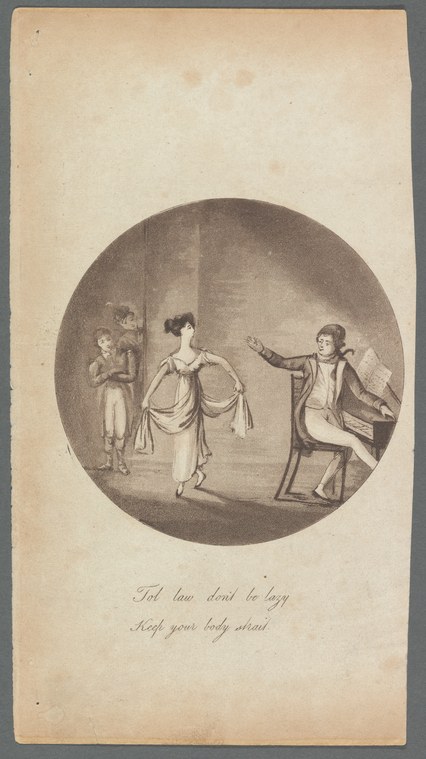
Tol law don't be lazy, keep your body strait
Unknown artist
- Collection:
- Prints depicting dance
- Source:
- New York Public Library
- Rights:
- Public domain — free to use, share and adapt.
- Recorded as:
- Public Domain
This image reveals the 18th-century assumption that correct bodily carriage—whether in dance or daily life—was a discipline to be learned and enforced, not an innate ability. It shows how prints functioned as behavioral instruction, using exaggerated figures and the moral weight of the engraving medium itself to teach viewers (likely children or those in service) the rules of bodily propriety that underpinned social order.
What you are looking at
This circular vignette depicts three figures in a stark interior space with draped fabric. A woman in a classical draped gown stands center-left, her body turned in contrapposto. To her left, a bearded male figure in period dress gestures toward her with one arm extended. On the right, a second male figure in coat and breeches leans back in an exaggerated posture, one arm raised. The composition uses strong chiaroscuro, with the figures emerging from shadow against a neutral background. The inscription below reads "Tol law don't be lazy, keep your body strait"—a directive that suggests moral instruction through bodily comportment.
The dancing
The central female figure maintains an upright, poised stance with weight distributed evenly—her body "strait" as the caption demands. The two male figures flank her asymmetrically: the left-hand man adopts a courtly gesture with open palm; the right-hand man's exaggerated backward lean and raised arm suggest either mockery or corrective demonstration of poor posture. Their relative positions and the woman's centered calm suggest she embodies the correct comportment that the men are either modeling or failing to maintain.
The dance depicted
This is not a depiction of theatrical dance but rather a moral instruction image using the body as its vehicle. The postures and the imperative in the caption suggest 18th-century conduct literature or etiquette instruction, where bodily 'straightness' and upright carriage signified virtue, discipline, and social propriety. The three-figure arrangement and the theatrical staging indicate this may derive from or relate to popular prints of the period that used exaggerated character types to teach social behavior. The specific phrase "keep your body strait" echoes the language of deportment instruction for both children and servants.
How it was made
This is an engraving or aquatint, likely produced in the late 18th century, working from the style of the line, the tonal modeling, and the circular composition within a rectangular page. The technique allowed fine gradations of tone and the precise rendering of fabric drapery and facial expression. The small scale and portable format suggest this was distributed as a popular print, likely part of a series of moral or behavioral instruction images. The composition in a circular frame—a common device in 18th-century print culture—gives the scene an almost medallion-like authority, as if this moment of instruction merits formal preservation.
About this work
This is a moral instruction print using dance-adjacent bodily comportment as its subject. It belongs in a gallery of dance in art because it documents how the body was understood as a sign system in the 18th century—where upright carriage, gesture, and balance conveyed not just grace but virtue and obedience. The print shows us that 'dance' in this period included not only theatrical spectacle but the everyday discipline of the body in social and domestic space. The inscription transforms what might appear to be a social scene into a lesson in self-regulation, making clear that bodily behavior was never merely aesthetic but always also moral and political.
How to look at it
Notice how the central woman's vertical alignment contrasts with the bent and gesturing men around her. The composition invites you to read from the chaotic or exaggerated figures on either side toward the upright, composed woman in the center—a visual argument for the superiority of 'straight' posture. The intense chiaroscuro and the theatrical staging also suggest that this instruction was meant to be memorable and even slightly amusing, using caricature to reinforce the lesson. Look at the quality of the line and tone: this is a professional engraving, produced for circulation and repetition, indicating that the lesson was considered important enough to distribute widely.
The period
This print dates to an era when dance instruction and bodily deportment were inseparable from moral education. The 18th century saw the proliferation of etiquette manuals, conduct books, and instructional prints that treated the body as a text to be read and corrected. Dancing masters of the period—including those who taught minuet and cotillion—were also teachers of bearing and carriage, training aristocratic and middle-class bodies to signify discipline and propriety. The theatrical vocabulary of the three-figure scene suggests that bodily instruction was often presented as theater, with exaggerated positive and negative examples to make the lesson vivid.
Where it lives
Held in the New York Public Library's collection of prints depicting dance. The work is part of a broader 18th-century archive of visual instruction and moral pedagogy, circulated in printed form.
Questions about this work
Is this actually a dance print?
It depicts bodily comportment and posture rather than theatrical dancing, but it belongs in dance history because it documents how the body was trained and disciplined in the 18th century. Dance instruction of the period was inseparable from deportment training, and this print shows that world. The three figures engage in what might be called 'dancing masters' theater'—using exaggerated posture to teach correct bodily behavior.
What does 'keep your body strait' mean?
'Strait' here means upright, aligned, and unbent—the opposite of the curved, gestural, or exaggerated postures shown by the two male figures. In 18th-century etiquette, an upright carriage signified virtue, obedience, and self-control. The word plays on 'strait' as constraint or narrowness, suggesting that correct posture requires discipline and alignment.
Who was this print made for?
Given its small scale, pedagogical tone, and the phrase 'don't be lazy,' this was likely made for children or servants—people whose bodies needed to be trained into correct social forms. The tone is corrective but not cruel, suggesting an audience that needed guidance rather than experienced dancers or aristocrats who would already know these rules.
More dance artwork





