49 works in this view — arrow keys or swipe to move between them.
Dance in Art
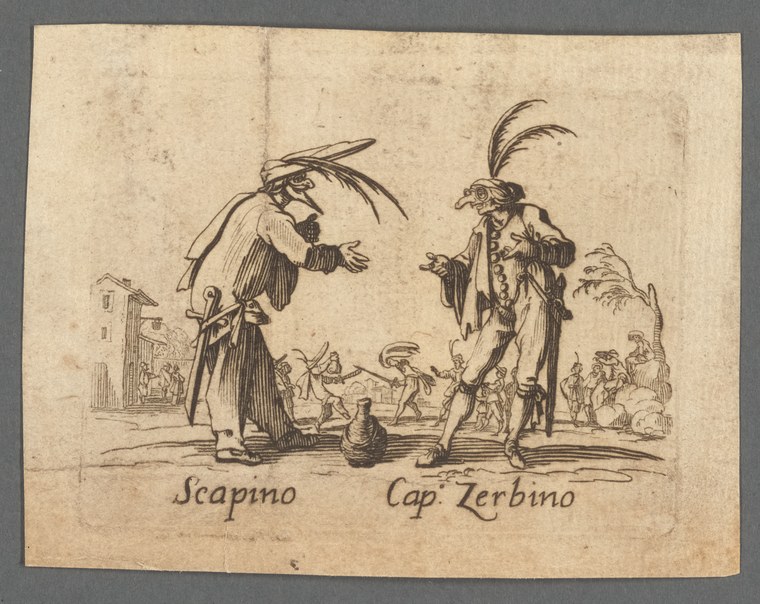
Scapino, Cap[tain] Zerbino
Unknown artist
- Collection:
- Prints depicting dance
- Source:
- New York Public Library
- Rights:
- Public domain — free to use, share and adapt.
- Recorded as:
- Public Domain
Commedia dell'arte was a training ground and vocabulary-source for theatrical movement that fed into formal dance traditions, and these character prints are among the few visual records of actual performance practice. Dancers and historians of popular theater need to understand what physical idiom these stock characters embodied, and this engraving preserves the gestural and postural language of Scapino and Zerbino as performed entertainers understood it.
What you are looking at
Two figures in exaggerated theatrical dress dominate this engraving, positioned in confrontation or animated conversation in what appears to be a public square or street. The figure on the left, labeled Scapino, wears a tall feathered hat and voluminous striped costume with a sword at his hip; the figure on the right, Cap[tain] Zerbino, sports an even more elaborate plumed hat and ornate decorated coat. Both strike dynamic poses with raised arms and bent knees, their bodies leaning toward each other in energetic engagement. Behind them, a crowd of smaller figures suggests a performance or gathering, with architecture (possibly a tavern or building entrance) sketched at the left edge. The composition freezes a moment of theatrical interaction—whether it is combat, mockery, seduction, or simply emphatic conversation. The setting and costume detail suggest street theater or popular comedy rather than court dance.
The dancing
Both figures stand in wide, assertive stances with knees bent and weight distributed for movement. Their arms are raised and extended toward each other in gestures that are emphatic and communicative rather than balletic. Scapino's left arm extends outward while Zerbino mirrors the energy on the opposite side. The poses suggest commedia dell'arte physicality—exaggerated, pantomimic, and built for visibility at distance. Neither figure is en pointe or in a closed partnership hold; the relationship is confrontational and comedic rather than partnered dance.
The dance depicted
This depicts comic theater rather than formal dance, but the physicality belongs to the gestural language of commedia dell'arte, which often incorporated movement, acrobatics, and rhythmic physical comedy. Scapino and Captain Zerbino are stock characters from the commedia tradition—Scapino as the clever, scheming servant and Zerbino as a miles gloriosus (braggart captain). The performers of these roles were trained in physical virtuosity and often performed comic dances and acrobatic movement as part of their character work. The engraving captures the character types and their theatrical interaction, but does not depict formal dance steps; it is documentation of popular theatrical character and physical comedy that inhabited the same cultural sphere as dance.
How it was made
This is an engraving on paper, executed in fine hatching and line work typical of northern European printmaking of the 17th century. The technique allows for precise reproduction and wide circulation—this image could be distributed as a standalone print, bound into a book of theatrical characters, or pasted into collections. The style of lettering, the scale, and the technique suggest this is a print made for collectors interested in theater, character types, or popular entertainment. The medium's reproducibility made images of commedia characters particularly valuable for documenting performance traditions that left no other visual trace.
About this work
This engraving documents two stock characters from commedia dell'arte—Scapino and Captain Zerbino—at a moment of theatrical encounter. Though not depicting formal dance, the image records the physical comedy and gestural vocabulary of popular theater in which trained performers incorporated movement, acrobatics, and rhythm as essential elements of character work. Commedia dell'arte troupes traveled across Europe and their physical language influenced both theatrical and social dance throughout the 17th and 18th centuries. The print's circulation and its faithful rendering of character costume and pose make it an important document of how popular performance was visualized and shared across audiences and regions.
How to look at it
Observe the body weight and posture: both figures are in motion or ready for it, with flexed knees and forward-inclined torsos that suggest physicality designed to be read from a distance. The raised arms and emphatic gestures are meant to communicate character and emotion to a crowd, not to show trained technique in the balletic sense. The engraver has captured the moment not as a freeze-frame of a single step but as a readable character interaction—notice how the two figures mirror and respond to each other's energy. The exaggerated costume and the crowd in the background tell you this is popular, public theater meant for outdoor or street performance, not courtly entertainment.
The period
This engraving dates stylistically to the 17th century, when commedia dell'arte had reached the height of its influence and prestige across Europe. Troupes from Italy and France performed at courts and in city squares, and their physical comedy and improvised performance became a model for other performance forms. The period saw increasing documentation of commedia characters through prints, engravings, and painted series; these visual records helped standardize character types and spread knowledge of performance practice beyond those who had seen the troupes perform. By the late 17th and 18th centuries, the influence of commedia movement and character work is visible in court dance, ballet, and comic opera.
Where it lives
The work is held in the New York Public Library's collection of prints depicting dance. It is catalogued with minimal information: artist unrecorded, date unknown, medium and technique not listed in the record but identifiable from the object as an engraving.
Questions about this work
Are Scapino and Zerbino real dancers?
They are stock character types from commedia dell'arte, the Italian tradition of improvised popular theater. The actors who played these roles were trained in physical performance and often incorporated acrobatic movement and comic dances into their act, but they were not ballet dancers or formally trained in court dance. The characters themselves are fictional personas that were performed by many different actors across different troupes.
Why is this in a collection about dance if it is theater, not dance?
Commedia dell'arte was a physical performance tradition closely related to dance: its practitioners trained in acrobatics, rhythmic movement, and gestural language, and its influence on formal dance was substantial. This print documents movement culture that shaped how dance and theater were understood and performed. It also shows how dance and theatrical movement were not separated in the early modern period.
When was this engraved?
The record does not give a date. The style of the engraving, the costume, the character types, and the style of lettering all point to the 17th century, but without further research or comparison to dated examples, a precise date cannot be determined.
More dance artwork





