49 works in this view — arrow keys or swipe to move between them.
Dance in Art
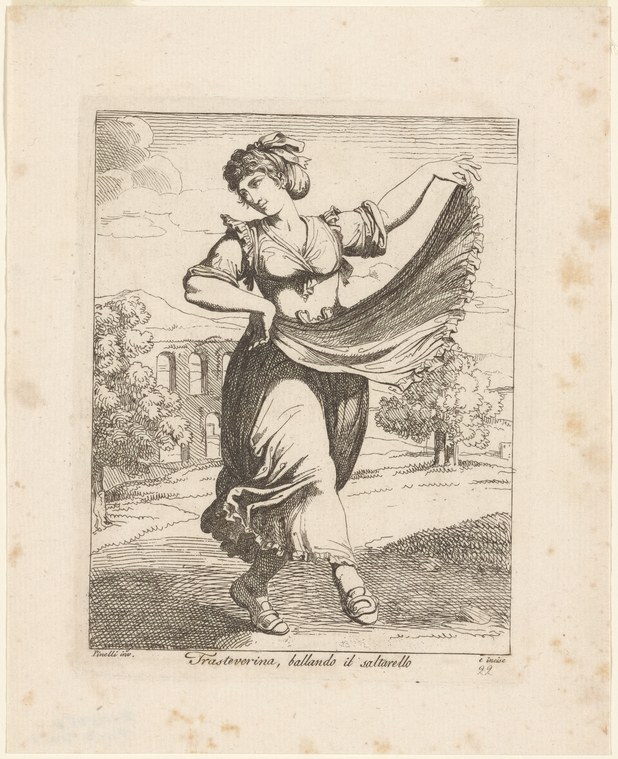
Trasteverina, ballando il saltarello
Unknown artist
- Collection:
- Prints depicting dance
- Source:
- New York Public Library
- Rights:
- Public domain — free to use, share and adapt.
- Recorded as:
- Public Domain
This engraving is one of the few contemporary visual records of the saltarello in performance, capturing both the physical vocabulary of the dance—the lifted leg, the spring-like posture—and its social context as a neighborhood practice. For dance historians and choreographers interested in reconstructing or understanding historical Italian folk movement, this print offers rare direct evidence. The inscription and the decision to document a working-class woman's dance rather than elite ballet or court dance also testifies to a 19th-century interest in preserving popular and regional movement practices.
What you are looking at
A young woman in early 19th-century dress executes a lively solo dance in an outdoor Italian setting. She wears a dark jacket or bodice with puffed sleeves, a white chemise visible at the neckline, and voluminous white skirts that billow around her legs. Her dark hair is pinned up with what appears to be a decorative wrap or turban. She stands in a spirited contrapposto pose with one leg extended and her upper body twisted, her right arm raised high holding a length of sheer fabric—a scarf or veil—that streams behind and above her. The background shows a classical portico or arcade with columns and trees, suggesting a public square or garden. The woman's face is animated, turned upward in pleasure, and her posture conveys energy and lift. The composition captures a moment of unrestrained joy in the dance, the scarf adding dynamic linear movement to complement her bodily gesture.
The dancing
A single female dancer stands on one leg with the other raised and turned outward, her torso rotated toward the viewer. Her arms are asymmetrical: the right arm extends high and backward, holding a scarf that trails upward; the left arm is lower. Her weight appears centered over her supporting leg, and her lifted leg suggests both a turn and a directional accent. The pose conveys spring and momentum rather than static display. Her body is neither rigidly vertical nor deeply bending, but caught in that moment of upward impulse characteristic of bouncing or hopping steps.
The dance depicted
The title identifies this as the saltarello danced by a woman of Trastevere, the working-class neighborhood across the Tiber from Rome's center. The saltarello was a popular Italian folk jump-dance, performed both as a solo or couple dance and as a feature of street celebrations and carnival. The woman's raised leg, the sense of spring in her frame, and the open-air setting all align with what is known of the saltarello in the early 19th century—a dance of quick, percussive steps with a characteristic hop or spring on the beat. The scarf as a hand prop was common in folk and popular dances of the period. This print documents a specific Roman folk tradition, capturing a regional dance practice that might otherwise be forgotten.
How it was made
This is an engraving, executed with fine parallel hatching lines to create tone and volume. The technique is clear from the regular linear marks visible throughout, the crisp outlines, and the way light and shadow are rendered through accumulated parallel strokes rather than blending. Engraving allowed for fine detail and wide circulation—many copies could be pulled from the same plate—making this an accessible image for a broad public. The medium was especially suited to documenting costume, setting, and gesture with precision, which would have made it valuable as a record of regional dress and dance practice.
About this work
This is an early 19th-century engraved print documenting a saltarello, the traditional jump-dance of Trastevere, a working-class district of Rome. The print captures a moment of folk celebration—a young woman in period dress executing the characteristic hopping, springing steps of the saltarello in an outdoor setting that suggests a public square or carnival moment. The work belongs in a gallery of dance in art because it records a specific, named regional dance practice with enough attention to pose, costume, and setting that a dancer or social historian can learn from it. It is not a high-art representation of dance by trained performers, but rather a document of popular dance culture, the kind of everyday practice that is often invisible to the historical record. The naming of both the dance and the specific regional identity of the dancer (Trasteverina) signals that folk dances were recognized, celebrated, and worth preserving in print.
How to look at it
Watch the line of the scarf and the woman's raised arm: they create a diagonal that pulls the eye upward, suggesting the lightness and lift of the saltarello's characteristic jump. Notice the position of her supporting leg and the angle of her raised leg—this is the moment just before or after the push-off of the hop, the axis of the whole movement. The artist chose a moment of clear, legible action rather than a frozen extension pose, which tells us something about how the saltarello was understood: as a bouncy, quick, folk movement rather than a held classical position. The outdoor setting and the casual, joyful expression on the woman's face invite us to see this not as a staged performance for an elite audience but as street celebration.
The artist
The artist is not recorded in the catalogue. The style and technique suggest a professional printmaker working in the early 19th century, likely in Rome or another major Italian city. The inscription in Italian and the choice of subject—a named regional practice—suggest an artist familiar with local culture and possibly working to document it for a Roman or Italian audience.
The period
The early 19th century saw growing interest across Europe in documenting folk culture, regional costume, and popular practices as nationalism and Romanticism shifted attention toward authentic, local tradition. In Italy, this period followed the Napoleonic era and preceded Italian unification, a time of regional consciousness and cultural recovery. The saltarello itself was undergoing transformation: it had been a courtly dance in the Renaissance, performed by nobility, but by the 19th century it was primarily a folk and street dance, most vigorous in working-class neighborhoods like Trastevere. This engraving sits at that intersection—a folk practice being preserved in print, a move that suggests both its vitality and the awareness that such practices might not survive industrialization and urban change.
Where it lives
This engraving is held by the New York Public Library as part of its Prints collection, in a group titled 'Prints depicting dance.' The object is a single-sheet print, the kind that would have circulated widely and been affordable to ordinary viewers, suggesting it was made for a broad public audience rather than for collectors of fine art.
Dance in this work
Questions about this work
What is the saltarello?
The saltarello is an Italian folk dance characterized by a hopping or jumping step—the name derives from 'saltare,' to jump. It was originally a courtly Renaissance dance but by the 19th century had become primarily a popular street and neighborhood practice. The saltarello remained vigorous in Rome and southern Italy well into the modern era. In this print, the woman's lifted leg and upright, bouncing posture convey the essential movement quality.
What does 'Trasteverina' mean?
Trasteverina means 'a woman of Trastevere,' the working-class neighborhood across the Tiber River from Rome's historic center. By naming the dancer's origin, the engraving acknowledges that regional and neighborhood identities were attached to particular dance practices—Trastevere had its own dance culture and style. The term appears in 19th-century descriptions of Roman life and popular culture.
Why is she holding a scarf?
The scarf or veil appears to be a hand prop that adds visual interest and suggests the woman's graceful, expressive use of her whole body in dance. Scarves and veils were common props in folk and popular dances across the Mediterranean and beyond. The scarf also gives the engraver an opportunity to show movement through a second element—its flutter adds to the sense of animation and lift.
Who made this print and when?
The artist is not recorded in the catalogue, and no date is given. Based on the style and technique, it was likely made in the early 19th century by a professional engraver, possibly working in Rome. The subject and inscription suggest the artist was documenting a living local practice for contemporary Roman or Italian viewers.
More dance artwork





