49 works in this view — arrow keys or swipe to move between them.
Dance in Art
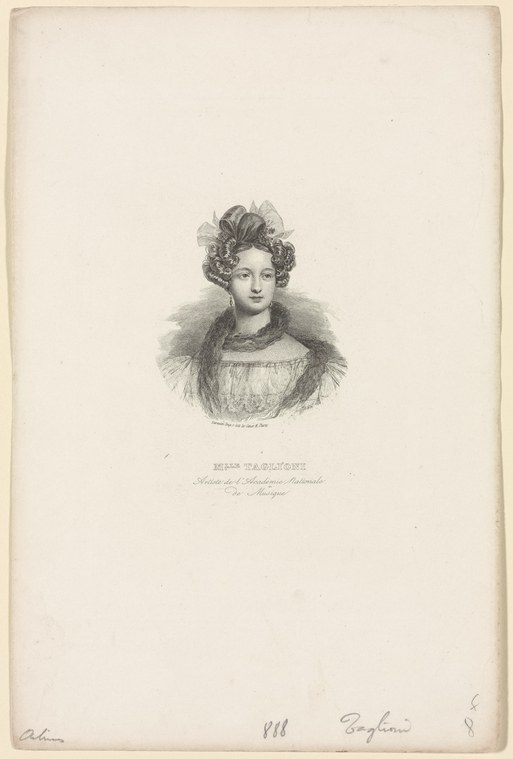
Mlle. Taglioni, artiste de l'Académie nationale de musique
Unknown artist
- Collection:
- Prints depicting dance
- Source:
- New York Public Library
- Rights:
- Public domain — free to use, share and adapt.
- Recorded as:
- Public Domain
Marie Taglioni revolutionized ballet technique and aesthetics during the Romantic period; her innovations in pointe work and her creation of a new ideal of weightless, otherworldly movement were foundational to modern ballet. This portrait, widely distributed in her lifetime, is a primary document of her celebrity and of how the theatrical world of the 1830s–1840s constructed and circulated the image of the star dancer.
What you are looking at
A bust-length portrait of a young woman in early 19th-century dress, shown against a plain background. She wears a low-necked, short-sleeved white or cream dress with delicate pleating across the bodice, and a dark fur stole or shawl draped across her shoulders. Her dark, curled hair is arranged elaborately atop her head in the Regency style, with ringlets framing her face. The woman gazes directly outward with a composed, dignified expression. The engraving is finely executed in fine linear hatching, with particular attention to the soft modelling of her face and the texture of the fur trim.
The dancing
A single seated or half-length figure, shown at rest rather than in motion. The posture is upright and formal, with the shoulders back and the head held level—the carriage expected of a professional dancer or performer of her standing. The costume is that of a fashionable woman of leisure or the theatre rather than rehearsal wear, and there is no indication of active movement or the physical exertion of dance.
The dance depicted
This is a portrait of Marie Taglioni, the Swedish prima ballerina who dominated European ballet in the 1830s and 1840s and is the most celebrated dancer of the Romantic era. The image shows her as a fashionable woman of the period rather than mid-performance; it is the kind of publicity or commemorative portrait circulated to celebrate a celebrated performer. The inscription identifies her as artiste of the Académie Nationale de Musique (the Paris Opéra), where she was the principal dancer and greatest star of her time. Her fame rested on the ethereal, weightless quality of her movement and her pioneering work in pointe technique, but this portrait captures her as a society figure rather than revealing anything of her dancing.
How it was made
This is an engraving, executed in fine lines with careful cross-hatching to create tonal gradation and volume. The technique allows for precise reproduction and wide distribution—such prints were sold individually and collected in albums, making them the primary means by which the appearance of celebrated performers reached the public before photography. The fineness of the line work and the quality of the execution suggest a high-end commercial production, likely made for sale to admirers and theatregoers.
About this work
This is a commemorative engraved portrait of Marie Taglioni, the Swedish prima ballerina and supreme star of Romantic ballet, identified in the inscription as a dancer at the Paris Opéra. It dates from the period of her greatest fame, likely the 1830s or 1840s. The image shows not the dancer at work but the celebrated woman in fashionable dress, the kind of likeness that would have been sold to admirers and collected as a souvenir of her celebrity. It belongs in a dance history collection as a record of one of the most influential dancers of her era and as evidence of how dance stars were marketed and remembered in the early 19th century.
How to look at it
The portrait works as a document of Regency and early Romantic fashion and deportment as much as it records the likeness of a dancer. Observe how the artist has balanced the delicacy and refinement of her features and dress against the formality and restraint of the pose—this was the visual language of gentility and high status in the period. The engraving technique, with its fine lines and precise control, allowed for a level of finish and tonal sophistication that made the portrait suitable for framing and collection. Compare this with other theatrical portraits of the same period to see how the star dancer was marketed as both a creature of the stage and a figure of fashionable society.
The artist
The engraver is not named in the inscription or record, which was common practice for commercial reproductive prints of the period. The quality and finish of the work suggest a professional print workshop operating in Paris or another major European art centre. Such unsigned prints were produced in quantity for commercial sale and often distributed by theatre management and print publishers.
The period
This portrait dates from the Romantic era of ballet, when the art form underwent a radical shift toward narrative pantomime, ethereal aesthetic, and the visual display of the female dancer's body as the primary focus of theatrical spectacle. Marie Taglioni emerged as the supreme embodiment of this new ideal in the early 1830s, following the success of *La Sylphide* (1832), in which she danced the role of a supernatural sylph. Her fame was international and unprecedented for a dancer, and the circulation of her portrait in engraved form was part of a new culture of celebrity that paralleled the rise of lithography and commercial print culture more broadly.
Where it lives
This engraving is held in the New York Public Library's collection of prints depicting dance. It is an example of the commercial engraved portrait that formed the primary visual record of celebrated performers in the early 19th century, before the advent of photography.
Questions about this work
Who was Marie Taglioni?
Marie Taglioni (1804–1884) was a Swedish prima ballerina and the most celebrated dancer of the Romantic era. She was famous for her innovations in pointe technique and her ethereal, weightless style of movement. Her greatest role was the Sylph in *La Sylphide* (1832), which became the cornerstone of the Romantic ballet repertory. She danced at the Paris Opéra and throughout Europe, and her fame was international and unprecedented for a dancer of her time.
Why is she dancing in pointe shoes if this is a portrait?
She is not dancing—this is a commemorative portrait showing her in fashionable dress, not performance costume. The portrait was made for circulation to admirers and was part of the celebrity culture surrounding her. It shows the woman rather than the dancer in action.
How do we know this is Taglioni and not another dancer?
The inscription at the foot of the print reads 'MLLE TAGLIONI / Artiste de l'Académie nationale de musique / de Musique,' which identifies her by name and by her affiliation with the Paris Opéra. The inscription is contemporary with the print.
What is an engraving and why was it used for portraits of dancers?
An engraving is a print made by cutting fine lines into a metal plate, which is then inked and printed onto paper. Engravings could be reproduced in large quantities and distributed widely, making them the primary means of circulating images of celebrated performers before photography. They were sold individually, collected in albums, and framed for display—this was how theatre-going public encountered the likenesses of their favourite dancers.
More dance artwork





