49 works in this view — arrow keys or swipe to move between them.
Dance in Art
Dancers' accidents
Unknown artist
- Collection:
- Prints depicting dance
- Source:
- New York Public Library
- Rights:
- Public domain — free to use, share and adapt.
- Recorded as:
- Public Domain
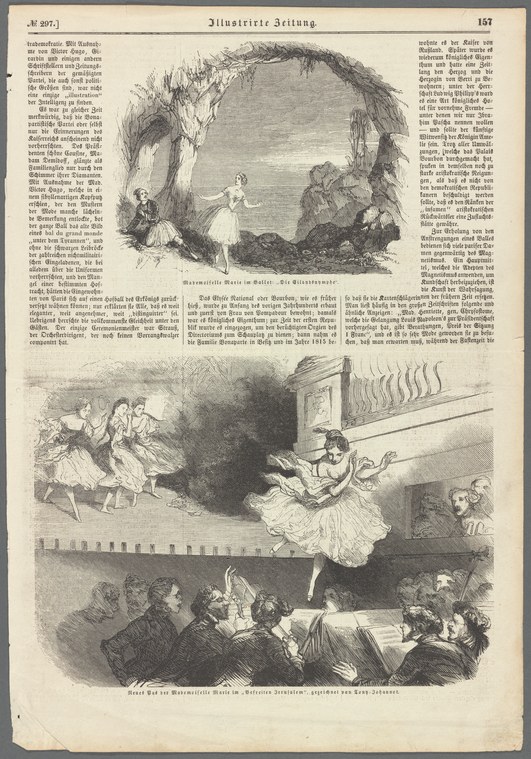
The image is a rare comic treatment of ballroom dancing that preserves tactile and physical information about 19th-century dancing—the dangers posed by crinolined skirts, the decorum expected of the ballroom, and the social stakes of a woman's loss of control. For historians of dance and dress, it is an invaluable record of how bodies and fabrics interacted in the ballroom.
What you are looking at
This is a German engraving from the mid-19th century depicting comical mishaps during ballroom dancing. The composition is divided into three scenes showing sequential moments of physical comedy. In the upper register, a woman in a white dress with a full skirt has caught her clothing on a tree or architectural feature while dancing, her body arched backward in distress as she attempts to free herself. The middle scene shows the interior of a ballroom or theater, where a dancer in a white tutu-like dress is captured mid-fall or collapse, limbs splayed inelegantly, while other figures in dark clothing observe from boxes or balconies. The lower register depicts the aftermath or a related incident, with formally dressed gentlemen and women in a state of alarm or amusement, crowded around what appears to be an accident or scandalous moment. The theatrical setting and the formal evening dress—tailcoats, cravats, full skirts with crinolines—date the work to the mid-to-late 1800s. The German text printed on the page and the title reference 'accidents' confirm this is satirical commentary on the perils and embarrassments of fashionable dancing.
The dancing
The figures are rendered in a detailed pen-and-ink style with strong modeling through cross-hatching. The dancing woman in the upper scene is shown in profile with her body thrown dramatically backward, one arm reaching upward, the other pressed against her torso—a posture of alarm rather than choreographic control. In the middle scene, the fallen dancer is shown without grace, her body limp and ungainly in contrast to the upright posture expected of a classical dancer. The spectators are depicted with exaggerated expressions of shock or amusement, their bodies leaning forward or recoiling. The formal ballroom hold is absent; instead, bodies are isolated or awkwardly grouped, emphasizing the comedy of loss of control.
The dance depicted
This is a ballroom dancing scene, almost certainly a waltz or a formal salon dance of the mid-19th century, depicted through parody. The artist has chosen not to show skilled execution but rather the dangers and indignities that could befall dancers—torn skirts, loss of balance, collisions. The composition suggests that these were recognizable hazards for women dancers in full crinolined skirts, whose voluminous dress was both the badge of respectability and a source of vulnerability. The scene mocks the pretension of formal ballroom culture while encoding actual information about how women moved in these garments and what could go wrong.
How it was made
This is a wood engraving or steel engraving, a medium that allowed for mass reproduction in printed periodicals. The technique employs fine parallel lines (hatching) to create tone and volume, and the composition is divided into distinct narrative scenes stacked vertically on the page. This format suggests it was published in a German illustrated journal or satirical magazine of the 1850s–1860s, aimed at an educated middle-class audience familiar with ballroom culture. The precision and the narrative sophistication indicate a work by a professional illustrator rather than a casual sketch.
About this work
This engraving is a satirical document of mid-19th-century ballroom culture that uses slapstick and physical comedy to comment on the hazards of fashionable dancing. It depicts not the idealized grace of the ballroom but its failures: torn skirts, lost balance, social embarrassment. The work sits at the intersection of social satire and dance documentation, capturing both the aspirations of formal dance and the material realities of dancing in heavily structured garments. It belongs in a gallery of dance art because it records how people actually moved under constraint, and because it reveals what anxieties the period associated with public dancing, particularly for women.
How to look at it
Attend to the moment the artist chose to freeze in each scene: not the execution of a move but the instant of failure or embarrassment. The upper scene captures the moment of entanglement, with the woman's body still in motion but her skirt arrested. The middle scene shows the body limp and uncontrolled. The lower scene freezes the moment of social alarm. Notice also how the artist uses dress—the white dress of the dancers contrasts sharply with the dark formal wear of the men and spectators, isolating the dancing women as objects of attention and potential ridicule. The composition assumes the viewer finds these moments funny rather than tragic.
The period
The work dates to a period when the waltz and quadrille dominated European ballroom culture, and when ballroom dancing was a crucial site of courtship and social display for the middle and upper classes. German satirical journals proliferated in the mid-19th century as a forum for middle-class commentary on social pretension and folly. The ballroom itself was becoming increasingly democratized—no longer the exclusive preserve of the aristocracy—which may partly explain the satirical tone: the aspiring middle classes were attempting to master forms of dance and decorum that had previously been the mark of privilege.
Where it lives
The work is held in the New York Public Library's collection of prints depicting dance. It appears to be a page from a German illustrated journal, identifiable by the printed text at the head and bottom of the page. The page number (181) indicates it is part of a larger publication.
Dance in this work
Questions about this work
What kind of dance is this?
Almost certainly a waltz, which dominated European ballrooms in the mid-1800s, or possibly a quadrille or other formal salon dance. The artist was not concerned with depicting the precise technique but with satirizing the social performance and physical hazards of ballroom dancing.
Why is the artist making fun of dancers?
The engraving is social satire, mocking the pretension and social anxiety surrounding fashionable ballroom culture. By depicting catastrophic failures, the artist reveals the precarious nature of the performance and the real physical hazards posed by women's dress.
What does this tell us about 19th-century ballroom dancing?
It documents the material reality of dancing in crinolines: how the skirt could catch, tear, or impede movement, and how a loss of composure could become a public scandal. It also suggests that the ballroom was a site of genuine social anxiety, despite its veneer of formality and elegance.
Is the artist criticizing women dancers?
The satire is directed at the social system of the ballroom rather than at women specifically. The women are shown as victims of circumstance—their voluminous skirts are the source of mishap, not their lack of skill. The comedy arises from the tension between the demand for perfect decorum and the actual fragility of the performance.
More dance artwork





