49 works in this view — arrow keys or swipe to move between them.
Dance in Art
Dance on music covers
Unknown artist
- Collection:
- Prints depicting dance
- Source:
- New York Public Library
- Rights:
- Public domain — free to use, share and adapt.
- Recorded as:
- Public Domain
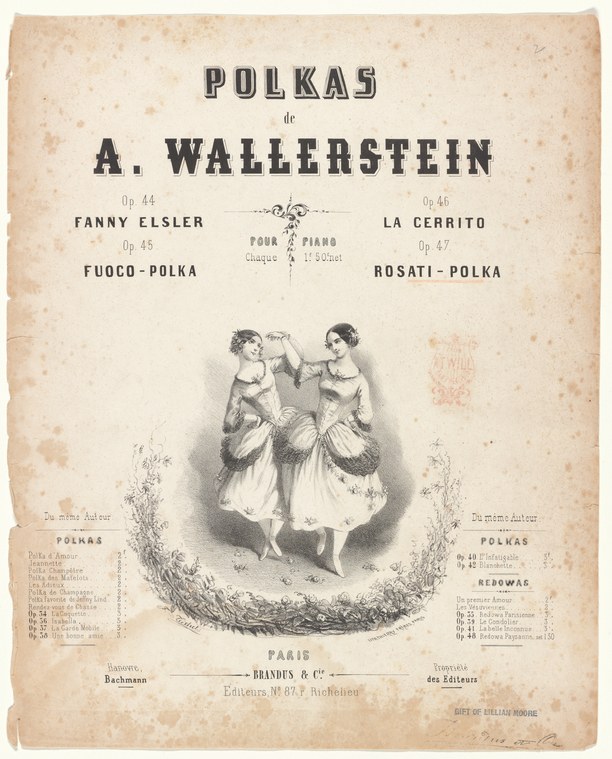
The attribution of polka compositions to famous dancers shows how commercial dance celebrity shaped the music publishing industry. For historians of the polka and of nineteenth-century ballroom culture, this cover is evidence of which dancers were visible enough to lend their names to sheet music, and it confirms that the polka was danced in a sociable, relatively upright manner by amateurs in the home.
What you are looking at
This is a decorated title page for a collection of polkas by the composer A. Wallerstein, printed in Paris by Brandus & Cie. The page features an engraved central vignette showing two women in mid-nineteenth-century ball dress—high-waisted white gowns with full skirts and fitted bodices—dancing together in an animated pose. They are positioned facing each other in a dynamic moment, their bodies angled and arms raised in a lively interaction. The composition is framed by a decorative wreath of flowering vines at the bottom. The page lists four named polka compositions at the top (Fanny Elsler Op. 45, Fuoco-Polka Op. 43, La Cerrito Op. 46, and Rosati-Polka Op. 47), each attributed to famous dancers of the era, alongside two lists of other numbered polkas in the Wallerstein catalogue. The overall design and typography are typical of mid-nineteenth-century French music publishing.
The dancing
The two dancers occupy nearly the full height of the vignette. Both stand on the ground plane with an upright carriage. Their arms are raised and extended toward each other in a sociable, engaged gesture rather than a formal dance hold. The figure on the left has her right arm reaching across her body; the figure on the right mirrors this, creating a sense of mutual approach and animation. Both maintain the elongated posture and refined deportment of ballroom dancers of the 1840s–50s. Their positioning suggests conversation or a moment of playful greeting as much as active stepping.
The dance depicted
This is a polka, the social dance that swept European ballrooms in the 1840s and became a publishing phenomenon. The two women are depicted in the context of a genteel ball rather than a theatrical performance, though the named attributions to celebrated dancers (Fanny Elsler, La Cerrito, and others) indicate these were fashionable figures whose names sold sheet music. The polka itself is a couple dance typically danced at a moderate or fast tempo in 2/4 time, with a characteristic hop-and-step pattern. The image captures not the technical footwork but the decorum and social pleasure of the dance—the moment of greeting or engagement between partners rather than the midst of vigorous stepping.
How it was made
This is a steel or copper engraving, a reproductive technique standard for music covers and illustrated publications of the period. Engraving allowed fine detail and crisp line work; the delicate rendering of the women's clothing, the decorative vines, and the typography all showcase the medium's capacity for precision. The decorative framing vignette was a conventional feature of luxury music publishing, signaling that this was a product aimed at domestic performance by genteel amateurs rather than professional performers. The technique and presentation suggest a reasonably high-end publication intended for middle and upper-class music purchasers.
About this work
This is a French music-publishing cover from the mid-nineteenth century, presenting a polka collection named after four of the era's most celebrated dancers. The engraved vignette shows two women in ball dress in a pose of social engagement typical of the polka's function as a genteel couple dance. It documents both the dance itself—its costuming, its social context, and the prominence of named dancers in driving music sales—and the aesthetic conventions of mid-Victorian music publishing. The polka was one of the defining dances of the 1840s–50s, originating in Central Europe and rapidly adopted across the ballrooms of Paris, London, and Vienna; this cover is a snapshot of that moment of fashionable dominance.
How to look at it
Attend to the posture and arm position of the dancers: there is no rigid ballroom frame here, but rather a relaxed, sociable interaction suited to amateur dancing in a parlour. Notice how the engraver has rendered the weight and fabric of the dresses, the delicate work of the shoes, and the upright carriage that defines genteel deportment. The vignette is a moment of greeting rather than a step; the polka's actual footwork is not depicted, but the dance's character as a lively, intimate couple dance is conveyed by the proximity and engagement of the two figures. The decorative wreath frames this as a refined social moment, not a theatrical spectacle.
The artist
A. Wallerstein is recorded as a composer of polkas for the mid-nineteenth-century market. Beyond the works listed here, little is known of his life and practice. His publications demonstrate the industrial scale of polka composition in Paris during the 1840s–50s—dozens of titled, opus-numbered works, each marketed with reference to celebrated dancers or dancers' names, each aimed at the rapidly growing middle-class market for domestic dance music.
The period
The polka emerged in Bohemia around 1830 and reached Paris by 1840, where it became a sensation. By the mid-1840s it was the dominant social dance across Europe, supplanting the quadrille in popularity. Paris was the centre of dance celebrity and music publishing; dancers including Fanny Elsler and La Cerrito (both named on this cover) were international stars of the Romantic ballet, and their names were commercially valuable. Music publishers marketed polkas by associating them with dancers, both to capitalize on celebrity and to suggest that these were fashionable, current compositions. The 1840s–50s saw an explosion of polka titles and a professionalization of domestic music consumption.
Where it lives
This is a music-publishing cover from the collection of prints on dance held by the New York Public Library. It is one example of the vast body of illustrated sheet music produced in Paris during the nineteenth century, a category that spans both elite theatrical music and commercial domestic dance music.
Dance in this work
Questions about this work
Who were Fanny Elsler and La Cerrito?
Both were celebrated Romantic-era ballet dancers. Fanny Elsler (1810–1884) was an Austrian dancer famous for her performances of Spanish and character dances as well as classical roles. La Cerrito (Enrico Cecchetti's partner) was an Italian dancer of the 1840s–50s. Their names on a polka cover indicated fashion and prestige; they may or may not have actually danced these particular polkas.
How was the polka danced?
The polka is a couples dance in 2/4 time, characterized by a hop-and-step pattern. It is faster and more energetic than the waltz, and it typically features a less formal hold. This cover suggests the sociable, upright deportment of amateur ballroom polka rather than any stylized theatrical version.
What is Brandus & Cie?
Brandus & Cie was a major Paris-based music publisher of the nineteenth century, specializing in dance music, opera, and popular compositions. They were among the leading producers of the enormous quantity of polka sheet music that circulated during the 1840s–50s.
Why did composers write so many polkas?
The polka was a commercial phenomenon: it was fashionable, it was danced by amateurs in the home, and it was relatively easy to compose. Publishers competed to issue new polka titles, often attaching the names of famous dancers to increase sales. The form was also flexible—it could be simple or complex, instrumental or vocal.
More dance artwork





