49 works in this view — arrow keys or swipe to move between them.
Dance in Art
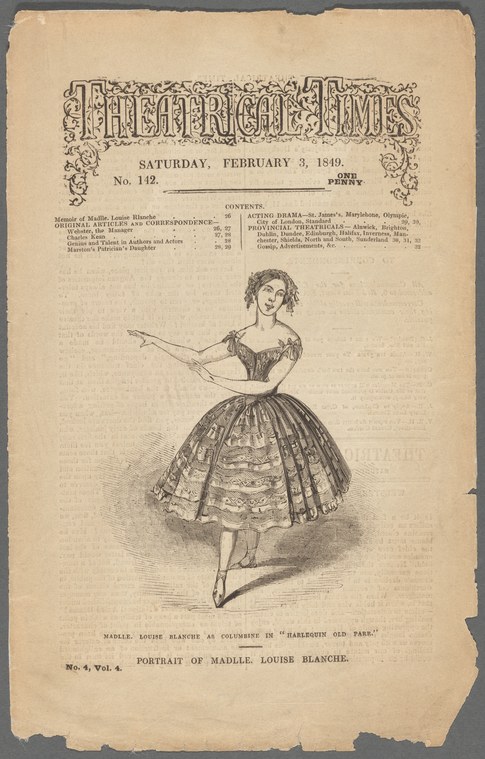
Portrait of Madlle. Louise Blanche [as Columbine in Harlequin Old Parr; with accompanying article on the verso]
Unknown artist
- Collection:
- Prints depicting dance
- Source:
- New York Public Library
- Rights:
- Public domain — free to use, share and adapt.
- Recorded as:
- Public Domain
This engraving documents the visual vocabulary of Victorian pantomime and the theatrical costume of the 1840s, showing how female performers in stage roles were represented and circulated to the public. It is evidence of the commedia dell'arte tradition's persistence in 19th-century British theater and of the role of the illustrated press in creating and sustaining celebrity. For historians of dance, it records a performer and a genre—pantomime and commedia character dancing—now largely lost except through such images.
What you are looking at
A single female dancer in theatrical costume dominates the composition, posed in a moment of graceful suspension. She wears a full, elaborately pleated skirt—characteristic of mid-19th-century theatrical dress—over a fitted bodice with short sleeves, and her hair is styled in the ringlets fashionable of the period. Her right arm is extended diagonally upward and outward, holding what appears to be a wand or stick, while her left arm hangs naturally at her side; her weight is centered and her posture is upright and poised. The figure is rendered in fine black engraving against the cream ground of the page, with careful cross-hatching to suggest volume and movement in the skirt's folds. The image occupies the center of what is clearly a page from *The Illustrated London News*, a popular weekly periodical, with ornamental typography at the head and small text blocks on either side describing the subject and contents. The overall effect is one of graceful, contained elegance—a portrait of a named performer rather than a narrative scene.
The dancing
The dancer's pose is fundamentally static yet suggests potential for motion. She stands in an upright, nearly symmetrical frame with her weight evenly distributed, her torso vertical, and her gaze directed toward the wand she holds. The extension of her right arm creates a diagonal line that lifts the composition; the wand or stick (possibly a theatrical prop for comic effect, as Harlequin carried such objects) defines the moment as one of theatrical gesture rather than social dance movement. Her free arm position—relaxed at the side—and the centered alignment of her body suggest neither the turned-out posture of ballet technique nor the closed partnership of ballroom forms. This is a posed portrait captured mid-gesture, not a freeze-frame of social or technical dancing.
The dance depicted
The catalogue identifies the subject as Madlle. Louise Blanche in the role of Columbine in *Harlequin Old Parr*. Columbine was a stock character of the commedia dell'arte and pantomime traditions—a witty, vivacious female character often paired with Harlequin as a romantic interest or foil. The theatrical context here is pantomime, a Victorian staple, rather than ballet or ballroom dance. The image records not a dance per se but a moment of theatrical character and costume; Columbine's charm was expressed through mimicry, wit, and physical comedy as much as through formal dance steps. The engraving serves as a portrait of the performer in her role, documenting the visual spectacle of Victorian theatrical dress and stage presence rather than the articulation of a particular dance technique.
How it was made
This is a steel or wood engraving, a technique that allowed for fine, precise detail and fine-line reproduction at high volume. The *Illustrated London News* (established 1842) pioneered the use of engraved theatrical and celebrity portraits to accompany newspaper criticism and gossip, circulating them weekly to a broad middle-class readership. The engraving's legibility and portability made theatrical performers' images accessible and collectible in ways that oil paintings and lithographs were not. The technique's precision—visible in the careful modulation of the skirt's pleats and the definition of the figure's silhouette—conveyed both the elegance of the performer and the technical refinement of the publication.
About this work
This is a celebrity portrait engraving from a major Victorian periodical, documenting a named performer—Madlle. Louise Blanche—in a specific theatrical role. It belongs to a vast archive of mid-19th-century theatrical imagery that circulated through the press, shaping public taste and celebrity culture. The work records not a particular dance form but a moment of theatrical spectacle and costume; it is evidence of how dance, theater, and performance were seen and circulated in the 1840s. The image sits at the intersection of dance history, theatrical history, and the history of print media, showing how mechanical reproduction made performers' images ubiquitous and how the periodical press constructed and celebrated theatrical celebrity.
How to look at it
Attend to the skirt's construction and the precision of its pleating: it is rendered with fine line work that suggests both the stiffness of theatrical costume and the potential for motion. The wand or stick in the dancer's hand is a commedia dell'arte and pantomime property, a signal of the character and genre. The pose—upright, poised, with the arm extended—is not a moment of active dance but a portrait attitude; it captures Columbine's readiness and charm rather than a step or phrase. The image is a record of how this performer was seen and celebrated by her public, a moment frozen for reproduction and circulation.
The artist
The engraver is not recorded in the catalogue. The image was published in *The Illustrated London News*, which employed a stable of staff engravers and freelancers to produce theatrical portraits, society scenes, and news illustrations. These images were often rendered from sketches or photographs and adapted for the engraver's hand; the precise attribution of individual plates to named artists in the periodical's archive is often uncertain. The work represents the labour of Victorian print production rather than individual artistic vision.
The period
In 1849, the mid-Victorian theatrical world was dominated by pantomime, melodrama, and the legacy of commedia dell'arte, which had been adapted to English stages for generations. Ballet was gaining ground—the Romantic era had elevated ballet to high art in Paris and was beginning to influence London theater—but pantomime remained a staple of popular entertainment and a vehicle for comic performance and spectacle. The illustrated periodical was a new and powerful medium; *The Illustrated London News* (founded 1842) pioneered the publication of detailed theatrical and celebrity portraits, making performers' images circulate in ways previously impossible and democratizing access to theater-going itself.
Where it lives
The New York Public Library holds this work as part of its prints collection documenting dance in visual culture. It is page 142 of *The Illustrated London News*, No. 112, dated Saturday, February 3, 1849. The periodical is a bound or paginated run of weekly issues, a medium of ephemeral publication that has become an archive of mid-Victorian visual culture.
Questions about this work
What is Columbine, and why was it an important role?
Columbine was a stock female character in commedia dell'arte (Italian improvisational theater) and its English adaptation, pantomime. She was witty, agile, and often a romantic interest for Harlequin. The role was a vehicle for physical comedy, charm, and spectacle rather than formal ballet technique. In the 19th century, actresses playing Columbine were celebrated performers in their own right.
What is pantomime, and how does it relate to dance?
Pantomime was a form of theatrical entertainment, especially popular in Britain, that blended narrative, slapstick comedy, music, spectacle, and physical performance. While not primarily a dance form, pantomime required performers to be physically eloquent and graceful; dancers and acrobats often performed in pantomime productions. By the 1840s, pantomime was beginning to decline in prestige as ballet rose, but it remained a staple of popular theater.
Why was Louise Blanche's image published in the newspaper?
The *Illustrated London News* used theatrical portraits to appeal to its middle-class readership, who were consumers of theater and celebrity gossip. Publishing images of named performers made theater-going glamorous and accessible to readers who might not attend performances themselves. These portraits were also collectible and were often cut out and kept as mementos of favorite performers.
What can this image tell us about theatrical costume in 1849?
The image records the full, elaborately pleated skirt characteristic of mid-19th-century theatrical dress, as well as the fitted bodice and short sleeves fashionable for female performers. The style is distinct from both ballet tutus (which were shorter and stiffer) and everyday dress. The costume was designed to display grace, elegance, and the performer's silhouette, and the engraving's fine detail showcases both the fabric's construction and the wearer's figure.
More dance artwork





