49 works in this view — arrow keys or swipe to move between them.
Dance in Art
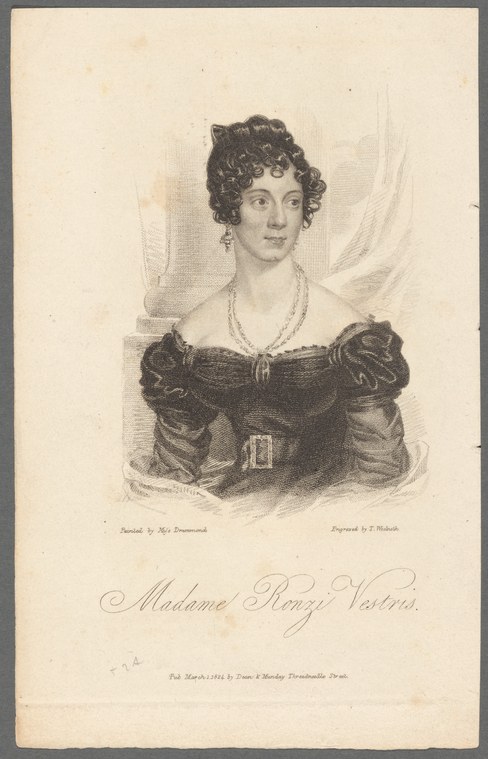
Madame Ronzi Vestris [Caroline Ronzi-Vestris]
Unknown artist
- Collection:
- Prints depicting dance
- Source:
- New York Public Library
- Rights:
- Public domain — free to use, share and adapt.
- Recorded as:
- Public Domain
This print documents the visual culture of Regency theatre and the celebrity status of professional dancers in the early 19th century. The Vestris family were central to the development of ballet and ballroom dance in Europe, and images of them shaped public taste and aspiration for fashion and movement.
What you are looking at
A half-length portrait of a woman in early 19th-century dress, shown from approximately the waist up against a plain background with subtle drapery. She wears a dark silk gown with pronounced puffed sleeves caught at the elbow, a low neckline, and a decorative buckle or brooch at the center front. Her dark curled hair is arranged in the Regency fashion, with ringlets framing her face. The engraving captures her with a composed, direct gaze and slight smile. The work is rendered in fine stippled and linear engraving technique, with careful attention to the texture of fabric and the modeling of her face through tonal gradation.
The dancing
This is a portrait rather than a dance scene, so there is no observable dance technique, hold, or frame to assess. The figure is stationary, posed for formal portraiture. The composition emphasizes the shoulders, arms, and upper body—the areas most visible in theatrical and ballroom dance of the period—but the woman is not dancing or demonstrating movement.
The dance depicted
This is not a depiction of dance in progress. It is a formal portrait of a performer, likely made to circulate as a print and promote her theatrical work. The inscription identifies her as Madame Ronzi Vestris (Caroline Ronzi-Vestris), a professional dancer of the Regency era. Prints of this kind served as publicity and records of celebrated performers, showing them in fashionable dress rather than in performance costume or mid-movement.
How it was made
This is a steel or copper engraving, a relief print that allows fine linear detail and tonal subtlety through careful stippling and cross-hatching. Engraving was the standard medium for theatrical portraits in the early 19th century because it was reproducible, portable, and could circulate widely—sold at theatres, in print shops, and by subscription. The technique's precision served both the commercial aim of capturing a recognizable likeness and the aesthetic aim of flattering the sitter.
About this work
A Regency-era engraved portrait of the professional dancer Caroline Ronzi-Vestris, shown in fashionable day dress rather than stage costume. The print exemplifies the type of promotional imagery that circulated among theatre patrons and performers in the early 19th century. Ronzi-Vestris was a member of the Vestris family, one of the most celebrated European dance dynasties, and would have been known for both ballet and social dance. This portrait records her as a public figure and star of the London stage, a woman of accomplishment and elegance in an age when dancers—especially virtuosos—were celebrities whose images sold.
How to look at it
Attend to the ensemble: the quality of the fabrics suggested by the stippling, the careful rendering of the face to suggest intelligence and personality, the fashionable arrangement of the hair and the precise jewellery. The engraver has chosen to present Ronzi-Vestris as a gentlewoman and woman of fashion, not as a performer caught in motion. This reflects the social status claimed by elite dancers in this period, who wanted to be seen as cultivated artists and eligible women, not merely athletes or entertainers.
The artist
The engraver is unnamed in the catalogue record. The inscription credits the work to 'Painted by Miss Drummond' and 'Engraved by T. Holcroft', suggesting the portrait was painted first and then transferred to the engraving plate—a standard practice. T. Holcroft was a working theatrical engraver of the period.
The period
The early 19th century was the age of the Romantic ballet and the rise of the professional female dancer as a public figure. The Vestris family controlled the King's Theatre in London and were arbiters of dance fashion. This portrait belongs to the 1820s–1830s, when engraved portraits of performers circulated as luxury commodities and tokens of social status. The dress shown—high waistline, puffed sleeves, low decolletage—is fashionable Regency wear, not stage costume, emphasizing the dancer's role as a sophisticated woman of taste and wealth.
Where it lives
Held in the New York Public Library's Prints collection as part of its holdings of theatrical portraiture. The inscriptions state it was published in March 1825 by Francis & Weatherby, London—a major theatrical print publisher. It is one of thousands of similar single-sheet engraved portraits produced for the theatrical market.
Questions about this work
Who was Caroline Ronzi-Vestris?
Caroline Ronzi-Vestris was a professional dancer and member of the Vestris family, one of the most powerful dynasties in European dance and theatre management in the 18th and early 19th centuries. The Vestris family controlled the King's Theatre in London and were influential figures in ballet, social dance, and pantomime. She was a celebrated performer whose image was sold and collected as a token of theatre culture and feminine accomplishment.
Why is this a print rather than a painting?
Engraved prints were the standard medium for promotional and commemorative portraits of performers. They were cheaper to produce in quantity than paintings, could be sold individually at theatres and print shops, and circulated much more widely. A print could reach hundreds or thousands of potential admirers, making it the most effective form of publicity and celebrity culture in the period.
What does the dress tell us about dance in this period?
The fashionable gown—empire waist, puffed sleeves, low neckline—shows that elite dancers of the Regency were also arbiters of fashion and aspired to be seen as gentlewomen. The silhouette reflects Regency taste but also allows freedom of movement in the shoulders and arms. In theatrical and ballroom dance of this period, upper-body elegance, arm carriage, and deportment were paramount, and the dress shown here accommodates that aesthetic.
What is the Vestris family's importance to dance history?
The Vestris family were central figures in the professionalization and popularization of ballet and social dance in the 18th and 19th centuries. They managed London's principal dance theatre, produced and danced in major ballets, and shaped European taste in dance and fashion. Their career spanned from the 18th-century reworking of ballet technique through the Romantic era.
More dance artwork





